01Symptoms in adults
Diagnostic criteria after age 18
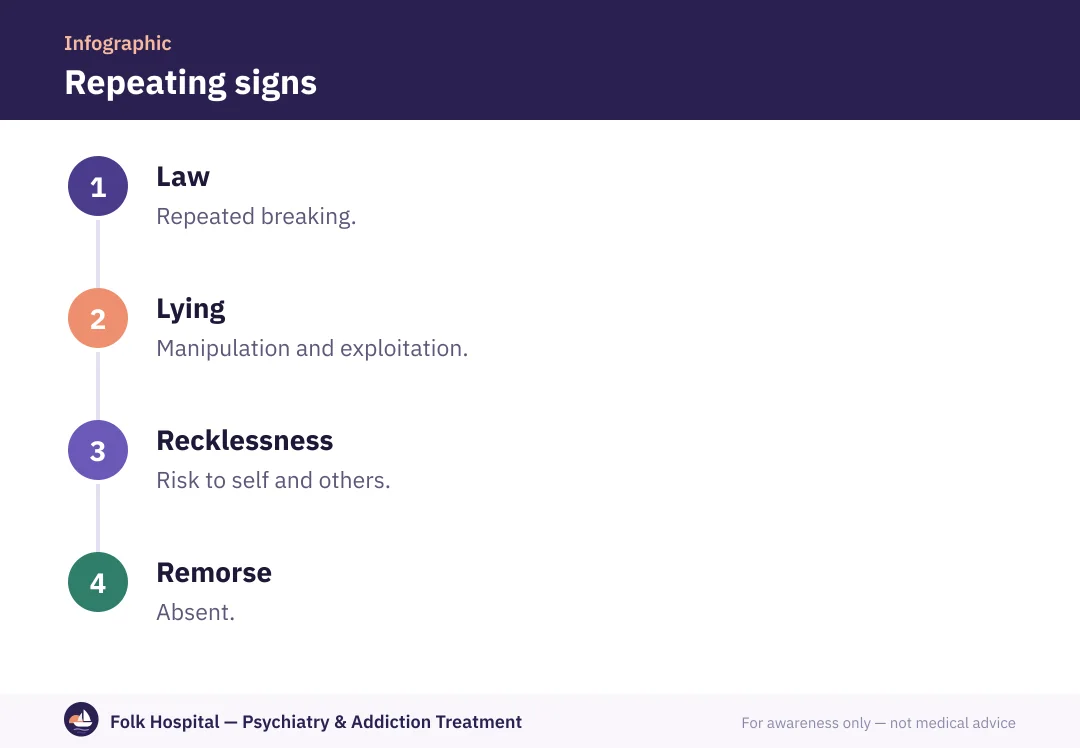
- Repeated law-breaking.
- Lying, deceit and manipulation.
- Impulsivity and failure to plan.
- Aggression and repeated fights.
- Recklessness regarding own or others' safety.
- Irresponsibility at work and with financial obligations.
- Lack of remorse or justifying harm.
02Signs in childhood and adolescence
| Area | Examples |
|---|---|
| Aggression | Bullying, fights, cruelty to animals |
| Destruction | Fire-setting or breaking property |
| Deceit and theft | Repeated lying and stealing |
| Rule-breaking | Running away from home or school |
03How it looks in relationships
At first
- Charming, confident and persuasive.
- Big promises.
- Striking attention.
Over time
- Lying and exploitation.
- Indifference to others' feelings.
- Blaming the victim and never apologising.
- Violence or threats of violence.
- Danger to children or older people at home.
Call the police on 122 or an ambulance on 123.
Ambulance: 123Read antisocial personality, manipulative personality and toxic personality.
؟Frequently asked questions
What are the signs of antisocial personality disorder?
Law-breaking, lying, impulsivity, aggression, recklessness, irresponsibility and lack of remorse.
What childhood signs precede it?
Cruelty to people or animals, vandalism, theft, repeated lying, and running away from home or school.
Is every liar affected?
No. The disorder is a pervasive, lasting pattern with many symptoms starting in youth.
Does the person feel guilt?
They usually justify their actions or blame the victim, showing little or no remorse.
Can someone with it be socially successful?
They may seem charming and persuasive and use that to manipulate, but the pattern shows over time.
Can drugs cause similar symptoms?
Yes. Addiction can cause lying, theft and impulsivity; the difference is these may improve with recovery.
Sources and references
- Antisocial personality disorder — NHS (UK)
- Personality disorder — NHS (UK)
- Comorbidity: Substance Use and Other Mental Disorders — National Institute on Drug Abuse (NIDA)

A psychiatrist specialising in addiction and mental illness in adults and adolescents, with a focus on dual diagnosis.
For awareness only — not a substitute for medical advice. Editorial policy · View profile