01Valium: why is it handled differently?
Valium (diazepam) is one of the oldest and most widely used sedatives. It's prescribed for anxiety, muscle spasm and sometimes alcohol withdrawal. Its key feature is that it's very long-acting: it and its by-products stay in the body for days. That means withdrawal from it appears more slowly and lasts longer, but with fewer sharp swings than short-acting sedatives.
Many people start Valium for back pain or muscle spasm, then come to rely on it for sleep and anxiety, with the dose creeping up without their noticing.
02How is it treated?
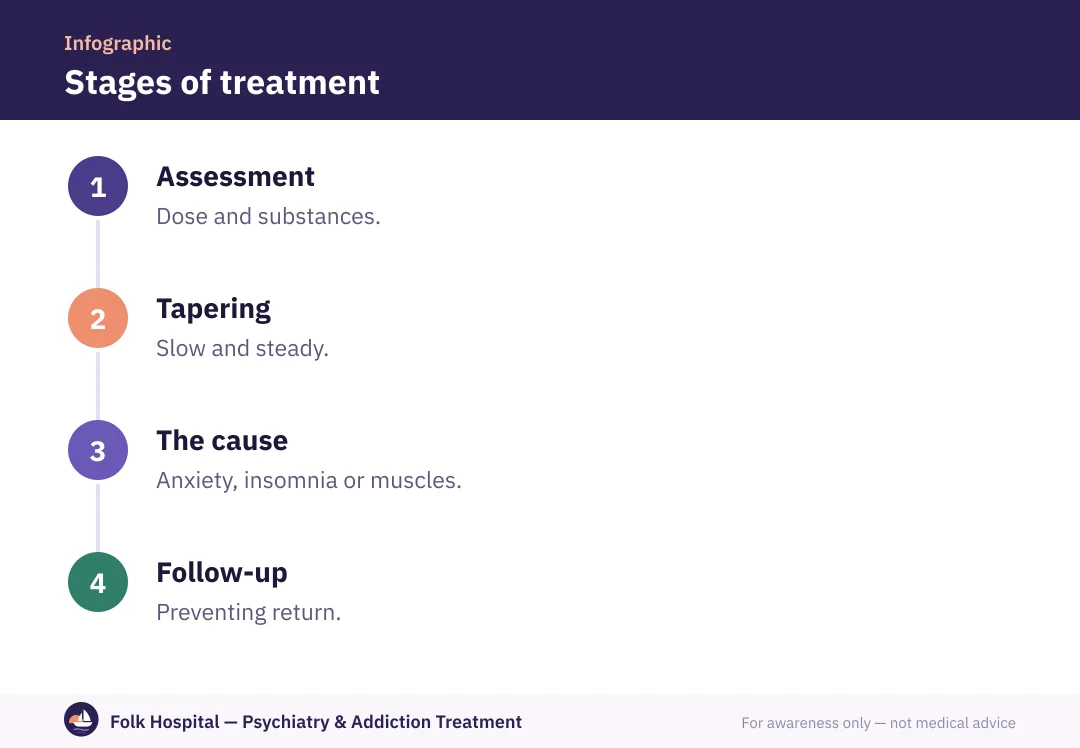
- Assessmentdose, duration and source, other substances, seizure history and the original reason (anxiety, insomnia, muscle spasm).
- Slow taperingsmall steps every one or two weeks, holding when symptoms intensify.
- Treating the causepsychological treatment for anxiety and insomnia, and an alternative plan for muscle pain and spasm.
- Treating other substancesif alcohol or opioids are involved.
- Follow-upfor weeks after the last dose, because symptoms can appear late.
Read the general principles in sedative addiction treatment.
03What to expect during tapering
Symptoms such as anxiety, insomnia, irritability, tremor, sweating, poor concentration and sometimes muscle tension may appear. Because Valium stays in the body so long, symptoms may show days after a tapering step, so we don't rush the next one. Read about Valium withdrawal.
No sudden stopping
Stopping suddenly after long daily use or at high doses can cause seizures. Mixing Valium with alcohol or opioids raises the risk of slowed breathing; call an ambulance on 123 for extreme drowsiness or slow breathing.
04An alternative for muscle pain and spasm
Anyone who started Valium because of their back or neck needs a plan that doesn't rely on a sedative:
- Physiotherapy and regular strengthening and stretching exercises.
- Non-addictive medicines for pain and spasm, decided by the doctor.
- Better posture at work, when sitting and in sleep.
- Psychological techniques for chronic pain and the stress that worsens it.
05Treating anxiety and insomnia
- Cognitive behavioural therapy for anxiety and for insomnia.
- Non-addictive medicines when needed.
- Regular sleep habits and less caffeine.
Read about insomnia and generalised anxiety disorder.
06Valium and older adults
Many older people have taken Valium for years, which raises the risk of falls and fractures and memory problems and confusion, especially as the body clears it more slowly at that age. Tapering usually benefits them, but it must be very slow and coordinated with their treating doctor.
07Residential or outpatient?
An outpatient taper usually suits
- A moderate prescribed dose.
- No alcohol or opioids.
- No previous seizures.
Residential care is better with
- High doses or more than one sedative.
- Mixing with alcohol or opioids.
- Previous seizures or severe depression.
Read about the harms of Valium and how long it stays in the body.
؟Frequently asked questions
How long does it take to come off Valium?
From several weeks to a few months depending on dose and length of use, reducing in small, regular steps.
I was taking it for back spasms. What now?
We set an alternative plan including physiotherapy, exercise and non-addictive medicines for muscle spasm, in coordination with an orthopaedic or neurology specialist.
Why did withdrawal come late?
Because Valium and its by-products stay in the body for days, symptoms may start several days after a reduction or stopping and last longer.
Is Valium milder than Xanax?
It isn't less addictive, but it's longer-acting, so withdrawal is usually slower and calmer. That's why it's sometimes used as a temporary substitute when tapering other sedatives.
Can treatment be done at home?
Yes in many cases with a structured outpatient taper, except with high doses, mixing with alcohol or opioids, or previous seizures.
Sources and references
- Prescription Medicines — research topic — National Institute on Drug Abuse (NIDA)
- Anxiety Disorders — National Institute of Mental Health (NIMH)
- Mental Health Medications — National Institute of Mental Health (NIMH)
- Treatment Approaches for Drug Addiction — DrugFacts — National Institute on Drug Abuse (NIDA)

A psychiatrist specialising in addiction and mental illness in adults and adolescents, with a focus on dual diagnosis.
For awareness only — not a substitute for medical advice. Editorial policy · View profile