01Pethidine: what makes it different?
Pethidine is an opioid painkiller given by injection in hospitals. Although weaker than morphine, it has an important property: the body converts it into a substance that builds up with repeated doses, especially in people with weak kidneys, and can cause tremor, muscle twitching and seizures. That's why its medical use has become limited in many places.
Addiction to it is seen in a notable share of healthcare workers because of easy access, and sometimes in patients who started it for recurrent pain. Read about signs of pethidine addiction.
02How is it treated?
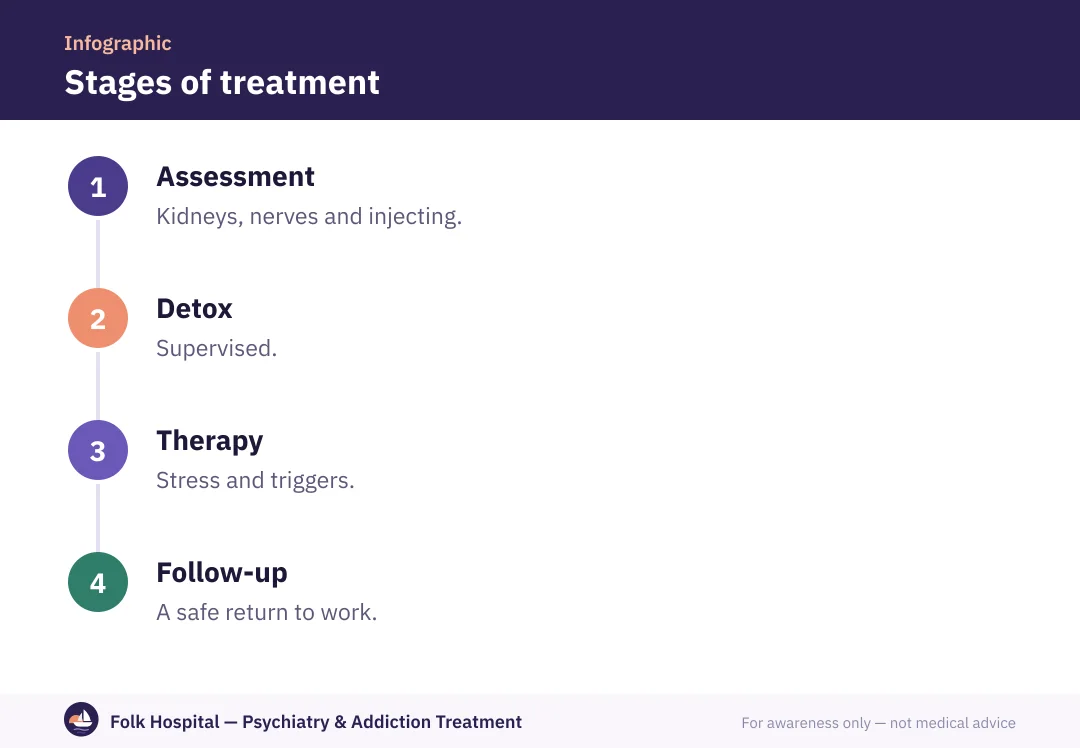
- Assessmentdose and injecting, kidney function, any tremor or seizures, other drugs and mental state.
- Supervised detoxsymptom medicines, nervous-system monitoring and seizure protection when needed.
- Treating injection complicationschecking veins, skin and hepatitis.
- Psychological rehabilitationwork pressure, exhaustion and triggers in the workplace.
- Safe return and follow-upa written return-to-work plan and long follow-up.
Read about pethidine withdrawal.
Signs that need urgent assessment
Sudden tremor or muscle twitching, seizures, confusion, or extreme drowsiness with slow breathing. Call an ambulance on 123 if the danger is immediate.
03If you work in healthcare
We know that fear of professional consequences is what most often delays doctors, nurses and pharmacists from seeking help. But in reality continuing to use is the greater risk to your career and to your patients' safety. So:
- Full confidentiality: your medical information isn't shared with anyone without your permission.
- Treatment that understands your work: shift pressure, exhaustion and easy access to medicines.
- A written return plan: when you return, under what conditions, with what follow-up, and how access to medicines is handled at first.
- Relapse-blocking medication may suit many healthcare workers, on the doctor's advice.
- Long follow-up, because returning to an environment where the drug is present needs ongoing support.
04Stress and burnout: common roots
Many people in healthcare start using to cope with chronic exhaustion, lack of sleep, intense stress and traumatic experiences at work. Treating these roots and learning healthy ways to cope is a core part of rehabilitation. Depression, anxiety or PTSD are treated within a dual diagnosis plan.
05Residential or outpatient?
Outpatient care may suit
- Limited, recent use.
- Healthy kidneys and no tremor or seizures.
- Being able to step away from access to the drug.
Residential care is better with
- Repeated injecting or high doses.
- Weak kidneys, tremor or seizures.
- Continued access to the drug at work.
- Depression or thoughts of self-harm.
Read about the harms of pethidine and opioid addiction treatment.
؟Frequently asked questions
I work in healthcare and use pethidine. Will I lose my job?
Early treatment is the best protection for you and your patients. Your medical information is confidential, and we set a treatment plan with you followed by a safe return to work with conditions and follow-up.
Why does pethidine cause seizures?
Because the body converts it into a substance that builds up with repeated doses or weak kidneys and can cause tremor, muscle twitching and seizures.
How long does treatment take?
Detox takes days to two weeks, rehabilitation one to two months, and follow-up usually a year, especially before returning to work with access to medicines.
Can treatment be done as an outpatient?
Sometimes, but with repeated injecting, high doses or weak kidneys, a residential stay is safer and also gives temporary distance from the work environment.
Is there medication after detox?
Yes, approved options for opioid use disorder may be suggested by the doctor, including a relapse-blocking treatment that suits many healthcare workers.
Sources and references
- Prescription Medicines — research topic — National Institute on Drug Abuse (NIDA)
- Opioids — research topic — National Institute on Drug Abuse (NIDA)
- Guidelines for the psychosocially assisted pharmacological treatment of opioid dependence — World Health Organization
- Drug misuse in over 16s: opioid detoxification (CG52) — National Institute for Health and Care Excellence (NICE)

A psychiatrist specialising in addiction and mental illness in adults and adolescents, with a focus on dual diagnosis.
For awareness only — not a substitute for medical advice. Editorial policy · View profile