01Harms
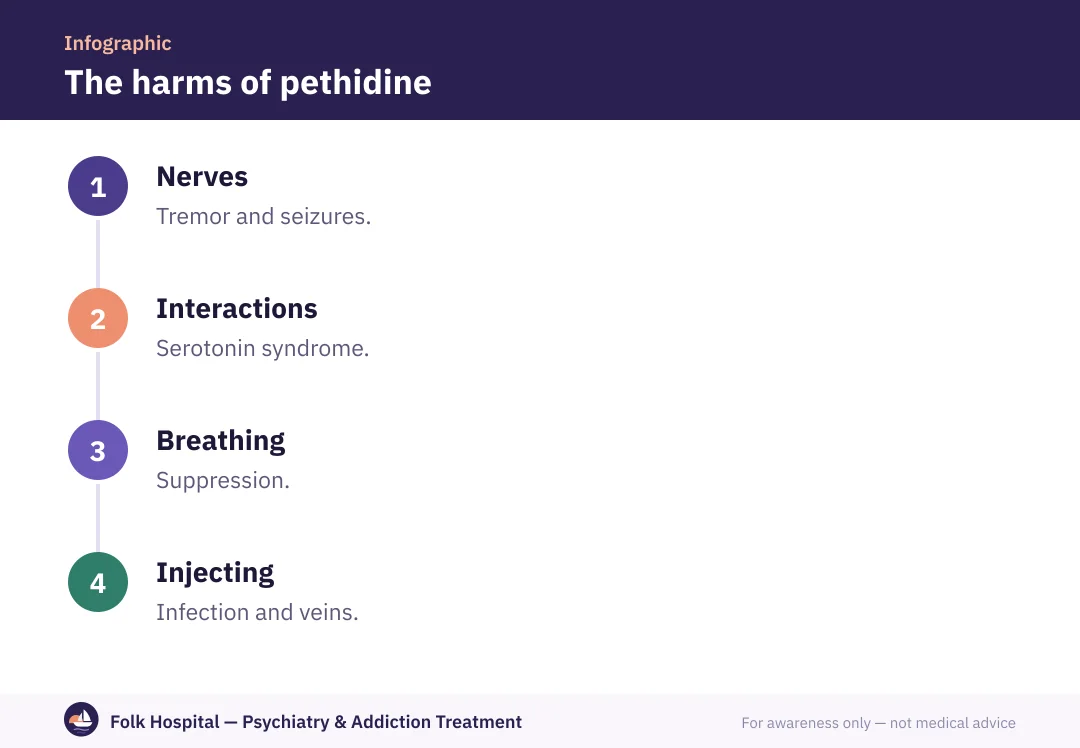
| Area | Harms |
|---|---|
| Nervous system | Tremor, agitation and seizures with repeated doses |
| Interactions | A dangerous reaction with some antidepressants |
| Injecting | Vein damage, muscle scarring, abscesses and infection |
| Breathing | Slowed with overdose or mixing |
| Dependence | Rapid dependence and repeated daily injecting |
| Work | Professional and legal problems, especially for healthcare workers |
Call an ambulance on 123 for
- Seizures, slow breathing, or fever and agitation after mixing with other medicines.
What to do right nowAmbulance: 123
02Treatment
Confidential treatment and supervised detox. Read about pethidine symptoms, its withdrawal and its treatment.
؟Frequently asked questions
Why does pethidine cause seizures?
Because its metabolite irritates the nervous system and builds up with repetition or weak kidneys.
Why has medical use of pethidine declined?
Because of its short action and the build-up of a by-product that causes seizures, and the availability of safer alternatives.
What are the harms of repeated intramuscular injection?
Muscle scarring, abscesses and chronic pain at injection sites.
Does it cause overdose?
Yes, especially when mixed with sedatives or alcohol.
Sources and references
- Opioids — research topic — National Institute on Drug Abuse (NIDA)
- Prescription Medicines — research topic — National Institute on Drug Abuse (NIDA)

Written byDr. Mahmoud ElsawyConsultant in psychiatry and addiction treatment
A psychiatrist specialising in addiction and mental illness in adults and adolescents, with a focus on dual diagnosis.
For awareness only — not a substitute for medical advice. Editorial policy · View profile