01What is lorazepam and why is it addictive?
Lorazepam is a benzodiazepine sedative used for anxiety and short-term insomnia, and in hospitals for acute agitation, seizures and sometimes alcohol withdrawal. It's intermediate-acting: a little longer than Xanax and much shorter than Valium. So anxiety between doses can occur, and withdrawal appears within a day or two of stopping.
Many people start it in an acute situation, such as an anxiety crisis or a hospital admission, then continue for weeks or months without a plan to stop, and it turns into dependence. Read about signs of lorazepam addiction.
02How is it treated?
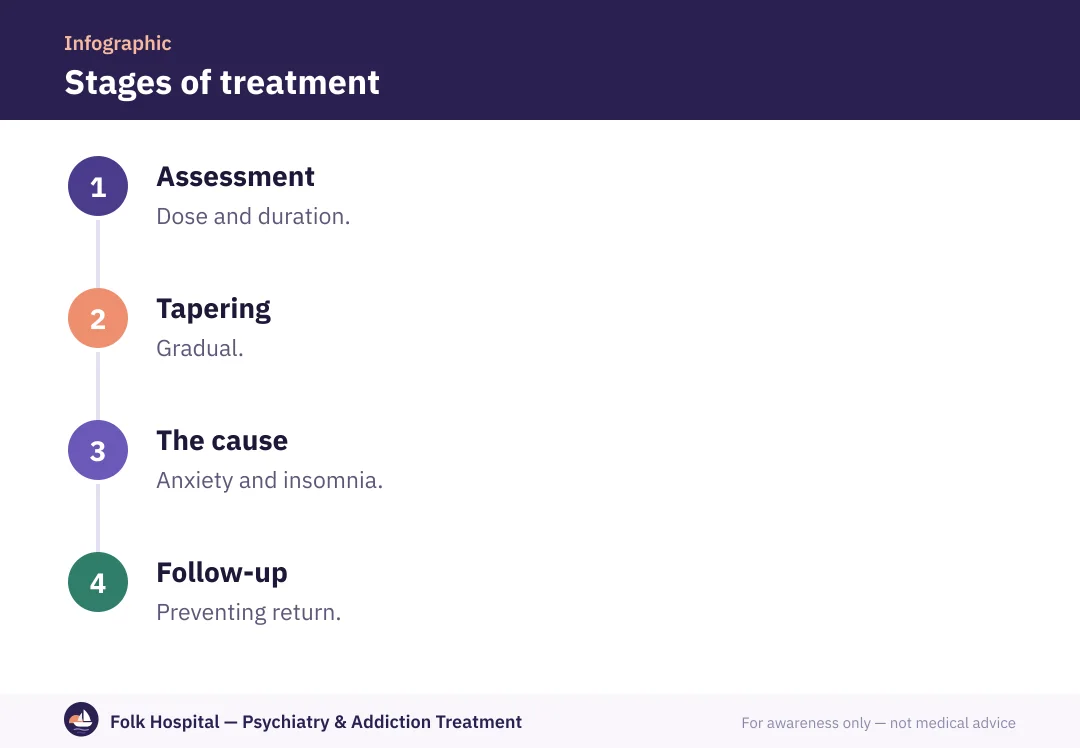
- Assessmentdose, duration and source, any alcohol or opioids, seizure history and why it was started.
- Deciding on a switchafter long-term use, the doctor often moves the patient to a longer-acting sedative at an equivalent dose.
- Gradual taperingsmall, regular steps, holding when needed.
- Treating anxiety and insomniaCBT and non-addictive medicines.
- Follow-upsessions for months after the last dose.
Read the general principles in sedative addiction treatment.
03Withdrawal: what to expect
| Period | What may happen |
|---|---|
| Within 1–2 days of a reduction | Anxiety, insomnia, irritability, sweating |
| The following days | Tremor, sensitivity to light and sound, poor concentration |
| Stopping high doses suddenly | Possible seizures or severe confusion |
We ease these symptoms with a slower taper, breathing exercises, physical activity and psychological sessions. Read about lorazepam withdrawal.
Dangerous combinations
Lorazepam with alcohol, opioids or pregabalin multiplies the risk of extreme drowsiness and slowed breathing. Difficulty waking or slow breathing needs an ambulance on 123 immediately.
04Treating anxiety and insomnia without a sedative
- Cognitive behavioural therapy: for anxiety and panic, and its version for insomnia.
- Non-addictive medicines chosen by the doctor according to the diagnosis.
- Daily habits: regular sleep, fewer stimulants, exercise and daylight.
Read about generalised anxiety disorder and insomnia.
05Residential or outpatient?
An outpatient taper usually suits
- A moderate prescribed dose.
- No alcohol or opioids.
- No previous seizures.
Residential care is better with
- High doses or more than one sedative.
- Mixing with alcohol or opioids.
- Previous seizures or severe depression.
Read about the harms of lorazepam and how long it stays in the body.
؟Frequently asked questions
How long does it take to come off lorazepam?
From a few weeks to several months depending on dose and length of use; a slow taper is more comfortable and safer.
Can I taper it without switching to another medicine?
Sometimes, with small doses over short periods, but after long-term use many doctors prefer switching to a longer-acting sedative to make tapering easier.
What are lorazepam withdrawal symptoms?
Anxiety, insomnia, irritability, tremor, sweating and sensitivity to light and sound, and seizures can occur when high doses are stopped suddenly.
I was given lorazepam in hospital and carried on. Was that wrong?
Lorazepam is useful short-term in acute situations, but continuing for weeks or months without a plan can cause dependence. The answer isn't stopping suddenly but a tapering plan with the doctor.
Does it affect memory?
It can impair memory for recent events, especially at high doses or with alcohol, and this usually improves after a structured taper.
Sources and references
- Prescription Medicines — research topic — National Institute on Drug Abuse (NIDA)
- Anxiety Disorders — National Institute of Mental Health (NIMH)
- Mental Health Medications — National Institute of Mental Health (NIMH)
- Treatment Approaches for Drug Addiction — DrugFacts — National Institute on Drug Abuse (NIDA)

A psychiatrist specialising in addiction and mental illness in adults and adolescents, with a focus on dual diagnosis.
For awareness only — not a substitute for medical advice. Editorial policy · View profile