01What exactly is addiction?
Doctors describe addiction as a substance use disorder: an ongoing pattern of using a substance that leads to clear harm or distress, with loss of control over it. The key phrase is "carrying on despite harm": the person sees what the drug is doing to their health, family, work and money, yet can't stop.
That's what sets addiction apart from a "bad habit". A habit can be dropped by decision; addiction has changed the brain itself in a way that makes decision alone insufficient most of the time.
02How does addiction happen in the brain?
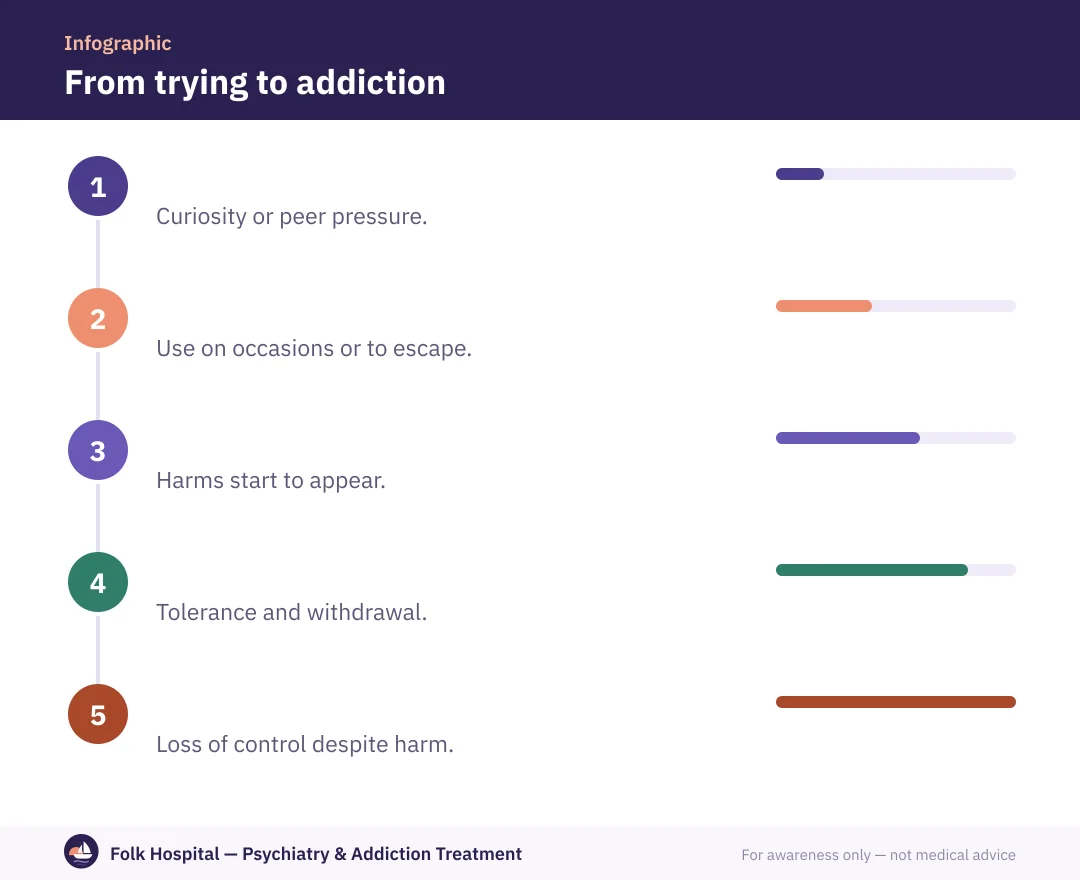
- Rewardthe drug releases dopamine in reward centres more strongly than natural pleasures, so the brain learns it's "very important".
- Adaptationwith repetition the brain becomes less sensitive, so a bigger dose is needed for the same effect, and ordinary pleasures fade.
- Dependencethe body works with the drug present, so when it's absent, withdrawal, anxiety and cravings appear.
- Weakened controlareas for planning and impulse control weaken, making cravings harder to resist.
- Memorythe brain links the drug with places, people and feelings, so these triggers set off cravings even months after stopping.
Read more in brain chemistry and addiction.
03How is addiction diagnosed?
Doctors rely on a set of signs, grouped into four clusters:
| Cluster | Examples |
|---|---|
| Loss of control | Using more or for longer than intended, failed attempts to cut down, a lot of time spent getting or recovering from the drug, strong cravings |
| Social harm | Neglecting work, study or home, carrying on despite problems with others, giving up important activities |
| Risky use | Using in dangerous situations such as driving, carrying on despite a health or mental problem the drug worsens |
| Physical signs | Tolerance (needing a bigger dose) and withdrawal on stopping |
The more signs there are, the more severe the addiction: two or three signs suggest a mild degree, four or five moderate, and six or more severe. The diagnosis is made by a doctor after assessment, not from a checklist alone.
An important note
Tolerance and withdrawal alone don't mean addiction if someone is taking a prescribed medicine under medical supervision, such as painkillers or sedatives. Read about physical versus psychological dependence.
04Why isn't it a weakness of will?
Seeing addiction as a moral weakness harms the patient and family, because it pushes them towards shame, hiding and delaying treatment. In reality:
- The brain changes in ways that make cravings stronger and control weaker.
- Vulnerability differs from person to person because of genes, mental health and circumstances. Read about the causes of addiction.
- Treatment works when it treats addiction as an illness: medically, psychologically and socially.
This doesn't mean the person isn't responsible; it means their main responsibility is to seek treatment and stick with it, and the responsibility of those around them is to support without enabling.
05Addiction is a chronic illness: what does that mean?
Scientific bodies compare addiction to chronic illnesses such as diabetes, asthma and high blood pressure: it has many causes, can be controlled with treatment, and may relapse if follow-up stops. In practice:
- Treatment doesn't end when detox ends.
- Relapse is possible and is a signal to adjust the plan, not final failure. Read about relapse.
- Long follow-up is part of treatment.
06Addictions without substances
Some behaviours share the same mechanism as substance addiction: gambling, gaming, pornography and others. They're treated with similar approaches. Read about behavioural addictions.
07Is recovery possible?
Yes. Millions of people around the world live in stable recovery. The factors that raise the chances are well known: early treatment, completing the programme, treating co-existing mental illness, family support and follow-up. Read about the stages of addiction treatment and life after recovery.
؟Frequently asked questions
Is addiction an illness or a choice?
Use often starts as a choice, but addiction itself is a state in which the brain has changed so that control weakens and cravings strengthen, which is why medical bodies classify it as a treatable illness.
What's the difference between drug use and addiction?
Use means taking the substance; addiction is an ongoing pattern of losing control and carrying on despite harm. Not everyone who uses is addicted, but repeated use raises the risk.
Can addiction be cured completely?
Stable recovery for many years and a normal life are achievable. But caution remains wise, because the brain keeps a memory of the drug, just as someone with diabetes needs follow-up even after their blood sugar is controlled.
Is addiction hereditary?
Genes explain an important part of vulnerability, but they aren't destiny. Environment, age at first use and mental health play a big role.
Is there addiction without drugs?
Yes, behavioural addictions such as gambling and gaming share loss of control and continuing despite harm with substance addiction.
Sources and references
- Treatment Approaches for Drug Addiction — DrugFacts — National Institute on Drug Abuse (NIDA)
- Mental disorders — fact sheet — World Health Organization
- Co-Occurring Disorders and Health Conditions — National Institute on Drug Abuse (NIDA)
- World Drug Report 2024 — United Nations Office on Drugs and Crime (UNODC)

A psychiatrist specialising in addiction and mental illness in adults and adolescents, with a focus on dual diagnosis.
For awareness only — not a substitute for medical advice. Editorial policy · View profile