01What's the difference between them?
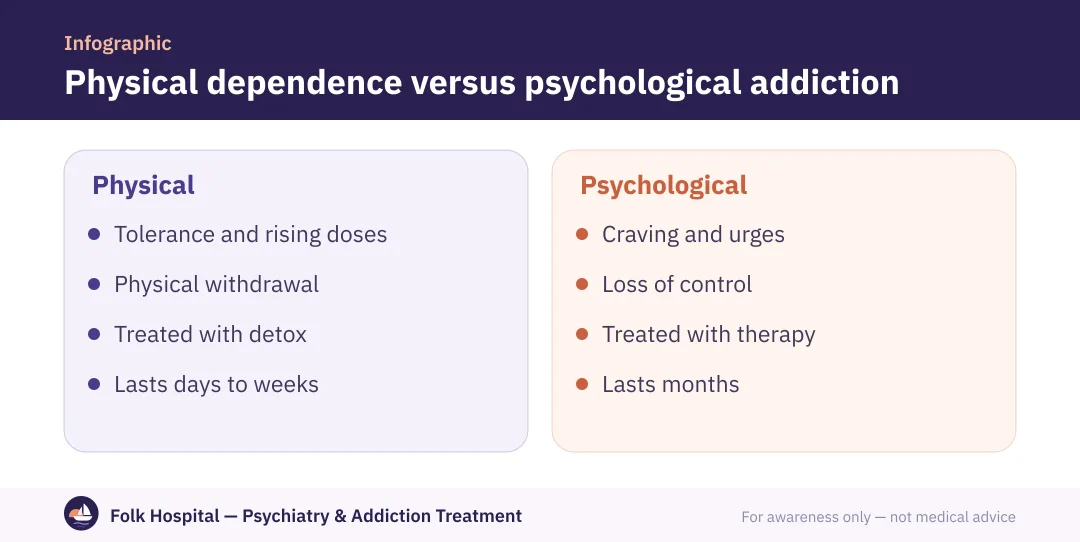
Physical dependence
- The body has adapted to the drug being present.
- Tolerance appears: needing a bigger dose.
- Withdrawal appears on stopping.
- Can occur with prescribed medicines without addiction.
- Treated with medical detox over days to weeks.
Psychological addiction
- Strong urges and cravings for the drug.
- Loss of control over amount and timing.
- Carrying on despite clear harm.
- The drug linked with feelings, places and people.
- Treated with psychological rehabilitation and follow-up over months.
02Physical dependence without addiction
A patient taking an opioid painkiller after an operation, or a sedative for anxiety under medical supervision, may adapt to the medicine and get withdrawal if they stop suddenly. That's expected physical dependence, not addiction, as long as they keep to the dose and don't lose control. The answer is a gradual taper with the doctor. Read what is addiction.
03Psychological addiction without clear physical withdrawal
Some drugs and behaviours don't cause strong physical withdrawal but do cause severe psychological addiction: stimulants, gambling and gaming, for example. The person loses control and carries on despite harm, and needs treatment even without major "physical symptoms". Read about behavioural addictions.
04How does it vary by drug?
| Drug | Physical side | Psychological side |
|---|---|---|
| Opioids | Strong: pain, diarrhoea, insomnia | Strong: long-lasting cravings |
| Alcohol and sedatives | Strong and can be dangerous | Strong |
| Stimulants | Relatively mild | Very strong: cravings and depression |
| Cannabis | Mild to moderate | Moderate to strong |
| Behavioural addictions | Almost none | Strong |
05Why must both be treated?
Many families think treatment is over when withdrawal ends. But the psychological side remains: cravings, triggers, habits and the reasons that drove the use. That's why most people who stop at detox relapse. Full treatment needs:
- Medical detoxto treat physical dependence safely. Read about detox.
- Psychological rehabilitationto treat cravings, habits and causes. Read about residential rehab.
- Follow-upbecause the psychological side takes longer. Read about aftercare.
؟Frequently asked questions
Does cannabis cause physical or psychological addiction?
Both, to varying degrees: it has mild physical withdrawal such as insomnia and poor appetite, but the psychological side of craving and habit is usually the harder part.
Which is harder to treat?
The physical side usually ends within days to weeks with medical detox; the psychological side needs longer, with rehabilitation and follow-up, which is why it's usually the harder one.
I take a prescribed medicine and get symptoms if I forget it. Am I addicted?
Not necessarily. That's expected physical dependence with some medicines. Addiction means losing control and carrying on despite harm. Talk to your doctor about a tapering plan if you want to stop.
Sources and references
- Treatment Approaches for Drug Addiction — DrugFacts — National Institute on Drug Abuse (NIDA)
- Drug misuse in over 16s: opioid detoxification (CG52) — National Institute for Health and Care Excellence (NICE)
- Prescription Medicines — research topic — National Institute on Drug Abuse (NIDA)

A psychiatrist specialising in addiction and mental illness in adults and adolescents, with a focus on dual diagnosis.
For awareness only — not a substitute for medical advice. Editorial policy · View profile