01Why does one person become addicted and another doesn't?
Many people use a substance once or a few times without becoming addicted, while others slide quickly. The reason is that addiction doesn't come from a single factor but from risk factors adding up, in the absence of enough protective factors. These factors fall into three groups:
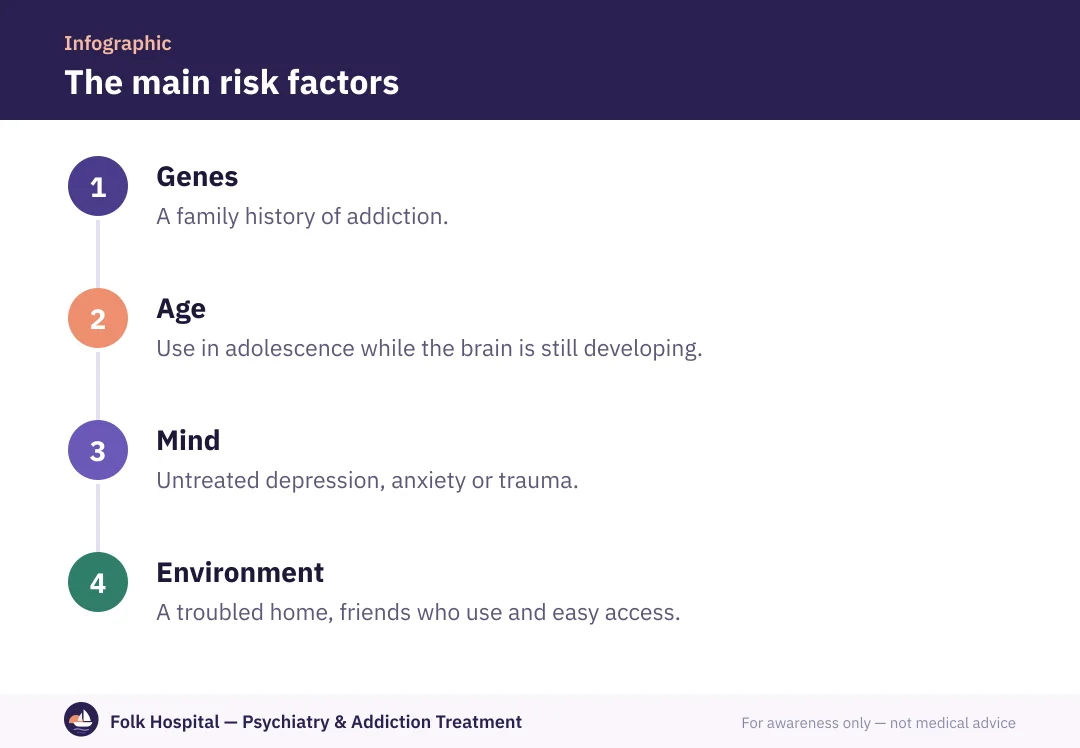
| Group | Main risk factors |
|---|---|
| Biological | Genetic vulnerability, starting young, and how the body handles the drug |
| Psychological | Depression, anxiety, ADHD, trauma and impulsivity |
| Environmental and social | A troubled home or violence, lack of supervision, friends who use, easy access to the drug, poverty and unemployment |
02Genes: vulnerability, not destiny
Research from the US National Institute on Drug Abuse indicates that genetic factors explain a large part of vulnerability to addiction. Someone whose parent or sibling has an addiction is at higher risk. But genes don't create addiction alone; they raise sensitivity, and environment and decisions shape what happens.
03Age at first use: why it matters so much
The brain keeps maturing until about the mid-twenties, especially the areas responsible for planning and impulse control. Using in adolescence affects this maturation and is linked to a higher risk of addiction later. That's why delaying first use is one of the most important forms of prevention. Read teenagers and drugs and about prevention.
04Self-medication: when the drug is a "medicine" for a mental health problem
Many patients say, "I used so I could sleep", "to stop thinking" or "to cope with people". This is self-medication:
- Depression drives a search for any sense of relief.
- Anxiety and social anxiety push towards sedatives, alcohol or cannabis.
- ADHD pushes towards stimulants or impulsive experimenting.
- Trauma pushes towards silencing painful memories.
The problem is that the drug gives temporary relief, then worsens the original problem. So treatment isn't complete without treating these conditions. Read about dual diagnosis.
05Environment: home, friends and community
- Home: violence, neglect, constant conflict, a family member who uses, or no communication.
- Friends: a group that uses makes the drug seem "normal".
- Availability: how easy and cheap the drug is to get.
- Pressures: unemployment, debt, work stress and empty time.
06What are protective factors?
Risk factors
- Early start in adolescence.
- An untreated mental health condition.
- A troubled home or lack of supervision.
- Friends who use.
- Easy access to the drug.
Protective factors
- Delaying any experimentation until after adolescence.
- Early treatment of anxiety, depression and ADHD.
- A supportive family, open communication and clear limits.
- Activities, goals and positive friends.
- Skills for coping with stress and refusing offers.
07What does this mean for treatment?
Understanding the causes of each patient's addiction changes their treatment plan: someone who started because of anxiety needs anxiety treatment, someone who started because of pain needs a pain plan, and someone who started because of friends needs to build a new environment. So treatment at Folk starts with an assessment that looks for the personal story of the addiction. Read what is addiction and about the addictive personality.
؟Frequently asked questions
Why does one person become addicted and another doesn't, using the same drug?
Because vulnerability differs: genes, age at first use, mental health, circumstances, the type of drug and how it's used. Several risk factors together raise the likelihood considerably.
Will the child of someone with addiction become addicted?
Their risk is higher than others', but it isn't destiny. Early awareness, a supportive environment, delaying any experimentation and treating any mental health problem clearly reduce the risk.
Are bad friends the cause?
Friends matter a lot at the start, but they're rarely the only cause. Usually there's also a psychological vulnerability, stress or empty time.
Can the family be a cause?
A troubled or violent home or lack of supervision are risk factors, but no single person creates addiction. Families blaming themselves doesn't help; it's better to focus on what can be changed now.
Sources and references
- Treatment Approaches for Drug Addiction — DrugFacts — National Institute on Drug Abuse (NIDA)
- Co-Occurring Disorders and Health Conditions — National Institute on Drug Abuse (NIDA)
- Mental disorders — fact sheet — World Health Organization
- World Drug Report 2024 — United Nations Office on Drugs and Crime (UNODC)

A psychiatrist specialising in addiction and mental illness in adults and adolescents, with a focus on dual diagnosis.
For awareness only — not a substitute for medical advice. Editorial policy · View profile