01Traumatic events
- Road traffic and other serious accidents.
- Physical violence and assault.
- War, conflict and displacement.
- Natural disasters and fires.
- Sudden or violent loss of a loved one.
- A difficult birth or pregnancy complications.
- Intensive care admission or a diagnosis of serious illness.
- Witnessing any of the above happen to others.
02Factors that raise or reduce risk
| Raise risk | Protect |
|---|---|
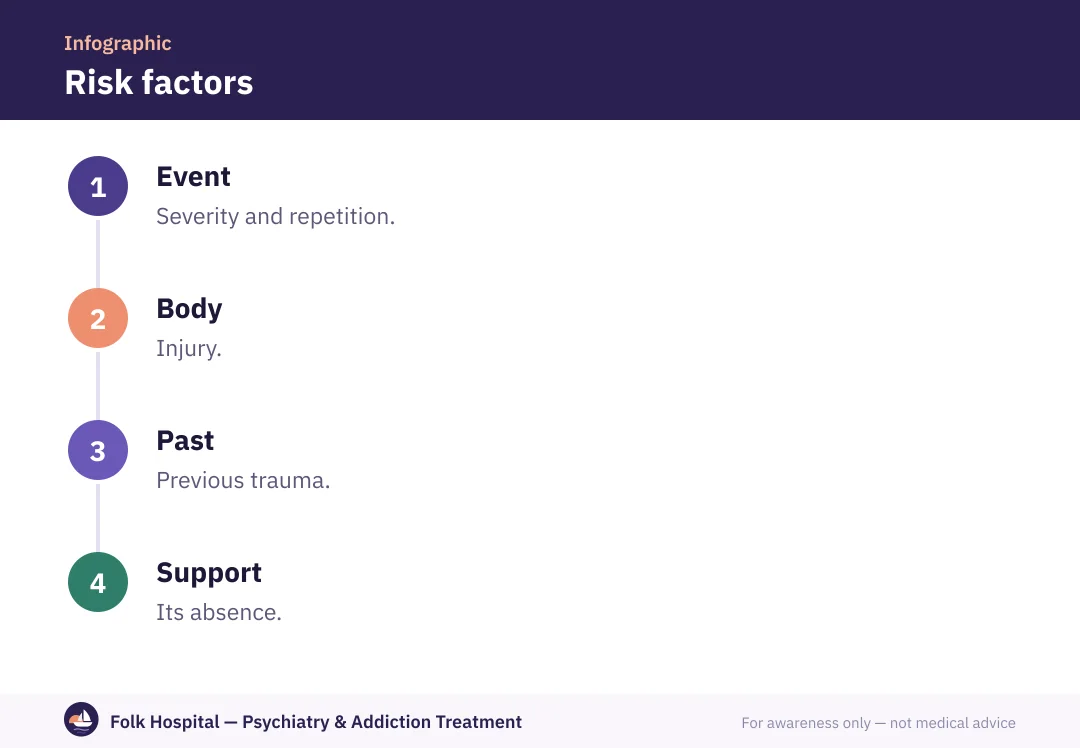
| Previous trauma, especially in childhood | Support from family and friends afterwards |
| Repeated or prolonged trauma | Feeling safe quickly after the event |
| Severe physical injury | Being able to talk about what happened |
| Prior anxiety or depression | Good coping skills |
| Extra stress afterwards, such as job loss | Getting help early |
| Alcohol or substance use | A daily routine and regular sleep |
03What happens in the brain?
Fear centres become more sensitive, while the areas that calm them and place the memory in time become less effective. The stress hormone system, including cortisol and adrenaline, also changes, keeping the body ready for danger.
04Why doesn't everyone recover on their own?
- The eventstored as a vivid, fragmented memory.
- Avoidancestops the brain processing the memory.
- Hyperarousaltells the brain the danger continues.
- Lack of supportleaves the person alone with negative interpretations.
- The resultthe event stays present.
- Suicidal thoughts or self-harm.
- Severe detachment from reality or inability to look after oneself.
- A large increase in alcohol or substance use.
Mental health hotline: 08008880700; ambulance: 123.
Ambulance: 123Read PTSD, psychological trauma and emotional trauma.
؟Frequently asked questions
What events can cause PTSD?
Serious accidents, violence, assault, war, disasters, sudden loss, a difficult birth, a diagnosis of serious illness, or witnessing these.
Why do some people develop it and others not?
Because of differences in the event's severity and repetition, personal history, support afterwards, and genetic and biological factors.
Does developing PTSD mean a weak personality?
No. It's the brain's response to an event beyond its capacity to process, and it affects the strongest people.
Can indirect trauma cause it?
Yes, such as learning that a loved one suffered violence or sudden death, or repeated exposure to trauma details at work.
Does childhood trauma raise the risk?
Yes. Early trauma raises the risk of PTSD after later trauma, as well as of depression and addiction.
Do genes play a role?
Genetic factors affect the sensitivity of the stress system, but the environment, the event itself and support matter more.
Sources and references
- PTSD (post-traumatic stress disorder) — overview — NHS (UK)
- Post-Traumatic Stress Disorder — National Institute of Mental Health (NIMH)
- Psychotherapies — National Institute of Mental Health (NIMH)

A psychiatrist specialising in addiction and mental illness in adults and adolescents, with a focus on dual diagnosis.
For awareness only — not a substitute for medical advice. Editorial policy · View profile