01Thought symptoms
What goes on in the mind
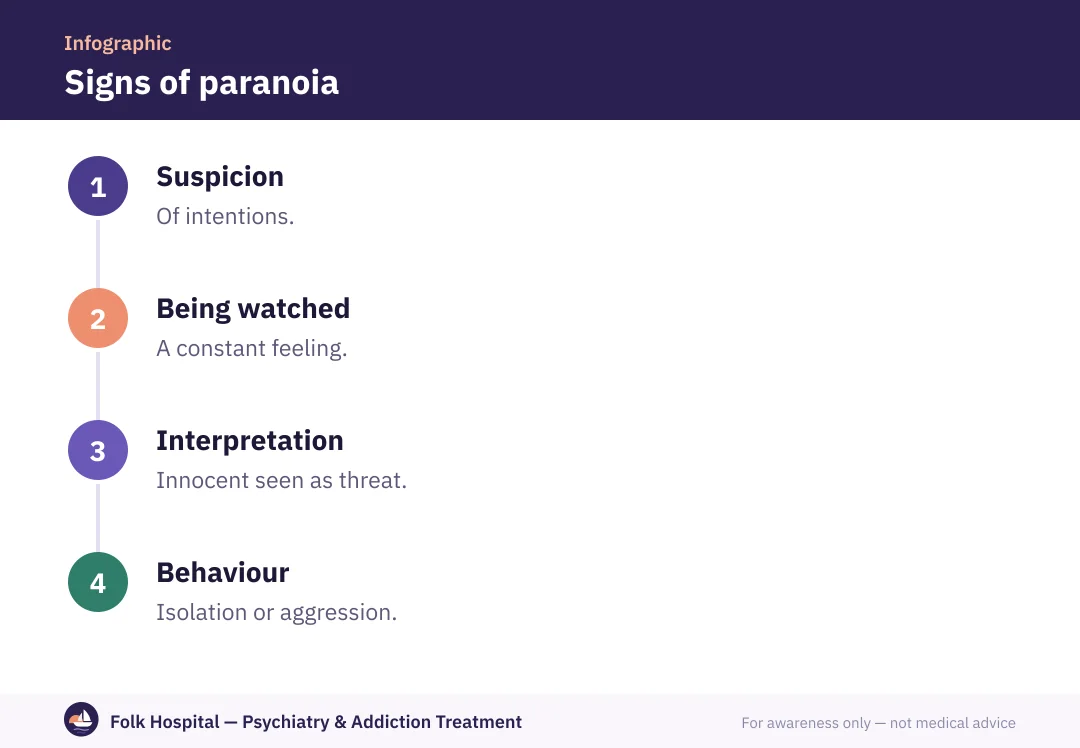
- «People are talking about me» or «laughing at me».
- Reading hidden intentions into ordinary speech.
- Conviction that the phone is monitored or someone is following.
- Suspecting a partner's or friends' loyalty without evidence.
- Constant thoughts of danger and revenge.
02Behavioural and emotional symptoms
| Area | What may appear |
|---|---|
| Relationships | Difficulty trusting, cutting people off, repeated accusations |
| Behaviour | Checking, locking doors and windows, changing numbers |
| Emotions | Quick anger, defensiveness, constant anxiety |
| Work | Clashes with colleagues, a sense of being victimised |
| Daily life | Isolation, avoiding public places |
03Acute paranoia or lasting traits?
Acute paranoia
- Began suddenly over days or weeks.
- With drug use, sleeplessness or psychosis.
- May come with hallucinations.
- Usually improves when the cause is treated.
Lasting paranoid traits
- A pattern since adolescence or early adulthood.
- No clear hallucinations or delusions.
- Consistently affects relationships.
- Needs longer psychological treatment.
- Threats or plans to harm someone.
- Refusing food or medicine for fear of poisoning.
- Hallucinations commanding actions.
Call an ambulance on 123 or the hotline on 08008880700.
Ambulance: 123Read paranoia, pathological jealousy, hashish paranoia and delusional disorder.
؟Frequently asked questions
What are the first signs of paranoia?
Reading ordinary situations as hostile, feeling others are talking about or plotting against you, and difficulty trusting.
What is paranoid personality disorder?
A long-standing pattern since early adulthood of suspicion and mistrust of others' motives, without psychosis, affecting relationships and work.
Does paranoia cause violence?
Most suspicious people aren't violent, but the risk rises with severe delusions and drugs, especially stimulants.
How do I know suspicion has become pathological?
When it's fixed despite evidence, exaggerated, and affects relationships, work and sleep, or comes with hallucinations.
Is paranoia similar to morbid jealousy?
Morbid jealousy is a form of suspicion focused on a partner's infidelity and can be part of paranoia or delusional disorder.
Why do paranoid people refuse treatment?
They see the danger as real and sometimes distrust doctors too, so they need a calm, patient approach.
Sources and references
- Psychosis — NHS (UK)
- Schizophrenia — National Institute of Mental Health (NIMH)
- Personality disorder — NHS (UK)

A psychiatrist specialising in addiction and mental illness in adults and adolescents, with a focus on dual diagnosis.
For awareness only — not a substitute for medical advice. Editorial policy · View profile