01Interacting factors
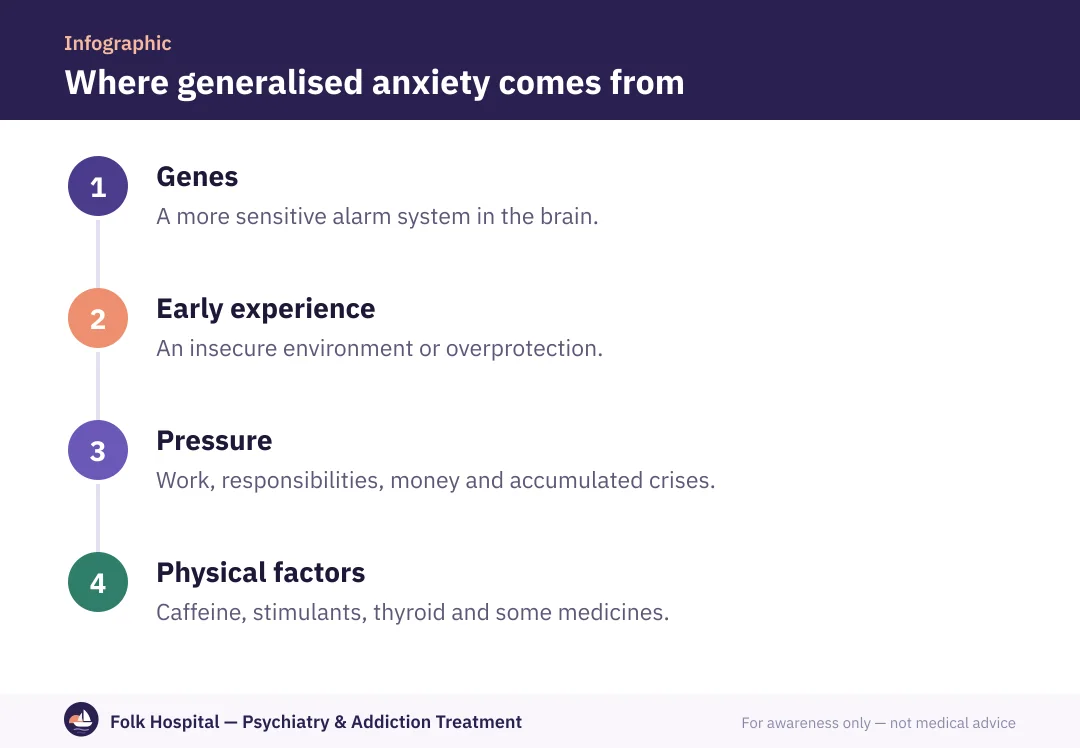
| Factor | Role |
|---|---|
| Genes and temperament | Sensitivity and caution from childhood |
| Brain chemistry | Serotonin, GABA and fear circuits |
| Childhood | Instability, over-protection, trauma |
| Stress | Work, money, illness, relationships |
| Thinking style | Intolerance of uncertainty, expecting the worst |
| Substances | Caffeine, stimulants, withdrawal from alcohol and sedatives |
| Physical causes | Thyroid, heart, some medicines |
02Beliefs that maintain anxiety
Common beliefs
- «Worry protects me from surprises».
- «If I don't worry, the worst will happen».
- «Worrying means I'm responsible».
What actually happens
- Worry doesn't prevent events.
- It drains energy without solving anything.
- Responsibility is possible without constant worry.
03The worry cycle
- An uncertain situation«what if...?»
- A chain of thoughtseach possibility leads to a worse one.
- Physical symptomstension and insomnia.
- Safety behavioursreassurance and over-planning.
- Ongoing anxietybecause the brain never learns to tolerate uncertainty.
Read generalised anxiety, overthinking and causes of mental illness.
؟Frequently asked questions
What causes GAD?
Genes and a sensitive temperament, brain chemistry, childhood experiences, life stress and a thinking style that struggles with uncertainty.
Is anxiety hereditary?
Genes contribute to vulnerability, but experiences, thinking and stress play a big role.
What does intolerance of uncertainty mean?
Feeling that not knowing what will happen is unbearable, so the mind tries to anticipate every possibility through worry.
Does coffee cause anxiety?
Large amounts of caffeine can increase anxiety, palpitations and insomnia in vulnerable people.
Are there physical causes of anxiety?
Yes, such as an overactive thyroid, some heart conditions, low blood sugar and some medicines.
Does trauma cause GAD?
Childhood trauma and stress raise the risk but aren't required.
Sources and references
- Anxiety Disorders — National Institute of Mental Health (NIMH)
- Anxiety disorders — fact sheet — World Health Organization
- Psychotherapies — National Institute of Mental Health (NIMH)

A psychiatrist specialising in addiction and mental illness in adults and adolescents, with a focus on dual diagnosis.
For awareness only — not a substitute for medical advice. Editorial policy · View profile