01Why does treatment need a team?
Eating disorders, such as anorexia nervosa, bulimia nervosa and binge-eating disorder, are mental illnesses with serious physical effects. So no single specialty is enough:
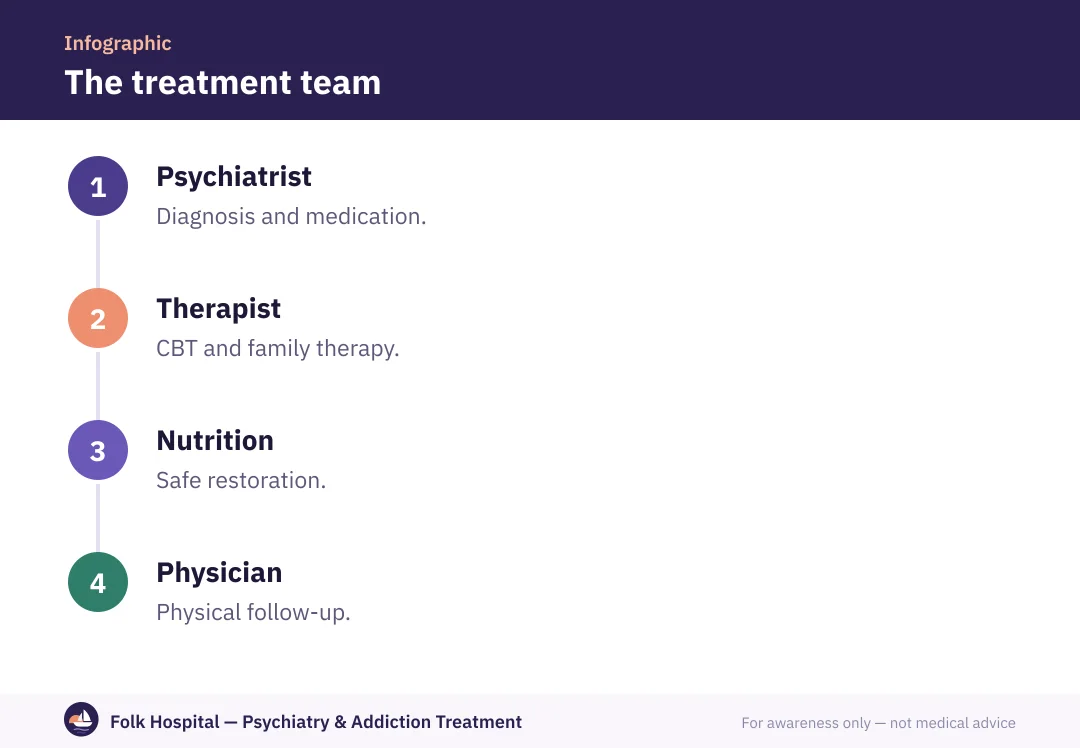
| Team member | Role |
|---|---|
| Psychiatrist | Diagnosis, treating accompanying depression, anxiety or OCD, and overseeing the plan |
| Therapist | CBT, family therapy, and work on body image and thoughts |
| Dietitian | A gradual, safe nutrition plan and a healthy relationship with food |
| Physical health follow-up | Checks of heart, salts, bones and hormones |
Read about the symptoms of eating disorders and their types.
02Psychological treatments
- Cognitive behavioural therapy: works on thoughts about food, weight and body image, and on cycles of restriction, bingeing and compensating.
- Family-based therapy: one of the most successful approaches with teenagers, involving the family in supporting a structured return to eating.
- Treating co-existing conditions: such as depression, anxiety and OCD, with suitable medicines when needed.
03Restoring nutrition safely
Don't rush
Restoring eating after a period of severe restriction must happen gradually and under medical supervision, because rushing can cause dangerous disturbances in salts and heart function. That's why the nutrition plan is set with the team, not at home without follow-up.
04Signs that need urgent assessment
- Fainting, severe dizziness or palpitations.
- Repeated vomiting or signs of dehydration.
- Near-total refusal of food or fluids.
- Thoughts of self-harm or suicide.
In immediate danger: ambulance 123.
Ambulance: 12305The family's role
- Talk about concern for health, not shape or weight.
- Avoid comments on bodies and diets at home.
- Don't turn meals into battles; follow the team's plan.
- Seek support for yourself too.
06When is admission needed?
When there's medical risk, severe food refusal with deterioration, thoughts of self-harm, or no response to outpatient treatment. See our psychiatric hospital.
؟Frequently asked questions
How long does recovery from an eating disorder take?
It varies widely, usually months to years of treatment and follow-up, and full recovery is possible.
Are eating disorders dangerous?
Yes. They can affect the heart, salts, bones and hormones, and some can be life-threatening, so they need early medical and psychological assessment.
How can I help my daughter if I suspect an eating disorder?
Talk to her calmly about your concern for her health rather than her shape or weight, avoid blame and comments on bodies, and seek a specialist assessment quickly.
When is admission needed?
When there's medical risk such as salt or heart-rhythm disturbances, severe food refusal with deterioration, thoughts of self-harm, or no response to outpatient treatment.
Sources and references
- Eating Disorders — National Institute of Mental Health (NIMH)
- Psychotherapies — National Institute of Mental Health (NIMH)
- Mental disorders — fact sheet — World Health Organization

A psychiatrist specialising in addiction and mental illness in adults and adolescents, with a focus on dual diagnosis.
For awareness only — not a substitute for medical advice. Editorial policy · View profile