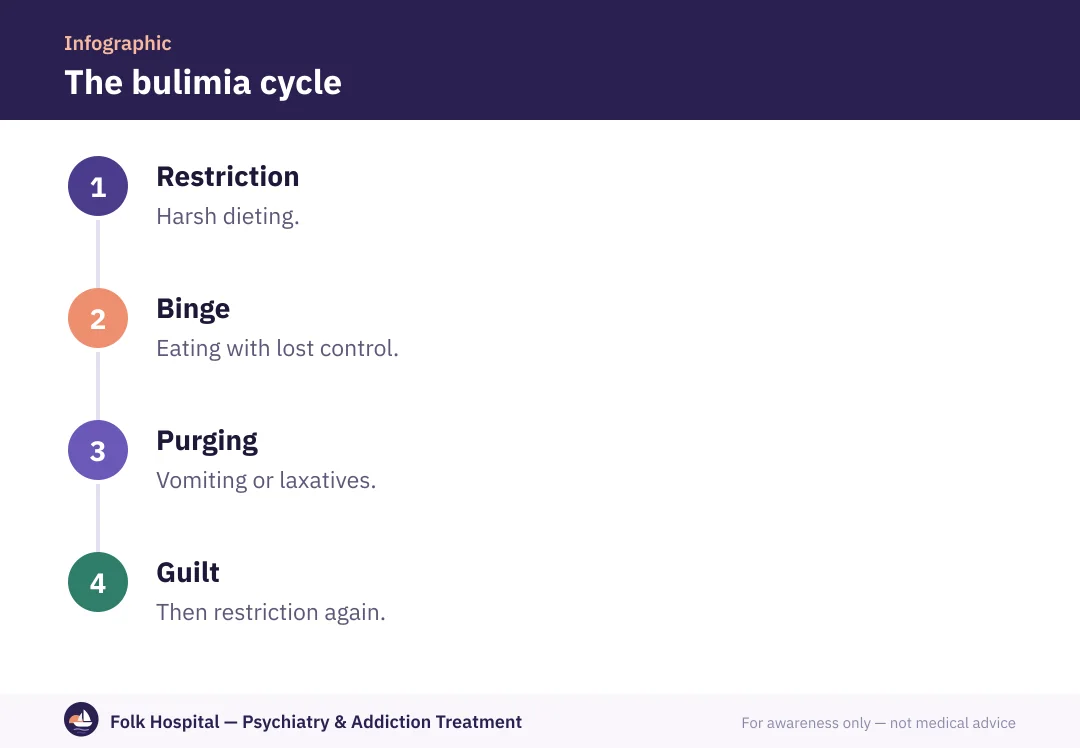
01The vicious cycle
- Restriction and strict food rulesincrease hunger and tension.
- A bingewith a sense of losing control.
- Guilt and shameand fear of weight gain.
- Compensatory behaviourbrings brief relief.
- Back to restrictionand the cycle restarts.
02Signs you may notice
Signs
- Food disappearing or hidden wrappers.
- Going to the bathroom straight after eating.
- Swollen glands around the jaw.
- Worn tooth enamel.
- Mood swings and secrecy.
03Complications
| Complication | Cause |
|---|---|
| Electrolyte imbalance | Vomiting and laxatives |
| Heart rhythm problems | Low potassium |
| Tooth erosion | Stomach acid |
| Oesophagitis | Repeated vomiting |
- Fainting, severe dizziness, palpitations or chest pain.
- Repeated vomiting with severe weakness or confusion.
- Suicidal thoughts or self-harm.
In Egypt call the ambulance on 123 immediately, or the mental-health hotline 08008880700.
Ambulance: 123Read eating disorders and their treatment, and try the eating disorders test. Also read food addiction.
؟Frequently asked questions
What is bulimia nervosa?
Binge episodes with loss of control followed by compensatory behaviours such as vomiting, laxatives or fasting, with preoccupation with weight.
Does bulimia show in appearance?
Usually not; weight can be normal, so it's often discovered late.
How dangerous is repeated vomiting?
It disturbs the body's salts, can affect the heart, and damages teeth and the oesophagus.
How does bulimia differ from binge eating disorder?
Bulimia has compensatory behaviour after a binge; binge eating disorder doesn't.
How is bulimia treated?
With specialised CBT, sometimes medication, plus medical monitoring.
Is full recovery possible?
Yes. Many recover with treatment, and relapses can be managed with a clear plan.
Sources and references
- Eating Disorders — National Institute of Mental Health (NIMH)
- Anorexia — overview — NHS (UK)
- Bulimia — overview — NHS (UK)
- Binge eating disorder — NHS (UK)

A psychiatrist specialising in addiction and mental illness in adults and adolescents, with a focus on dual diagnosis.
For awareness only — not a substitute for medical advice. Editorial policy · View profile