01Comparing the types
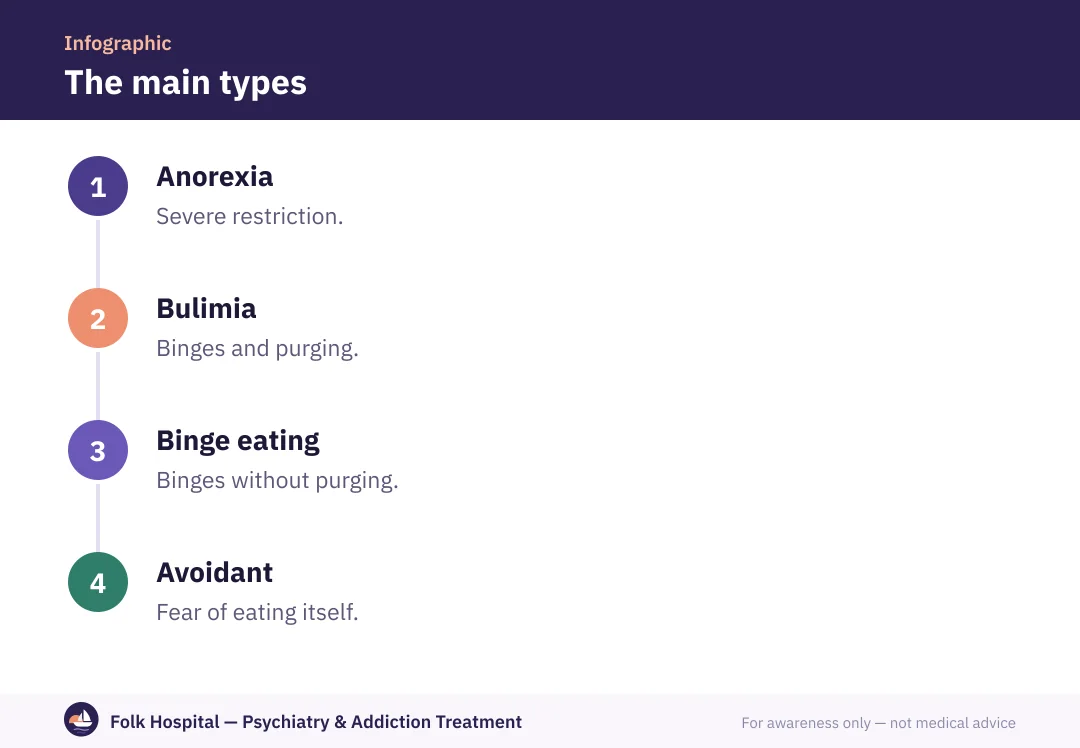
| Type | Core feature | Compensation | Body image |
|---|---|---|---|
| Anorexia nervosa | Severe restriction | May occur | Distorted |
| Bulimia | Binges | Present | Intense preoccupation |
| Binge eating disorder | Binges | Absent | Guilt and shame |
| ARFID | Avoiding foods | Absent | Not related |
02Other types
Other specified types
Presentations that don't meet every criterion but are harmful and deserve treatment.
Rumination disorder
Repeatedly bringing food back up from the stomach without a physical cause.
Pica
Persistently eating non-food substances, which needs medical assessment.
Read eating disorders and their treatment, and try the eating disorders test. Also read anorexia, bulimia and food addiction.
؟Frequently asked questions
What are the types of eating disorders?
Anorexia nervosa, bulimia nervosa, binge eating disorder, ARFID and other specified types.
How does bulimia differ from binge eating disorder?
Bulimia has compensatory behaviour after a binge; binge eating disorder doesn't.
What is ARFID?
Avoiding foods or eating little because of sensory sensitivity or fear of choking or vomiting, not because of appearance.
Can the type change?
Yes. A person may move from restriction to bingeing or the reverse.
Is binge eating disorder food addiction?
They overlap, but binge eating disorder is a specific medical diagnosis treated psychologically.
Are atypical types less serious?
No. They can carry the same complications and need the same seriousness.
Sources and references
- Eating Disorders — National Institute of Mental Health (NIMH)
- Anorexia — overview — NHS (UK)
- Bulimia — overview — NHS (UK)
- Binge eating disorder — NHS (UK)

A psychiatrist specialising in addiction and mental illness in adults and adolescents, with a focus on dual diagnosis.
For awareness only — not a substitute for medical advice. Editorial policy · View profile