01How is a depression treatment plan built?
There's no single treatment for everyone. Medical guidelines, including those of the UK's National Institute for Health and Care Excellence, recommend building the plan around the severity of depression, the patient's preference and previous episodes:
| Severity | Main options |
|---|---|
| Mild | Psychological therapy (such as behavioural activation or CBT), structured physical activity and follow-up |
| Moderate | Psychological therapy, an antidepressant, or both, depending on the case and preference |
| Severe | Usually therapy and an antidepressant together, with close follow-up of suicide risk |
| Severe with risk or psychosis | Intensive care or admission, sometimes brain stimulation treatments |
Read about the symptoms of depression and its types.
02What types of psychological therapy help depression?
Cognitive behavioural therapy
Uncovers and changes negative thinking patterns, and rebuilds daily activity.
Interpersonal therapy
Focuses on relationships, roles and conflicts linked to the depression.
Behavioural activation
Gradually brings back enjoyable and useful activities.
Family therapy
Helps the family support the patient and understand the illness.
Behavioural activation: why start with action?
Depression makes people withdraw from activities, so less brings them pleasure or a sense of achievement, so the depression deepens. Behavioural activation breaks this cycle with very small, planned steps: a ten-minute walk, a call to a friend or a simple task. Action comes before motivation, not the other way round.
03How do antidepressants work?
They act on neurotransmitters and brain networks that regulate mood and stress, gradually helping the brain regain its balance. The doctor chooses a medicine based on symptoms, side effects, other illnesses and current medicines.
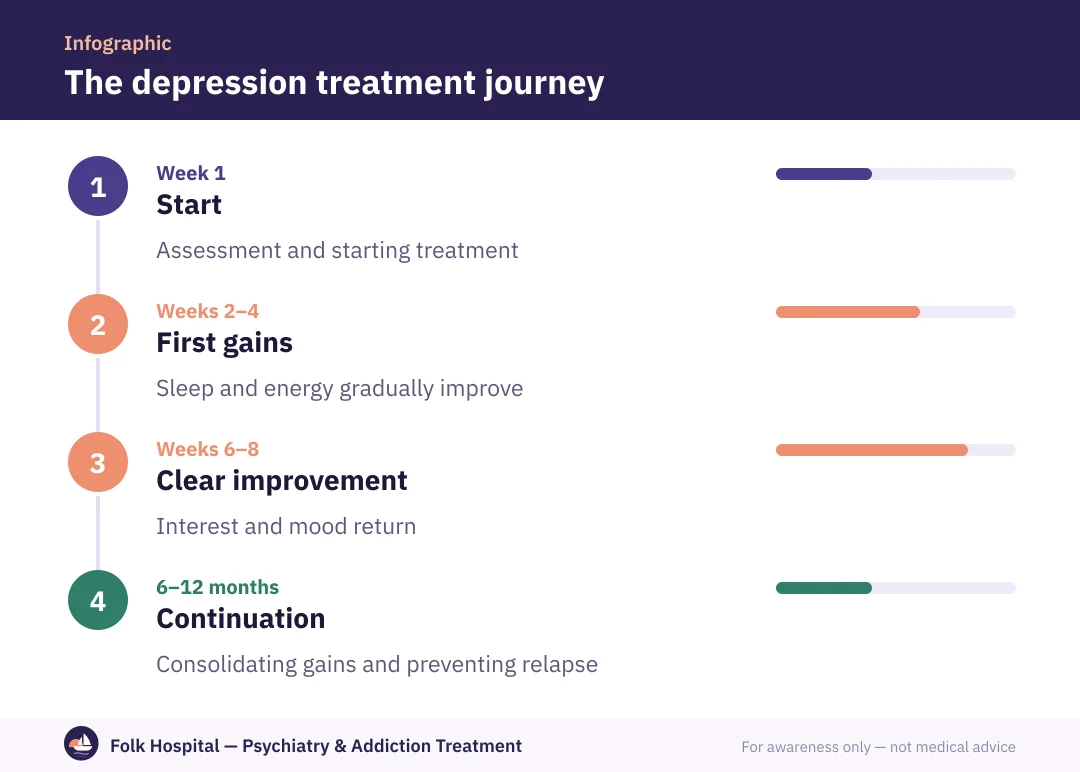
| What to expect | Approximate timing |
|---|---|
| Better sleep and energy | Two to four weeks |
| Better mood | Four to six weeks |
| Full benefit | Six to eight weeks |
| Continuing after improvement | Usually six months to a year, longer with repeated episodes |
Important about medication
- Don't stop an antidepressant suddenly; tapering is done gradually with the doctor.
- Early side effects such as nausea or headache are usually temporary.
- Tell the doctor about severe anxiety or thoughts of self-harm in the first weeks, especially in young people.
- Antidepressants aren't addictive in the usual sense.
Read about psychiatric medicines.
04Lifestyle: part of treatment
- Regular physical activity is among the strongest supports for treatment, even a daily walk.
- Regular sleep at fixed times.
- Social contact, even in small steps.
- Avoiding alcohol and drugs, which deepen depression and interact with medicines. Read about depression and addiction.
Read about treating depression without medication.
05What if depression doesn't improve?
The doctor reviews the diagnosis, dose and duration, and may switch or add a treatment. For resistant cases there are options such as TMS and ECT under anaesthesia in specific cases with informed consent. It's also important to look for things blocking improvement: a thyroid disorder, substance use or undiagnosed bipolar disorder.
06When is admission needed?
When there's suicide risk, refusal to eat or drink, psychotic symptoms or inability to look after oneself. See our psychiatric hospital.
- Don't stay alone; talk to someone you trust straight away.
- Remove medicines and dangerous objects.
Call an ambulance on 123 or the mental health hotline on 08008880700.
Ambulance: 12307Preventing depression from returning
Depression can return, especially after repeated episodes or stopping treatment early. What protects against this: continuing medication long enough, psychological therapy that teaches long-term skills, and knowing your personal early warning signs. Read about depression relapse.
؟Frequently asked questions
When will I feel better after starting an antidepressant?
Sleep and energy usually improve first, within two to four weeks, followed by mood. If there's no improvement after 6–8 weeks, the doctor adjusts the plan.
How long does depression treatment last?
After improvement, medication usually continues for six months to a year, longer with repeated episodes. The doctor decides when to taper.
Are antidepressants addictive?
They aren't addictive in the usual sense, but stopping suddenly can cause unpleasant symptoms such as dizziness and anxiety, so they're tapered with the doctor.
Can depression be treated without medication?
In mild and sometimes moderate cases, yes, with psychological therapy, behavioural activation and lifestyle changes. Severe depression usually needs medication alongside therapy.
What if the first medicine doesn't work?
That's common. The doctor reviews the dose and duration and may switch or add a treatment. For resistant cases there are other options such as TMS or ECT.
Can depression come back?
Yes, especially if treatment stops early. Continuing medication long enough, learning warning signs and psychological therapy greatly reduce the risk.
Sources and references
- Depression in adults: treatment and management (NG222) — National Institute for Health and Care Excellence (NICE)
- Depressive disorder (depression) — fact sheet — World Health Organization
- Depression — National Institute of Mental Health (NIMH)
- Psychotherapies — National Institute of Mental Health (NIMH)
- Mental Health Medications — National Institute of Mental Health (NIMH)
- Suicide Prevention — National Institute of Mental Health (NIMH)

A psychiatrist specialising in addiction and mental illness in adults and adolescents, with a focus on dual diagnosis.
For awareness only — not a substitute for medical advice. Editorial policy · View profile