01Non-medication options
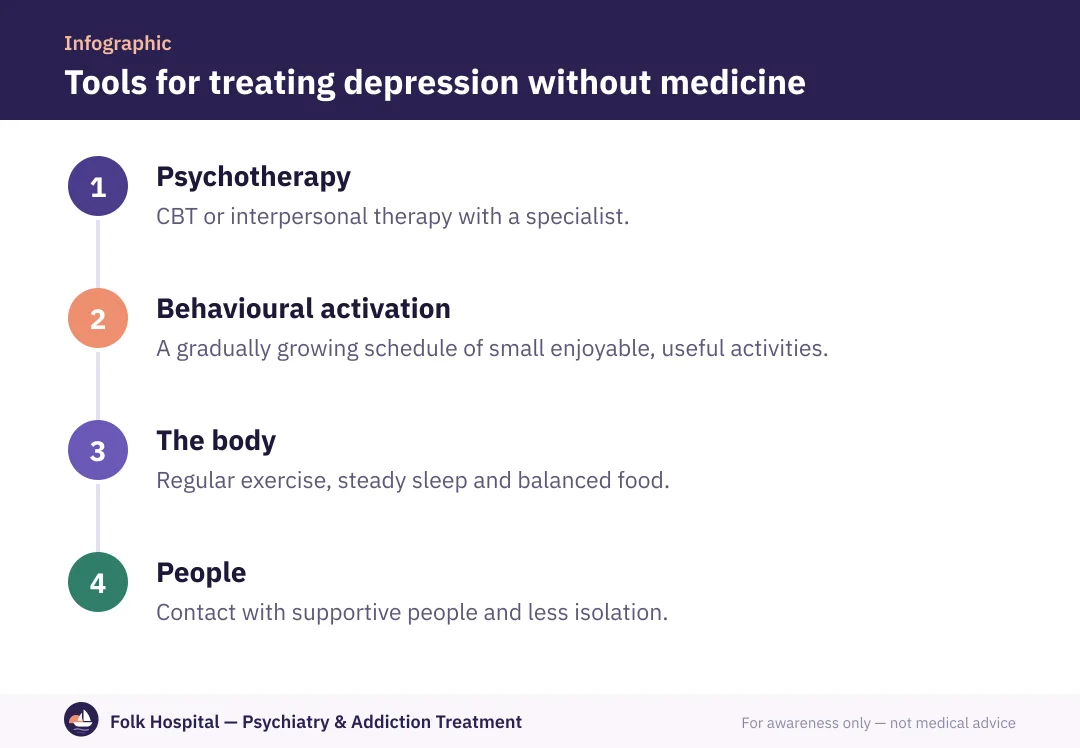
| Option | How it helps |
|---|---|
| Cognitive behavioural therapy | Changing negative thoughts |
| Behavioural activation | Gradually returning to enjoyable, useful activities |
| Interpersonal therapy | Improving relationships and resolving conflicts |
| Physical activity | Improving mood, energy and sleep |
| Regular sleep | Stabilising mood |
| Social support | Reducing isolation |
02A simple weekly plan
- A small daily activitya 20 to 30 minute walk.
- Something enjoyableeven briefly.
- Connectiona call or meeting with someone close.
- Regular sleepa fixed wake-up time.
- No substanceskeeping away from alcohol and drugs.
03When isn't non-medication treatment enough?
Usually enough
- Mild depression.
- Recent symptoms.
- Still able to work and function.
Usually needs medication
- Severe depression.
- Suicidal thoughts.
- Psychosis.
- No improvement after adequate therapy.
- Suicidal thoughts or plans, or self-harm.
Mental health hotline 08008880700; ambulance 123.
Ambulance: 123Read depression treatment, antidepressants and psychological therapies.
؟Frequently asked questions
Can depression be treated without medication?
Yes, in mild and some moderate cases, with psychotherapy, activity, regular sleep and social support.
What's the best psychotherapy for depression?
CBT, behavioural activation and interpersonal therapy are among the most effective.
Does exercise treat depression?
Regular physical activity clearly improves mood and is a useful part of treatment, especially in mild cases.
Do herbs treat depression?
Some herbs have limited evidence and may interact with other medicines, so don't use them without advice.
When do I need medication?
In moderate to severe depression, with suicidal thoughts, psychosis, or no improvement with psychotherapy.
Can I stop medication and rely on therapy?
Only with a gradual taper under the doctor's supervision after a sufficient period of stability.
Sources and references
- Depressive disorder (depression) — fact sheet — World Health Organization
- Depression — National Institute of Mental Health (NIMH)
- Psychotherapies — National Institute of Mental Health (NIMH)

A psychiatrist specialising in addiction and mental illness in adults and adolescents, with a focus on dual diagnosis.
For awareness only — not a substitute for medical advice. Editorial policy · View profile