01How a session works
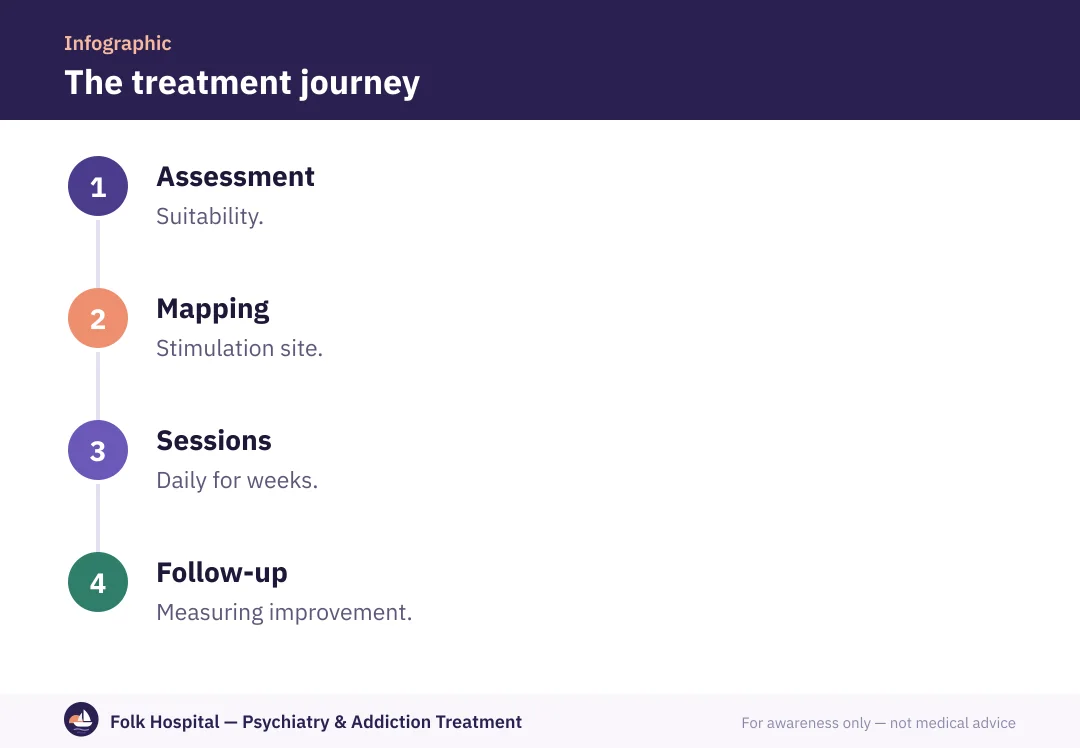
- Assessmentconfirming suitability and no metal in the head.
- Positioningsetting the coil over the target area.
- The sessionthe patient sits awake.
- Afterwardsreturning to activity right away.
- Repetitionregular sessions over weeks.
02Who it suits and who it doesn't
Usually unsuitable
- Metal or implanted devices in the head.
- Some cases of epilepsy.
Usually suitable
- Depression not responding to medication.
- People who can't tolerate medication side effects.
| TMS | ECT | |
|---|---|---|
| Anaesthesia | No | Yes |
| Memory | Usually unaffected | Possible temporary disturbance |
| Speed | Slower | Faster |
Read psychiatric therapies and the psychiatric hospital. Also read ECT and depression.
؟Frequently asked questions
What is TMS?
A non-invasive treatment using a magnetic field to stimulate brain areas linked to mood.
Is it painful?
No. The patient may feel light tapping or scalp discomfort.
Who is it for?
Mainly depression that hasn't responded to adequate medication trials.
What are the side effects?
Mild headache and scalp discomfort; seizures are very rare.
Does it affect memory?
It usually doesn't cause memory disturbance.
Does it replace medication?
It's usually used alongside existing treatment; the decision is made with the doctor.
Sources and references
- Brain Stimulation Therapies — National Institute of Mental Health (NIMH)
- Depression — National Institute of Mental Health (NIMH)

Written byDr. Mahmoud ElsawyConsultant in psychiatry and addiction treatment
A psychiatrist specialising in addiction and mental illness in adults and adolescents, with a focus on dual diagnosis.
For awareness only — not a substitute for medical advice. Editorial policy · View profile