01Fact and myth
Myths
- Painful and violent.
- Punishment for the patient.
- Wipes memory permanently.
Facts
- Under general anaesthesia.
- A medical treatment with consent.
- Usually temporary memory disturbance.
02How a session works
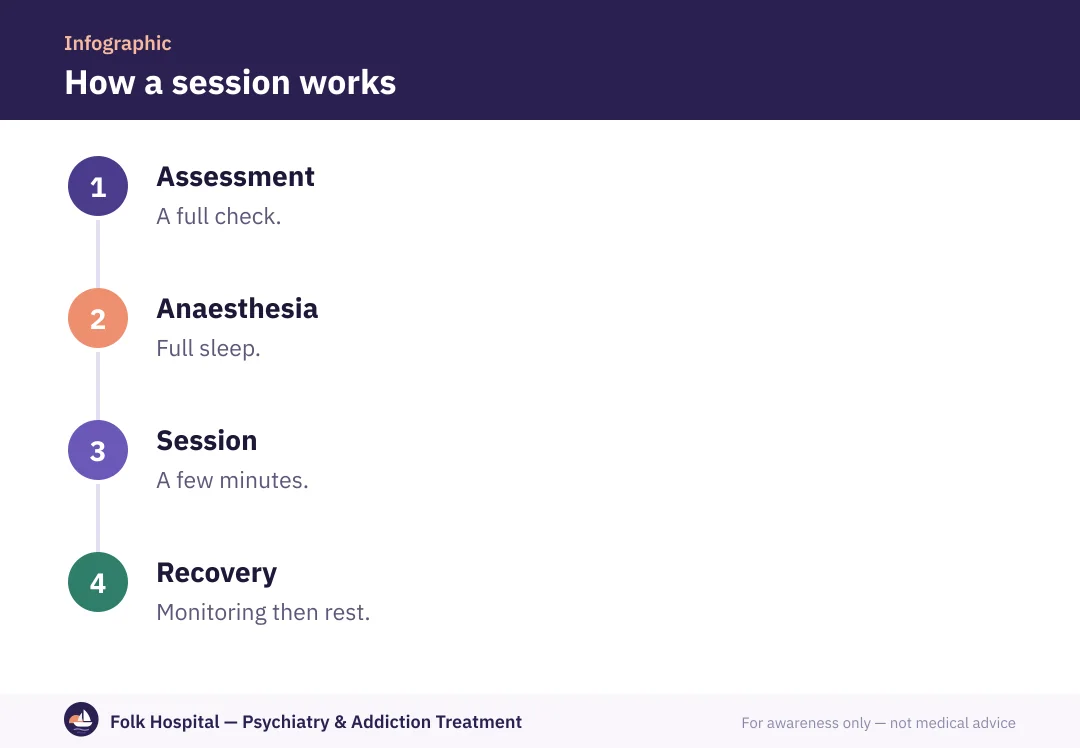
- Assessmentmedical exam, blood tests and ECG.
- Fastingbefore the session, as with any anaesthesia.
- Anaesthesia and muscle relaxantunder an anaesthetist.
- Stimulationa few seconds with monitoring.
- Recoverywithin minutes, with follow-up.
03Compared with TMS
| ECT | TMS | |
|---|---|---|
| Anaesthesia | Yes | No |
| Speed of response | Fast | Slower |
| Memory | Possible temporary disturbance | Usually unaffected |
| Cases | Severe and urgent | Moderate and resistant |
Read psychiatric therapies and the psychiatric hospital. Also read TMS and depression.
؟Frequently asked questions
Is ECT painful?
No. It's done under general anaesthesia and the patient feels nothing.
When is it used?
For severe or resistant depression, high suicide risk, catatonia and some cases of mania.
What are the side effects?
Headache and confusion after a session, and temporary memory disturbance that usually improves.
Does it damage the brain?
Studies haven't shown brain damage with the modern method.
How many sessions?
A series of sessions set by the doctor according to response.
Is consent needed?
Yes. Informed consent after explaining benefits, risks and alternatives.
Sources and references
- Brain Stimulation Therapies — National Institute of Mental Health (NIMH)
- Depression — National Institute of Mental Health (NIMH)

Written byDr. Mahmoud ElsawyConsultant in psychiatry and addiction treatment
A psychiatrist specialising in addiction and mental illness in adults and adolescents, with a focus on dual diagnosis.
For awareness only — not a substitute for medical advice. Editorial policy · View profile