01The main harms
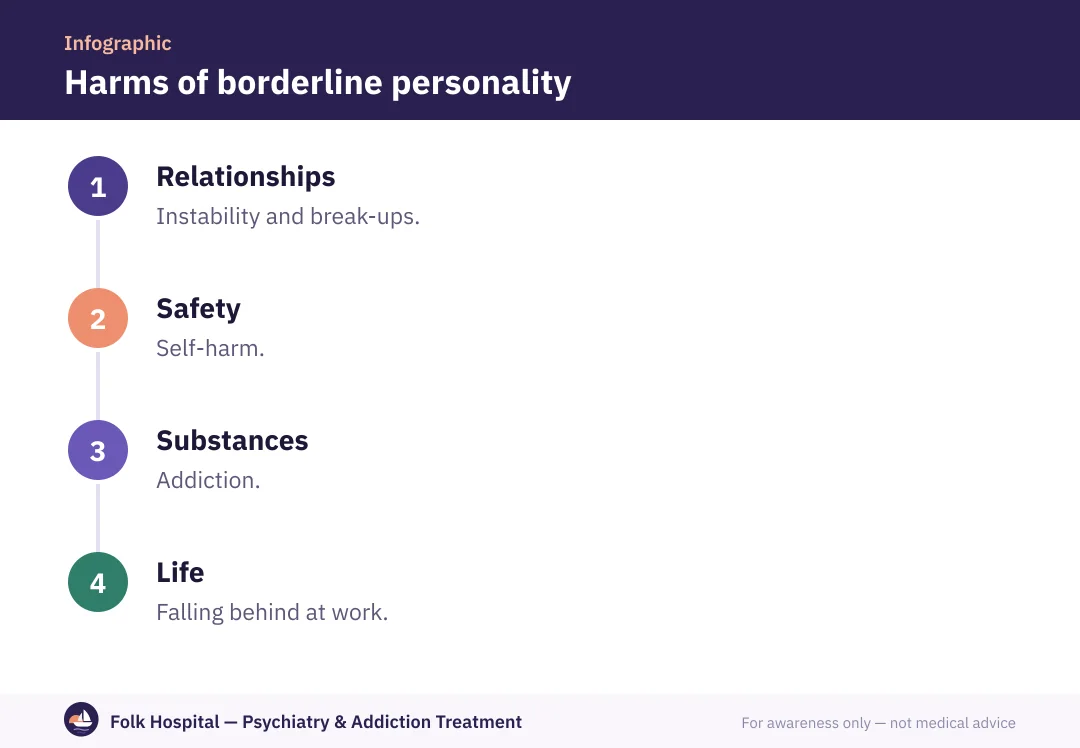
| Area | Possible harm |
|---|---|
| Life | Self-harm and suicide attempts |
| Relationships | Repeated breakdowns, jealousy and conflict |
| Work and study | Frequent changes, difficulty sticking with things |
| Substances | Addiction to alcohol, sedatives or others |
| Mental health | Depression, anxiety, eating disorders |
| Impulsivity | Debts, risky relationships, reckless driving |
02The effect on those around them
What family and partners may experience
- Constant fear for the person.
- Exhaustion from repeated crises.
- A sense of walking on eggshells.
- Confusion between love and anger.
Read supporting a mentally ill relative.
- Suicidal thoughts or plans, or self-harm.
- Taking a large dose of a medicine or substance.
- Intense anger with risk to self or others.
Mental health hotline: 08008880700.
Ambulance: 12303Treatment reduces the harms
- Safety firsta clear crisis plan and reducing means of harm.
- Dialectical behaviour therapyskills for emotion regulation, distress tolerance and relationships.
- Treating co-occurring problemsdepression, addiction and eating disorders.
- Involving the familyto understand the disorder and reduce conflict.
Read borderline personality, dialectical behaviour therapy and suicidal thoughts.
؟Frequently asked questions
What are the most serious harms?
Self-harm and suicide attempts, so any talk of death must be taken seriously and help sought.
Does BPD cause addiction?
It raises the risk, because substances are used to relieve emotional pain and emptiness.
Can someone with BPD succeed at work?
Yes, especially with treatment, though early instability may cause frequent changes.
How does it affect relationships?
Through swinging between intense closeness and rejection, jealousy and fear of abandonment, which exhausts both sides.
Does it come with other disorders?
Often: depression, anxiety, PTSD, eating disorders and addiction.
Does it improve with treatment?
Yes. Many patients improve clearly, self-harm reduces and relationships stabilise over time.
Sources and references
- Borderline Personality Disorder — National Institute of Mental Health (NIMH)
- Personality disorder — NHS (UK)
- Psychotherapies — National Institute of Mental Health (NIMH)

A psychiatrist specialising in addiction and mental illness in adults and adolescents, with a focus on dual diagnosis.
For awareness only — not a substitute for medical advice. Editorial policy · View profile