01A direct comparison
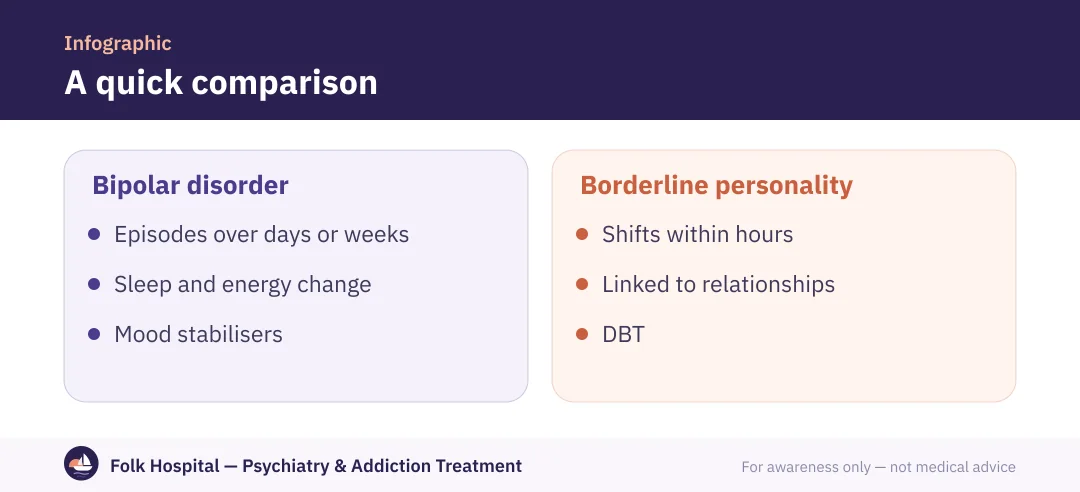
| Aspect | Bipolar disorder | Borderline personality |
|---|---|---|
| Length of mood shift | Days to weeks | Hours |
| Trigger | May come without clear reason | Usually a relationship or fear of abandonment |
| Sleep and energy | Change clearly in episodes | Don't usually change in the same pattern |
| Between episodes | Usually stable | An ongoing pattern in relationships and self-image |
| Self-image | Usually stable outside episodes | Unstable |
| Self-harm | Less common as a repeated pattern | More common as a way to relieve pain |
| Main treatment | Mood stabilisers | Dialectical behaviour therapy |
02Signs pointing to each
Point to bipolar disorder
- Long periods of high energy and little sleep.
- Depressive episodes lasting weeks.
- A family history of bipolar disorder.
- Return to normal between episodes.
Point to borderline personality
- Rapid shifts tied to relationships.
- Intense fear of abandonment.
- A chronic sense of emptiness.
- Intense, unstable relationships.
- Suicidal thoughts or self-harm.
- Severe mania with risky decisions.
Hotline 08008880700; ambulance 123.
Ambulance: 123Read bipolar disorder, borderline personality, dialectical behaviour therapy and mood swings.
؟Frequently asked questions
What's the difference between bipolar disorder and borderline personality?
Bipolar disorder means mood episodes lasting days or weeks with changes in sleep and energy; borderline means rapid relationship-linked shifts with an unstable self-image.
Can they occur together?
Yes, in some people, which needs a treatment plan addressing both.
Which is treated with medication?
Bipolar disorder relies mainly on mood stabilisers; borderline relies mainly on psychotherapy such as DBT, with medicines for specific symptoms.
Why are they confused?
Both involve mood swings, impulsivity and sometimes suicidal thoughts.
Is borderline a mood disorder?
No. It's a personality disorder affecting relationships, self-image and emotion regulation; its shifts are usually reactions to events.
How does the doctor decide?
Through a detailed history of how long shifts last, sleep and energy, relationship patterns, and follow-up over time.
Sources and references
- Bipolar Disorder — National Institute of Mental Health (NIMH)
- Bipolar disorder — fact sheet — World Health Organization
- Borderline Personality Disorder — National Institute of Mental Health (NIMH)

A psychiatrist specialising in addiction and mental illness in adults and adolescents, with a focus on dual diagnosis.
For awareness only — not a substitute for medical advice. Editorial policy · View profile