01Steps in diagnosis
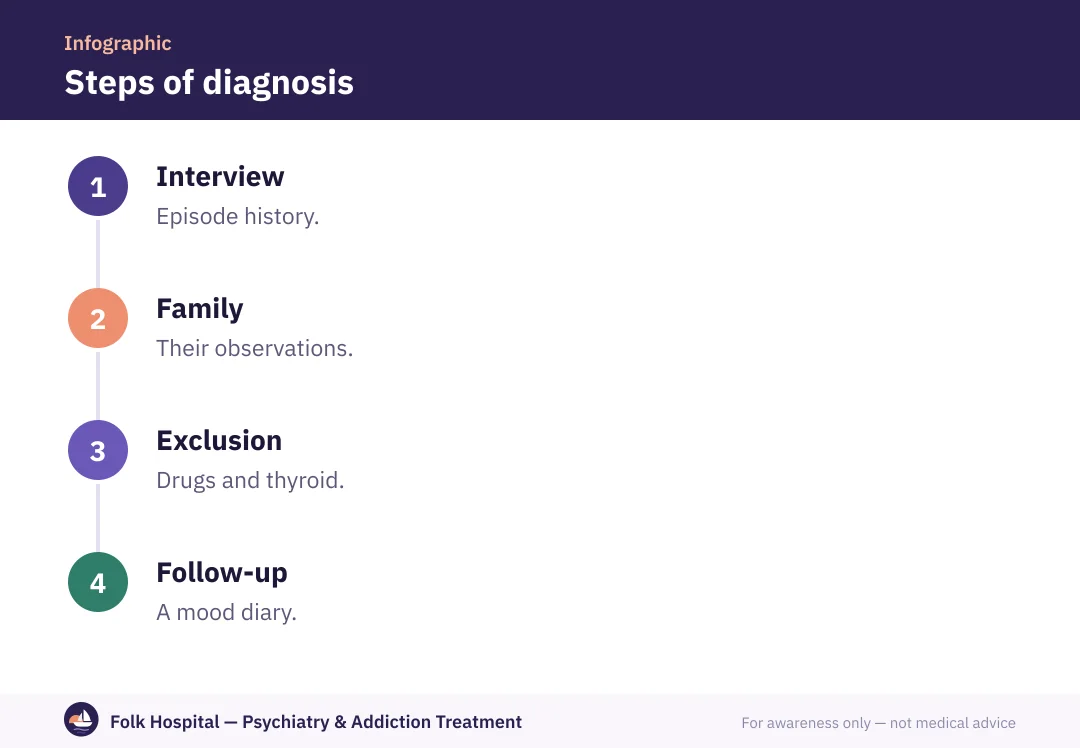
- Psychiatric interviewcurrent symptoms, past episodes, their length and impact.
- History from familyperiods of high energy or odd decisions they noticed.
- Family historyrelatives with bipolar disorder, depression or suicide.
- Substances and medicinesstimulants, hashish, steroids or antidepressants.
- Teststhyroid, a drug screen and sometimes others.
- Follow-upobserving the pattern of episodes to confirm the diagnosis.
02Questions the doctor asks
Questions about hypomania
- Have you had days when you needed much less sleep without feeling tired?
- Were you talking faster or starting lots of projects?
- Did you spend a lot of money or make hasty decisions?
- Did others notice you weren't your usual self?
03Conditions that can be confused with bipolar disorder
| Condition | What distinguishes it |
|---|---|
| Depression | No manic or hypomanic episodes |
| Borderline personality | Rapid shifts within hours linked to relationships |
| ADHD | Ongoing distractibility and impulsivity since childhood, without episodes |
| Schizoaffective disorder | Ongoing psychosis even without mood episodes |
| Substance effects | Episodes occur only with use |
| Thyroid disease | Improves with thyroid treatment |
- Suicidal thoughts or plans, especially in depressive or mixed episodes.
- Severe mania with days of little sleep and risky decisions.
- Psychosis or agitation with risk to self or others.
Mental health hotline: 08008880700.
Ambulance: 123Read bipolar disorder, bipolar vs borderline and the bipolar test.
؟Frequently asked questions
How is bipolar disorder diagnosed?
Through a detailed psychiatric interview about episodes, their duration and symptoms, information from family, and tests to exclude other causes.
Is there a test for bipolar disorder?
No test diagnoses it, but tests exclude other causes such as thyroid problems and drugs.
Why is diagnosis often delayed?
Patients usually seek help when depressed and don't see hypomania as a problem, so they're diagnosed with depression alone.
Is an online bipolar test enough?
No. It's an aid that flags possible illness; diagnosis needs a psychiatrist.
What conditions resemble bipolar disorder?
Borderline personality disorder, ADHD, depression, schizoaffective disorder, drug effects and thyroid disease.
Does diagnosis take time?
Sometimes, especially at a first episode; the doctor confirms it through follow-up and observing the pattern of episodes.
Sources and references
- Bipolar Disorder — National Institute of Mental Health (NIMH)
- Bipolar disorder — fact sheet — World Health Organization

A psychiatrist specialising in addiction and mental illness in adults and adolescents, with a focus on dual diagnosis.
For awareness only — not a substitute for medical advice. Editorial policy · View profile