01When is treatment without consent allowed?
Treatment without the patient's consent is an exception medicine turns to when refusing treatment is itself a danger to the patient's life or others'. In Egypt, the Mental Health Care Law sets out these situations and their procedures, chiefly:
Situations that may call for admission without consent
- Threats or attempts to self-harm.
- Violence or danger to the family or others.
- Psychosis or loss of contact with reality.
- Severe health deterioration with refusal of any treatment.
It happens on a medical decision after assessment, with safeguards including regular review, the patient's right to appeal, and the family being informed of every step.
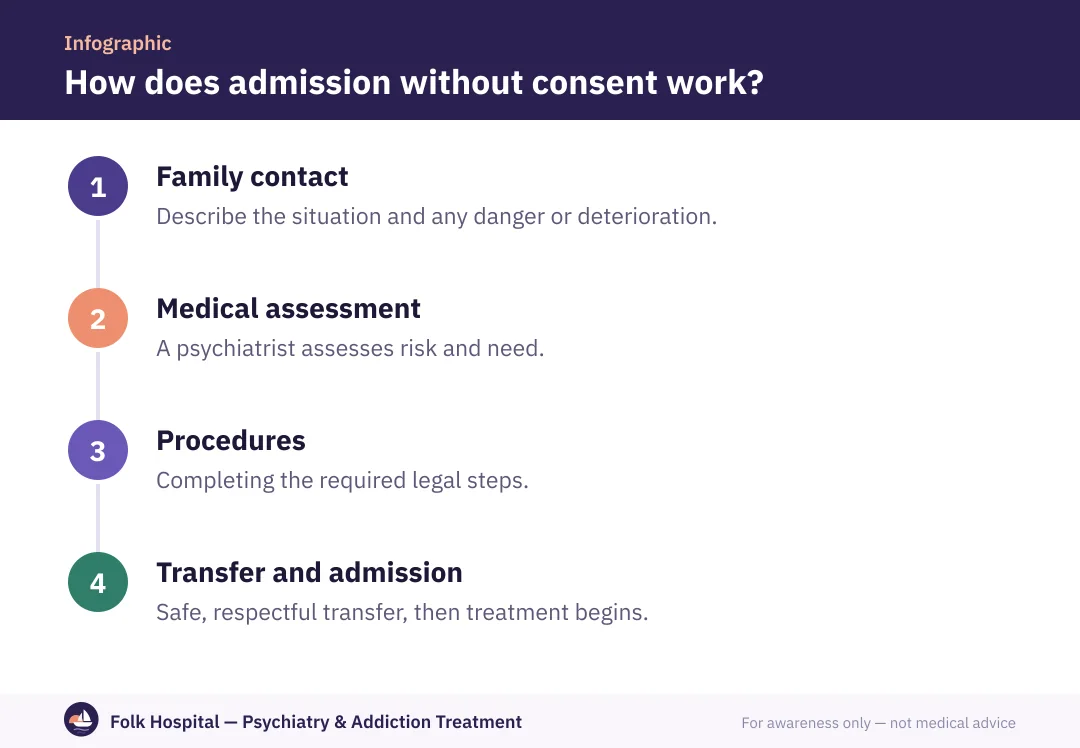
02Another route: family requests under the narcotics law
The narcotics law also allows a spouse, parents or children to apply for the person's treatment through the competent committee, without a criminal case being brought, under certain conditions. Read the details in addiction treatment and the law in Egypt.
03What should the family do first?
Before considering admission without consent, try steps to persuade and structured family intervention. If danger is present, contact us to assess the situation and decide the best step.
- Choose the momenttalk when they aren't under the influence, somewhere calm.
- Talk about your worry, not their faultsdescribe what you see and feel, without accusation or insult.
- Offer a clear plana set assessment appointment, a known place and a promise of support.
- Get helpfamily counselling teaches more effective approaches, such as the family-training approach known as CRAFT.
- Set boundariesif they refuse, keep clear limits that protect the home without closing the door to treatment.
04Why does the "lock-up" some families try fail?
Some families lock the person up at home or send them to unlicensed places that rely on force. This is dangerous for many reasons: withdrawal without medical care, violence, psychological trauma, and a quick return to using after release with a higher risk of overdose. Read how to choose a treatment centre.
05In immediate danger
- Don't try to control them physically yourself.
- Move away and get children out of harm's way.
- Remove sharp objects if you can do so safely.
Call an ambulance on 123 or the police on 122.
Ambulance: 12306Does involuntary treatment work?
Many people believe treatment only works if "the patient wants it". In reality, many patients enter treatment under pressure from family, work or the law, then change their attitude as the drug wears off and trust with the team grows. Motivation is built during treatment, and motivational interviewing is designed for exactly that. But respecting the patient's dignity and rights is essential for that change.
؟Frequently asked questions
Can my son be admitted to hospital against his will?
In specific situations set out in law, such as serious danger to himself or others or severe deterioration with refusal of treatment, on a medical decision and with clear procedures. Otherwise, start with persuasion and family counselling.
Does treatment work if it starts without the patient wanting it?
Many patients start treatment under pressure, then change their attitude as the drug wears off and trust with the team grows. Motivation can be built during treatment, and that's part of the therapist's job.
Are locking up or restraint used?
We use restrictive measures only when absolutely necessary, for the shortest time and on a documented medical decision. Any place that relies on locking up and beating as treatment should be avoided.
What should I do if he threatens violence?
Your safety and the children's come first: move away, don't try to control him physically, and call an ambulance on 123 or police on 122.
Sources and references
- قانون رقم 182 لسنة 1960 في شأن مكافحة المخدرات (النص وفق آخر تعديل) — Egyptian law text
- Mental disorders — fact sheet — World Health Organization
- Treatment Approaches for Drug Addiction — DrugFacts — National Institute on Drug Abuse (NIDA)

A psychiatrist specialising in addiction and mental illness in adults and adolescents, with a focus on dual diagnosis.
For awareness only — not a substitute for medical advice. Editorial policy · View profile