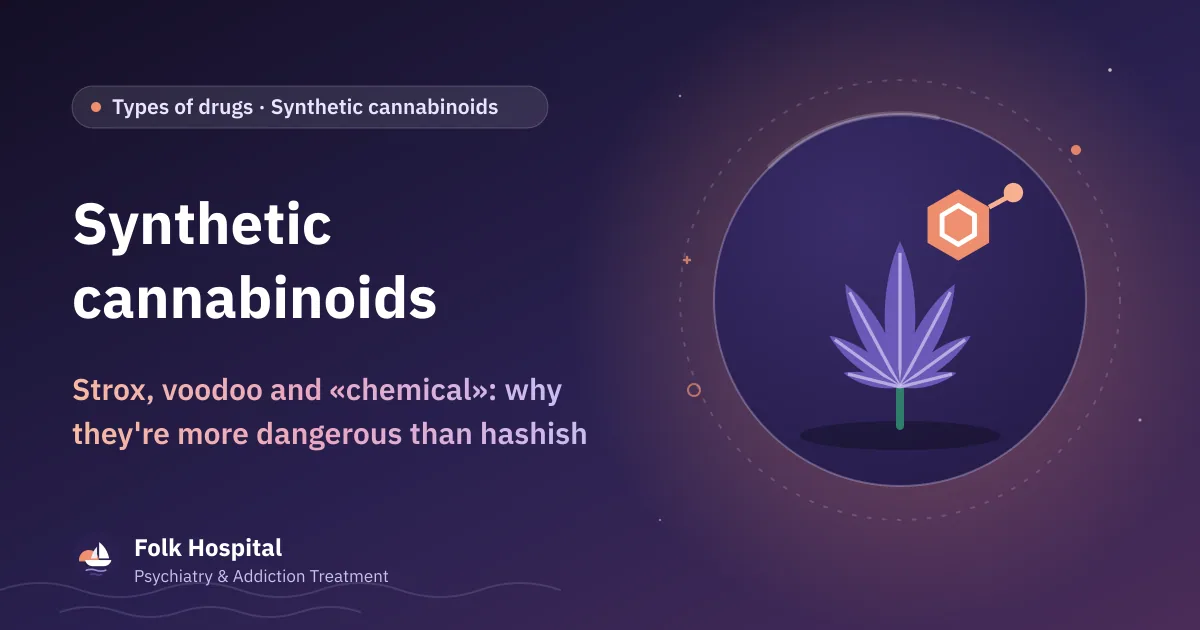
These substances spread because they were cheap and strong and were first believed not to show on tests. Their real price is paid in emergency departments: young people arriving seizing, frozen or severely agitated after «one cigarette». The reason is that the seller doesn't know what was sprayed on the herbs, or how much.
01How do synthetic cannabinoids affect the brain?
These chemicals bind to the brain's CB1 receptors like THC, but many are «full agonists» that switch the receptor on to the maximum, whereas THC is a «partial agonist». The result is a stronger, less predictable effect, including disrupted electrical activity in the brain (seizures), heart rhythm problems and overheating. The compounds keep changing to get around the law, so new chemicals with unknown effects appear regularly.
02The best-known substances in this group
| Substance | Common form | What sets it apart |
|---|---|---|
| Strox | Sprayed herbs, smoked | The best known in Egypt; causes freezing and seizures |
| Voodoo | Sprayed herbs | Another brand name for similar mixtures |
| «Chemical» (kemia) | Herbs or powder | A general street name for unknown synthetics |
03Signs you may notice in someone using them
Common signs
- Freezing in one position or a fixed stare.
- Sudden agitation or aggression.
- Vomiting, sweating and palpitations.
- Incoherent speech and confusion.
- Seizures.
- Packets of herbs with colourful brand names.
04Health and mental-health risks
- Seizures and loss of consciousness.
- Heart rhythm problems and heart attacks in healthy young people.
- Acute kidney injury.
- Acute psychosis that can last days or longer.
- Suicidal thoughts and violent behaviour.
- Rapid dependence and unpleasant withdrawal.
- Seizures or loss of consciousness.
- Chest pain or severe palpitations.
- High temperature with agitation.
- Prolonged freezing with no response.
Put the person on their side away from sharp objects, don't put anything in their mouth, and tell the paramedics the substance's name if you know it.
Ambulance: 12305What is withdrawal like?
Withdrawal resembles cannabis withdrawal but can be harsher: irritability, insomnia, anxiety and poor appetite, sometimes with palpitations and sweating. It starts within a day or two and usually eases within one to two weeks.
- Days 1–2anxiety, irritability, insomnia and cravings.
- Days 3–7the peak, possibly with sweating, palpitations and mood swings.
- After the first weekgradual improvement, with monitoring for any psychosis or depression.
06How does treatment differ?
Treatment starts by assessing the heart, kidneys and mental state, because complications can be physical. Withdrawal is then managed by treating insomnia and anxiety, any psychotic symptoms are treated, and psychological and family rehabilitation continues. Read strox addiction treatment and strox symptoms.
07Read also
؟Frequently asked questions
Is strox the same as hashish?
No. Strox is manufactured chemicals sprayed on herbs that act on cannabis receptors far more strongly, so its effects and dangers are different and more severe.
Why do people freeze on strox?
The strong effect on the brain can cause a rigid, detached state; sometimes freezing is a sign of a seizure or acute psychosis needing emergency care.
Does strox show up on a drug test?
It usually doesn't show on a standard cannabis strip and needs specialist tests, and even these may miss newer compounds.
Are synthetic cannabinoids legal?
No. The law criminalises them and their compounds are added to drug schedules, but dealers keep changing the formula.
Can a single strox cigarette kill?
Yes. It can cause seizures, heart rhythm problems or acute kidney injury even the first time, because the strength and substance are unknown.
How long does strox addiction treatment take?
Acute withdrawal passes within one to two weeks, but rehabilitation and follow-up take months, especially if psychotic symptoms appeared.
Sources and references
- Synthetic Cannabinoids (K2/Spice) DrugFacts — National Institute on Drug Abuse (NIDA)
- Drugs, Brains, and Behavior: The Science of Addiction — National Institute on Drug Abuse (NIDA)
- Commonly Used Drugs Charts — National Institute on Drug Abuse (NIDA)

A psychiatrist specialising in addiction and mental illness in adults and adolescents, with a focus on dual diagnosis.
For awareness only — not a substitute for medical advice. Editorial policy · View profile