01What exactly is «chemical»?
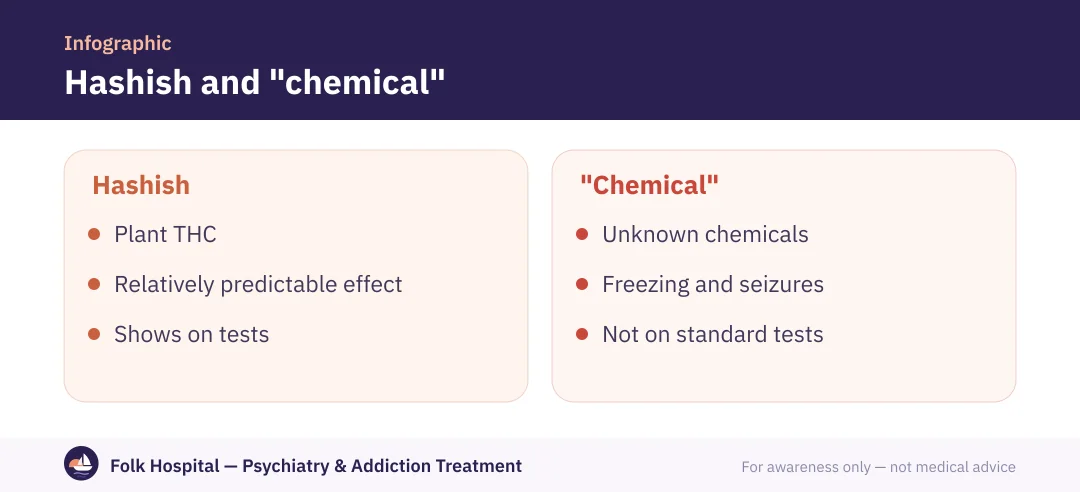
On the street, «chemical hashish» or simply «chemical» means hashish or bango sprayed with a chemical liquid to make it «stronger». That liquid is in fact synthetic cannabinoids, the same family as strox and voodoo. The problem is that the seller doesn't know the compound or its strength, so two pieces from the same source can differ greatly.
02Why is it more dangerous than hashish?
| Natural hashish | «Chemical» | |
|---|---|---|
| Active substance | THC from the plant | Changing lab compounds |
| Strength at receptors | Partial | Full and far stronger |
| Seizures | Very rare | Possible, even the first time |
| Shows on standard tests | Usually | Usually not |
| Speed of dependence | Moderate | Faster, with harsher withdrawal |
03Symptoms after use
Common symptoms
- «Freezing»: stuck in one position with a fixed stare.
- A panic attack and intense fear of dying.
- Palpitations, sweating, nausea and vomiting.
- Confusion and incoherent speech.
- Hallucinations, or suspicion and aggression.
- Seizures or unconsciousness in severe cases.
- Seizures or loss of consciousness.
- Chest pain or severe palpitations.
- Prolonged freezing with no response.
- Severe agitation with a risk of harm.
Put the person on their side away from sharp objects, don't put anything in their mouth, and tell the paramedics they took «chemical».
Ambulance: 12304Harms with repeated use
- Rapid dependence and strong cravings.
- Panic attacks and ongoing anxiety, even after stopping.
- Psychosis that may persist and need psychiatric treatment.
- Kidney injury and heart rhythm disturbances.
- Decline in study, work and relationships.
05Does «chemical» show on a test?
Rapid urine tests look for THC, while «chemical» compounds are chemically different, so the result may be negative despite use. Specialist tests for synthetic cannabinoids exist but may miss newer compounds. Read drug testing.
06How is it treated?
- Assessmentheart and kidney checks, and a psychiatric assessment for panic, psychosis or suicidal thoughts.
- Managing withdrawaltreating insomnia, anxiety and irritability during the first two weeks.
- Treating psychological symptomsif psychosis or persistent anxiety is present.
- Rehabilitationcognitive behavioural therapy, family work and a relapse-prevention plan.
Details in strox addiction treatment, as the plan is similar.
؟Frequently asked questions
What is «chemical»?
A street name for herbs or hashish sprayed with lab-made synthetic cannabinoids, which act on the brain's cannabis receptors far more strongly than natural hashish.
What's the difference between «chemical» and strox?
Both are synthetic cannabinoids; the difference is mostly the name and how they're sold. Strox is usually sold as herbs in packets, while «chemical» may be sold as boosted hashish.
How can I tell if hashish has been sprayed?
You can't be sure by look or smell. Symptoms such as freezing, intense panic, seizures and palpitations suggest it.
Does «chemical» show up on a drug test?
It usually doesn't show on a standard cannabis strip and needs specialist tests, and even these may miss some compounds.
Can «chemical» cause madness?
It can cause acute psychosis with hallucinations, suspicion and aggression, which may last days or longer, especially in those predisposed.
How is it treated?
With a medical assessment of the heart, kidneys and mental state, then managing withdrawal and symptoms, then psychological rehabilitation and follow-up, as with strox.
Sources and references
- Synthetic Cannabinoids (K2/Spice) DrugFacts — National Institute on Drug Abuse (NIDA)
- Drugs, Brains, and Behavior: The Science of Addiction — National Institute on Drug Abuse (NIDA)
- Commonly Used Drugs Charts — National Institute on Drug Abuse (NIDA)

A psychiatrist specialising in addiction and mental illness in adults and adolescents, with a focus on dual diagnosis.
For awareness only — not a substitute for medical advice. Editorial policy · View profile