01Why does tramadol need a specific treatment plan?
Because its withdrawal is twofold, because the doses sold on the street are high and uncertain, and because seizure risk is real. So we don't treat it like any painkiller, or like any other opioid.
Tramadol works in two ways at once: it acts on opioid receptors like morphine, and raises serotonin and noradrenaline in the brain like some antidepressants. That's why many people at first feel energetic, in a better mood and able to work long hours, not just pain relief. And that's what makes stopping hard: the person doesn't only lose a painkiller but the "energy" and "mood" they came to rely on.
02Why do so many people start tramadol?
Understanding why it started is part of treatment, because the reason often returns after stopping:
- Long working hours: drivers, labourers and tradespeople use it to push through exhaustion.
- Sexual performance: a common belief that it delays ejaculation, so it starts as an experiment and becomes dependence.
- Genuine pain: an injury or chronic back pain, on prescription at first, then at rising doses.
- Escaping difficult feelings: depression, anxiety or financial and family pressure.
- Friends and surroundings: its spread in some circles makes it seem "normal".
Read more in causes of tramadol addiction.
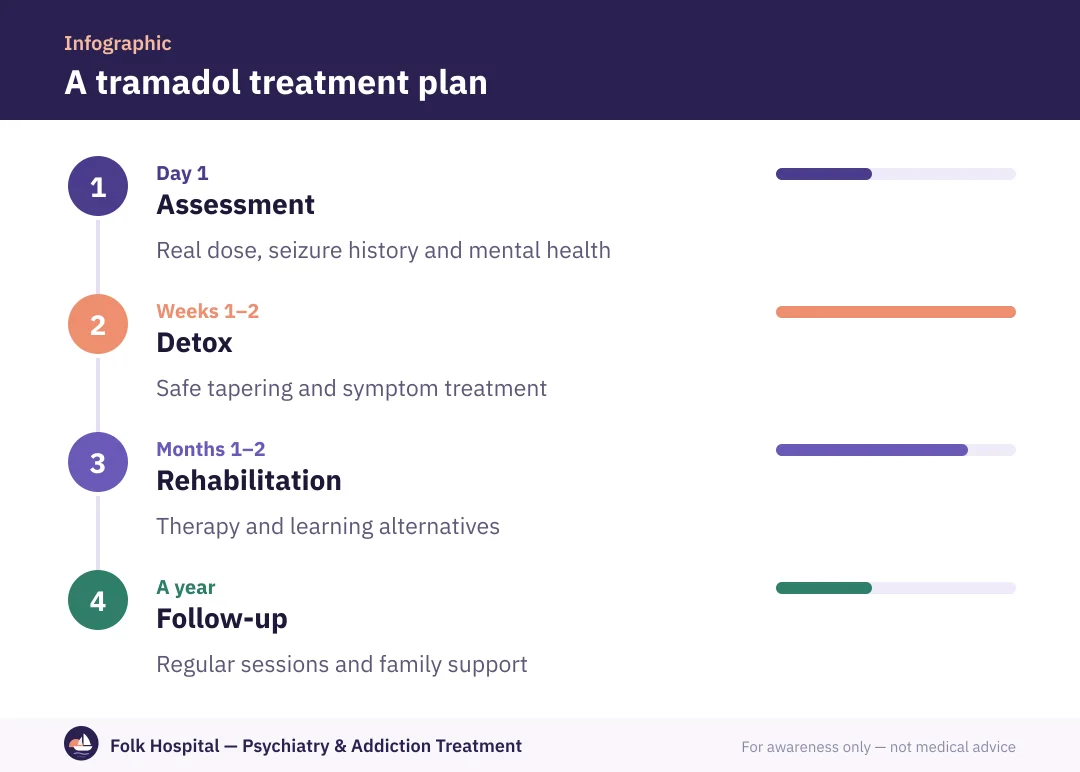
03What are the stages of tramadol treatment?
- Assessmentthe number and strength of tablets, other drugs used, any past seizures, mental state, and liver and kidney function.
- Detoxa gradual taper or a temporary substitute chosen by the doctor, with medicines for symptoms, sleep and anxiety, and seizure protection where needed. See tramadol withdrawal.
- Rehabilitationcognitive behavioural therapy for thoughts like "I can't work without it", plus training to manage stress, energy and sleep.
- Treating what lies behind itdepression, anxiety, chronic pain or sexual problems that started the use.
- Follow-upregular sessions and a family programme to prevent relapse.
04Tramadol withdrawal: the opioid side and the psychological side
| Type | Symptoms | How we manage them |
|---|---|---|
| Opioid symptoms | Bone and muscle pain, runny nose, sweating, diarrhoea, insomnia | Symptom medicines, fluids, and a gradual taper where needed |
| Serotonin-related symptoms | Severe anxiety, panic attacks, tingling, dizziness, mood swings, sometimes confusion or hallucinations | Close psychiatric monitoring, treating anxiety and reassessing mental state |
| Protracted symptoms | Insomnia, low energy, low mood, intermittent cravings | Psychological rehabilitation, sleep regulation, exercise, and treating depression if it persists |
05Protecting the patient from seizures
Seizures are among the most serious risks linked to tramadol, especially with:
- High doses far above medical limits.
- Mixing with antidepressants, some sedatives or alcohol.
- A history of seizures, head injury or epilepsy.
So the doctor asks carefully about any previous seizure, sets the pace of detox accordingly and puts protection in place where needed. This is one of the main reasons not to stop high doses suddenly at home. Read about high doses of tramadol.
Dangerous combinations
Mixing tramadol with pregabalin, sedatives or alcohol multiplies the risk of slowed breathing and loss of consciousness, and mixing it with some antidepressants can cause serotonin syndrome: fever, tremor, racing heart and confusion. Any of these signs needs emergency care immediately.
06Medication after detox
Not every patient needs long-term medication. But people who used very high doses or have relapsed more than once may benefit from approved treatments for opioid use disorder, such as medical substitution or relapse-blocking treatment. Many need treatment for co-existing depression or anxiety, chosen carefully by the doctor because of tramadol's interactions with serotonin medicines. Read opioid addiction treatment.
07Rehabilitation: what exactly do we work on?
- Dependence thoughts: "I can't work without it", "without it I'm not a man", "just one pill".
- Energy and exhaustion: regulating sleep, food and working hours instead of making up for exhaustion with pills.
- Stress and emotions: learning ways to calm down and handle anger and anxiety.
- Relationships and family: repairing trust and involving a wife or family in the plan. See our family programme.
- Returning to work: a gradual plan that protects against one of the riskiest moments, the first days back in the old work setting.
08When there's genuine pain
Someone who started tramadol for chronic pain can't just stop, because the pain will return and push them back. So we set a pain-management plan that includes non-opioid medicines, physiotherapy and exercise, proven psychological techniques for chronic pain, and referral to an orthopaedic or neurology specialist when needed. Read alternatives to tramadol.
09Tramadol and sexual life
Many people stop treatment for fear of how it will affect sexual performance. In fact, long-term tramadol itself causes problems with desire, erection and hormones. After stopping there may be a temporary disturbance that usually improves within weeks to months, and any lasting problem can be treated safely after assessment. Read tramadol and sex.
10How long does tramadol treatment take?
Detox takes one to two weeks, rehabilitation usually four to eight weeks, and follow-up a year. It takes longer with high doses or a co-existing mental health condition.
11Residential or outpatient?
Outpatient care may be enough
- Relatively low doses for a short time.
- No previous seizures and no mixing with other drugs.
- A supportive family and work that allows follow-up.
- No severe depression or thoughts of self-harm.
Residential care is better with
- High doses or years of use.
- Previous seizures, or mixing with pregabalin or sedatives.
- Repeated failed attempts.
- Severe depression or anxiety.
12If you're the wife or mother of someone using tramadol
- Don't treat it as an "ordinary" medicine; dependence on it is an illness that needs treatment.
- Don't buy the tablets to avoid his anger; that prolongs the problem.
- Choose a calm moment to talk, and focus on your worry rather than accusations.
- Start with family counselling. Read how to deal with someone using tramadol.
؟Frequently asked questions
Can tramadol addiction be treated at home?
Mild cases on low doses can sometimes be managed as outpatients with a tapering plan, but high doses, previous seizures or mixing with other drugs call for a residential stay.
I was taking it for back pain. What do I do after stopping?
We set a pain-management plan with non-opioid medicines, physiotherapy and psychological approaches to chronic pain. Read alternatives to tramadol.
Does stopping tramadol cause seizures?
Seizures are linked more to high doses of tramadol itself and to mixing it with other drugs, but the doctor accounts for this risk during detox and uses the necessary protection for anyone with a seizure history.
How long does tramadol withdrawal last?
Symptoms start within 12 to 24 hours, peak between days two and four, and the acute symptoms ease within about a week, while anxiety and insomnia can last weeks.
I use tramadol for sexual performance. Will I be affected after stopping?
Temporary changes in performance or ejaculation timing can occur after stopping and usually improve with time. They can be treated safely after assessment and don't require going back to tramadol. Read tramadol and sex.
Will I need a substitute medicine after detox?
Some patients on very high doses or with repeated relapses benefit from relapse-prevention medication; others don't. The doctor decides after assessment.
Does tramadol show up on a standard drug test?
It doesn't show on every standard rapid test and needs its own test strip. Read how long tramadol stays in the body.
Can I keep working during treatment?
With outpatient care, usually yes. With residential care, work stops for a few weeks, then the patient returns gradually with follow-up.
Sources and references
- Prescription Medicines — research topic — National Institute on Drug Abuse (NIDA)
- Opioids — research topic — National Institute on Drug Abuse (NIDA)
- Guidelines for the psychosocially assisted pharmacological treatment of opioid dependence — World Health Organization
- Drug misuse in over 16s: opioid detoxification (CG52) — National Institute for Health and Care Excellence (NICE)
- Treatment Approaches for Drug Addiction — DrugFacts — National Institute on Drug Abuse (NIDA)

A psychiatrist specialising in addiction and mental illness in adults and adolescents, with a focus on dual diagnosis.
For awareness only — not a substitute for medical advice. Editorial policy · View profile