01LSD: why is its treatment different?
LSD is a powerful hallucinogen that changes perception, thinking and feelings for many hours, usually sold on small squares of paper, which is why it's linked with the name paper. Unlike opioids or alcohol, it doesn't usually cause physical withdrawal, so it doesn't need "detox" in the usual sense. The problem lies in its psychological effects: bad trips, ongoing anxiety, visual disturbances and sometimes psychosis.
02A bad trip: when is emergency care needed?
- Severe panic or an attempt at self-harm.
- Dangerous behaviour or acting without awareness of risk.
- High temperature or seizures, especially with other drugs.
- Complete loss of contact with reality.
Call an ambulance on 123, and keep the person away from heights, roads and sharp objects.
Ambulance: 123In milder cases, a quiet place, soft lighting, a reassuring voice and a trusted person present help until the effect wears off.
03How is it treated?
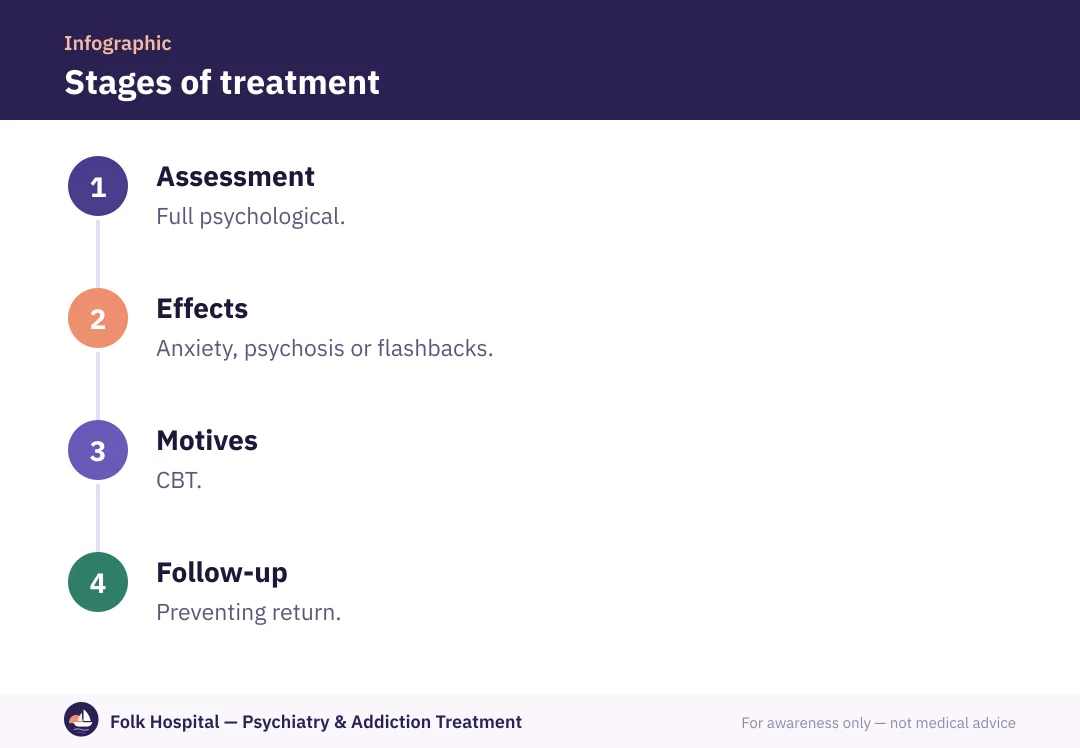
- Psychological assessmentpattern of use, other drugs, any anxiety, depression or psychotic symptoms, and family history of mental illness.
- Treating persistent symptomsanxiety, panic attacks and insomnia, and visual disturbances if present.
- Treating psychosis if it appearsspecialist psychiatric follow-up and medicines when needed.
- Cognitive behavioural therapymotives, curiosity, escaping reality and peer pressure.
- Family and follow-upespecially with teenagers and young adults.
04Visual disturbances after stopping
After stopping, some people experience returning visual effects: halos around objects, moving colours or trails behind moving things. For most these are fleeting, but in a few they persist and cause severe anxiety, a condition called hallucinogen persisting perception disorder. It helps to:
- Stop hallucinogens and cannabis completely.
- Treat the accompanying anxiety, which makes symptoms worse.
- Keep regular sleep and cut down on stimulants.
- Have a medical assessment to choose suitable treatment when needed.
05When LSD reveals a vulnerability to psychosis
In people with a genetic vulnerability or a family history of schizophrenia or bipolar disorder, LSD can trigger a psychotic episode that doesn't end when the effect wears off. These cases need a psychiatrist and long follow-up. Read about drug-induced psychosis and psychosis.
06Residential or outpatient?
Most cases are treated as outpatients. We use a residential stay for psychosis, dangerous behaviour, suicidal thoughts or heavy use of other drugs. See also treatment for blue elephant use.
Read about the harms of LSD.
؟Frequently asked questions
Is LSD addictive?
It doesn't usually cause physical dependence or withdrawal, but some people use it compulsively, and tolerance builds quickly. The greater risk lies in its psychological effects.
What are flashbacks?
A sudden return of some visual effects days, weeks or longer after use, such as halos and moving colours. If they persist and affect daily life, they need assessment and treatment.
What should I do with someone having a bad trip?
Stay calm, move them somewhere safe and quiet with soft lighting, speak reassuringly and don't leave them alone. If there's danger to themselves or others, seizures or high temperature, call an ambulance.
Does LSD cause permanent mental illness?
Not in most people, but in those with a vulnerability to psychosis or a family history it can trigger a psychotic episode that needs treatment and follow-up.
How long does treatment take?
It depends on the problem: sessions for several weeks for anxiety and motives, and longer if psychosis or persistent visual disturbances appear.
Sources and references
- Hallucinogens — research topic — National Institute on Drug Abuse (NIDA)
- Treatment Approaches for Drug Addiction — DrugFacts — National Institute on Drug Abuse (NIDA)
- Co-Occurring Disorders and Health Conditions — National Institute on Drug Abuse (NIDA)
- Drug misuse in over 16s: psychosocial interventions (CG51) — National Institute for Health and Care Excellence (NICE)

A psychiatrist specialising in addiction and mental illness in adults and adolescents, with a focus on dual diagnosis.
For awareness only — not a substitute for medical advice. Editorial policy · View profile