01Ketamine: a medical anaesthetic that's misused
Ketamine is an anaesthetic used in medicine, and more recently at set doses under close supervision for some cases of treatment-resistant depression. But it's misused for the sense of detachment from the body and reality it brings. With repetition, psychological dependence and strong cravings can develop, along with serious physical harm, above all to the bladder.
Read about signs of ketamine use.
02The bladder comes first
Signs that need prompt assessment
Troublesome frequent urination, severe pain or burning, blood in the urine, or lower abdominal pain. These may be signs of ketamine-related bladder inflammation, and the damage can become permanent if use continues. Stopping early is the most important step to protect it.
So the assessment includes a urine test, kidney checks and referral to a urologist when needed. Read about the harms of ketamine.
03How is it treated?
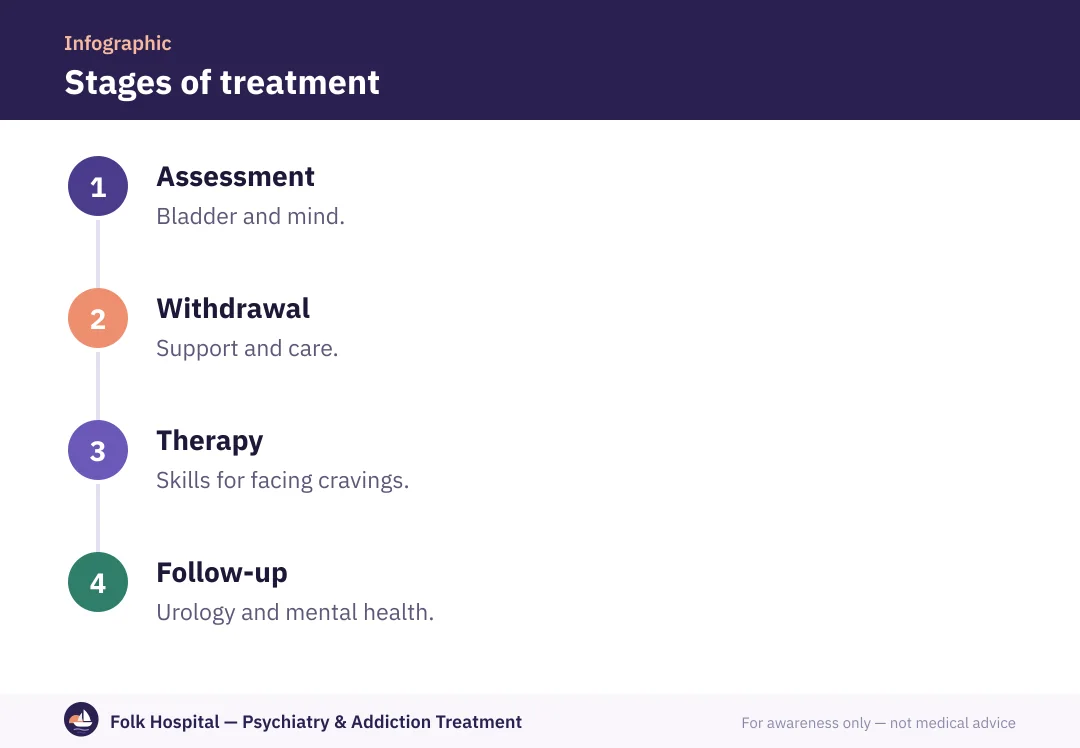
- Medical assessmentbladder, kidneys and liver, pattern of use and other drugs.
- Support through withdrawaltreating insomnia, anxiety and low mood, and monitoring strong cravings.
- Treating depression and anxietymany users started as an escape from difficult feelings.
- Cognitive behavioural therapymotives, triggers and skills for handling cravings.
- Follow-uppsychological sessions, and bladder follow-up if affected.
Read about ketamine withdrawal.
04Withdrawal: what to expect
Ketamine withdrawal is mainly psychological: strong cravings, anxiety, low mood, insomnia, fatigue and poor concentration. It usually doesn't carry physical risks like alcohol or sedatives, but low mood can be severe in some patients, so we watch mood and thoughts carefully.
05Why do people start ketamine?
- Escaping feelings: the detachment feels like relief from sadness, anxiety or trauma.
- Parties and curiosity.
- "Self-treating" depression after hearing it's used medically, which is dangerous because doses and frequency are uncontrolled.
Treating these motives, especially depression and trauma, is key to preventing a return. Read about depersonalisation if a sense of detachment persists after stopping.
06Residential or outpatient?
Outpatient care may be enough
- Occasional use.
- No severe depression.
- Little use of other drugs.
Residential care is better with
- Daily use or overwhelming cravings.
- Severe depression or suicidal thoughts.
- Mixing other drugs or failed previous attempts.
؟Frequently asked questions
What does ketamine have to do with the bladder?
Repeated use can inflame the bladder wall, causing pain, very frequent urination and blood in the urine, and it can progress to permanent damage if use continues.
Does the bladder recover after stopping?
Symptoms improve in many people after stopping, especially if it's early, while advanced cases may need specialist treatment from a urologist.
Ketamine is used to treat depression, so how can it be harmful?
Medical use involves set doses under supervision in a specialist clinic for a defined period; misuse involves repeated, uncontrolled doses, which is where harm and addiction arise.
How long does treatment take?
Usually several weeks to two months of intensive treatment, then follow-up, with medical follow-up of the bladder if affected.
Can treatment be done as an outpatient?
Yes in many cases; daily use, severe depression or mixing other drugs calls for a residential stay.
Sources and references
- Hallucinogens — research topic — National Institute on Drug Abuse (NIDA)
- Treatment Approaches for Drug Addiction — DrugFacts — National Institute on Drug Abuse (NIDA)
- Drug misuse in over 16s: psychosocial interventions (CG51) — National Institute for Health and Care Excellence (NICE)
- Co-Occurring Disorders and Health Conditions — National Institute on Drug Abuse (NIDA)

A psychiatrist specialising in addiction and mental illness in adults and adolescents, with a focus on dual diagnosis.
For awareness only — not a substitute for medical advice. Editorial policy · View profile