01Why is injecting the most dangerous route?
When a drug is snorted or smoked, part of it passes gradually through membranes or the lungs. Injecting puts the full dose into the blood within seconds, leaving no time to back off if the drug is stronger than expected. Every injection also breaks the skin, every shared item passes blood between people, and every adulterated drug carries impurities straight into the blood vessels.
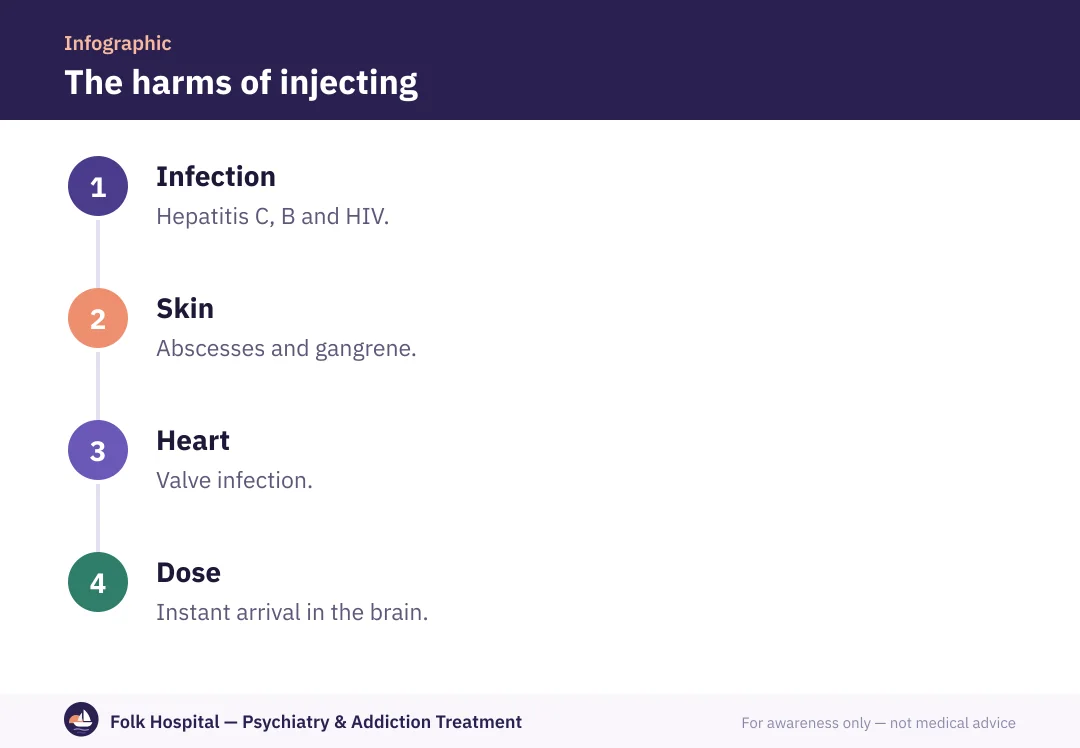
02The harms of injecting
| Harm | How it happens | Signs |
|---|---|---|
| Hepatitis C and B | Sharing needles, spoons, filters and water | Often no symptoms for years, then fatigue and jaundice |
| HIV | Sharing needles | No symptoms at first; found by testing |
| Abscesses and skin infection | Bacteria from skin or equipment | Redness, swelling, heat and pus |
| Vein inflammation and scarring | Repeated injection and impurities | Hard or blocked veins |
| Heart valve infection | Bacteria reaching the heart through the blood | Fever, fatigue, breathlessness and a heart murmur |
| Blood clots | Damaged veins and missed injections | Leg swelling and pain, or sudden breathlessness |
| Gangrene | Injecting into an artery or severe infection | Cold, darkened, painful skin |
03Overdose and injecting
Overdose risk is higher with injecting, especially at three moments: after a period of abstinence, because tolerance has dropped; when the source changes, because purity is unknown and the drug may be cut with fentanyl; and when mixing with sedatives or alcohol. Read overdose.
- No response or slow breathing after injecting.
- Fever with back or chest pain or breathlessness.
- Cold or darkened skin, or severe pain in the injected limb.
- Redness spreading quickly around an injection site with fever.
- Sudden, painful swelling of a leg.
Fever in someone who injects isn't «just flu» until proven otherwise; it may be an infection of the heart or blood.
Ambulance: 12304Hepatitis C: the silent harm
Many people who inject live for years with hepatitis C without knowing, because it's usually symptomless. Over time it can cause liver cirrhosis or cancer. The good news is that modern treatment cures most cases with tablets for a limited period. That's why we test every patient who has injected for blood-borne viruses and refer them for treatment if positive.
05Tests after stopping
- Blood-borne virus testinghepatitis C and B and HIV, even without symptoms.
- Liver functionto gauge any damage.
- Skin and vein examinationto treat abscesses and chronic infections.
- Heart checkif there's fever, a heart murmur or breathlessness.
- Vaccinationagainst hepatitis B if not immune.
06Treatment starts with stopping
Every day without injecting means less chance of infection and overdose. Most people who inject use opioids, which have approved medicines that reduce relapse and death. Read heroin addiction treatment, opioid addiction treatment and body recovery after addiction.
؟Frequently asked questions
What are the most serious harms of injecting?
Overdose, infection with hepatitis viruses and HIV, heart valve infection, deep abscesses and blood clots.
Is hepatitis C treatable?
Yes. Modern medicines cure most cases within weeks to months, which is why testing matters even without symptoms.
Can you be infected without sharing the needle itself?
Yes. Sharing a spoon, filter, water or syringe can transmit hepatitis C, because tiny amounts of blood are enough.
What are the signs of an abscess or skin infection after injecting?
Redness, swelling, heat and pain at the injection site, sometimes pus or fever. It needs prompt medical assessment, especially if redness spreads or the skin darkens.
Do veins recover after stopping?
Some veins improve, but veins that have scarred or blocked may not fully recover. Stopping prevents further damage.
What tests does someone who injected need?
Tests for hepatitis C and B and HIV, liver tests, and sometimes a heart check if there's fever or a heart murmur, plus hepatitis B vaccination if not immune.
Sources and references
- Hepatitis C — fact sheet — World Health Organization
- HIV and AIDS — fact sheet — World Health Organization
- Heroin — research topic — National Institute on Drug Abuse (NIDA)
- Opioid overdose — fact sheet — World Health Organization
- Drugs, Brains, and Behavior: The Science of Addiction — National Institute on Drug Abuse (NIDA)

A psychiatrist specialising in addiction and mental illness in adults and adolescents, with a focus on dual diagnosis.
For awareness only — not a substitute for medical advice. Editorial policy · View profile