01Gabapentin: a nerve medicine that's misused
Gabapentin is prescribed for nerve pain and some types of epilepsy, and belongs to the same family as pregabalin. Although weaker at the same dose, it's misused at high doses and often mixed with opioids to boost their effect or ease their withdrawal. Read about pregabalin versus gabapentin.
Read about causes of gabapentin addiction and its signs.
02How is it treated?
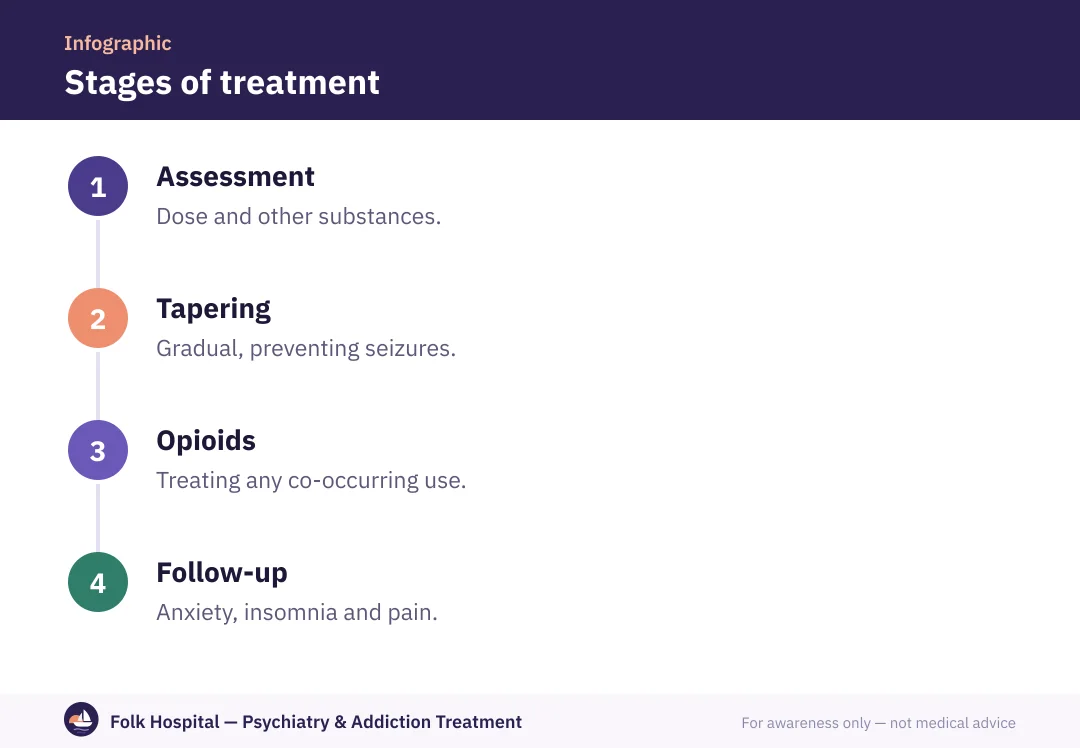
- Assessmentthe real dose, the original reason, kidney function, accompanying opioids or sedatives, and seizure history.
- Gradual taperinga structured reduction that prevents withdrawal and seizures.
- Treating accompanying opioidsif present, with one plan covering both.
- Treating the causenerve pain, anxiety or insomnia by safe means.
- Psychological therapy and follow-upmotives, triggers and relapse prevention.
Read about gabapentin withdrawal.
Mixing with opioids
Gabapentin with tramadol, heroin, methadone or sedatives raises the risk of extreme drowsiness and slowed breathing. Difficulty waking or slow breathing needs an ambulance on 123 immediately. Read opioid addiction treatment.
03Tapering: why slowly?
Stopping high doses suddenly can cause anxiety, insomnia, sweating and nausea, and sometimes seizures. So it's reduced gradually, and the doctor slows down if symptoms intensify. The principles are similar to pregabalin addiction treatment.
04Treating the original cause
- Nerve pain: other medication options, physiotherapy and chronic-pain techniques, with a neurologist.
- Anxiety: cognitive behavioural therapy and non-addictive medicines.
- Insomnia: healthy sleep habits and CBT for insomnia.
05Residential or outpatient?
An outpatient taper usually suits
- Moderate doses from a medical source.
- No opioids or sedatives.
- No previous seizures.
Residential care is better with
- Mixing with opioids or sedatives.
- Very high doses.
- Previous seizures or severe depression.
Read about the harms of gabapentin.
؟Frequently asked questions
What's the difference between gabapentin and pregabalin?
They're from the same family and work similarly, but pregabalin is absorbed faster and has a stronger effect at the same dose. Both can be misused and need gradual tapering.
How long does tapering gabapentin take?
At least a week for therapeutic doses, and weeks for high doses and long-term use, depending on symptoms.
Does it show up on a drug test?
It usually doesn't appear on standard rapid tests and needs a specific test.
I take it for nerve pain. Should I stop?
If it's prescribed and taken at the right dose, there's usually no problem. If the dose has risen or you've started using it for other reasons, talk to your doctor about a plan.
Sources and references
- Prescription Medicines — research topic — National Institute on Drug Abuse (NIDA)
- Treatment Approaches for Drug Addiction — DrugFacts — National Institute on Drug Abuse (NIDA)
- Opioids — research topic — National Institute on Drug Abuse (NIDA)
- Drug misuse in over 16s: psychosocial interventions (CG51) — National Institute for Health and Care Excellence (NICE)

A psychiatrist specialising in addiction and mental illness in adults and adolescents, with a focus on dual diagnosis.
For awareness only — not a substitute for medical advice. Editorial policy · View profile