01What do the two medicines have in common?
Both bind a subunit of calcium channels on nerve cells, reducing the release of some excitatory neurotransmitters. The result is calmer, less overactive nerve signalling, which is why they help nerve pain and epilepsy. Although their names suggest a link with GABA, they don't act on its receptors the way sedatives do.
02A detailed comparison
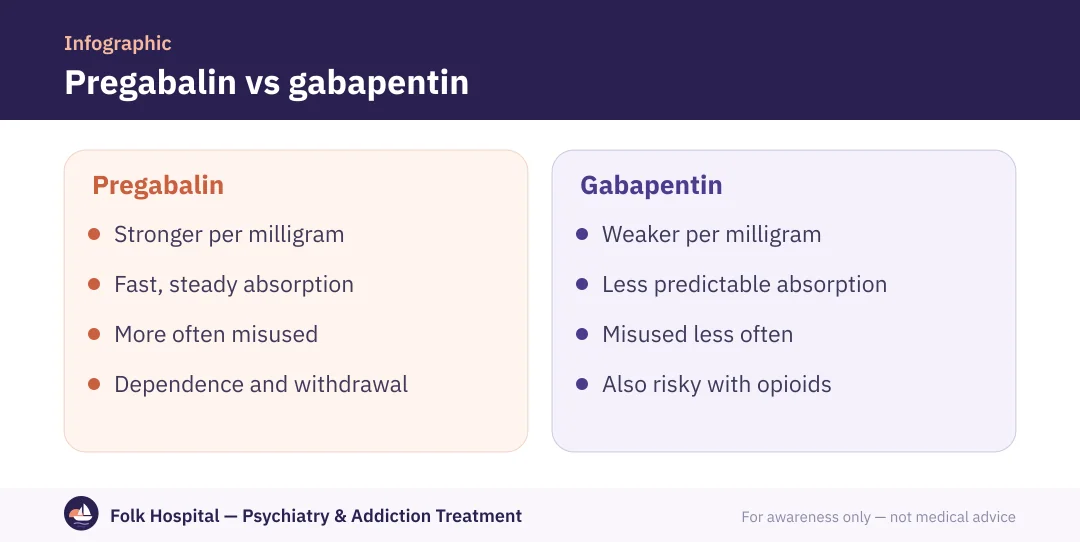
| Aspect | Pregabalin | Gabapentin |
|---|---|---|
| Mechanism | Same calcium-channel target | Almost the same target |
| Strength | Stronger per milligram | Weaker; needs larger doses |
| Absorption | Fast and predictable at all doses | Relatively reduced as dose rises |
| Daily doses | Usually twice | Usually three times |
| Common uses | Nerve pain, epilepsy, generalised anxiety in some countries | Nerve pain, epilepsy |
| Misuse | More common | Relatively less |
| Danger with opioids | Suppressed breathing | Suppressed breathing |
03Why is pregabalin misused more?
Its fast, predictable absorption means high doses give a clear sense of calm and euphoria, while gabapentin's limited absorption blunts the effect of very large doses. That doesn't make gabapentin safe to misuse: it too has been linked to dependence, and to deaths when combined with opioids.
- Deep drowsiness or difficulty waking.
- Slow breathing, especially with tramadol, heroin, sedatives or alcohol.
- Seizures after stopping suddenly.
04Should I switch from one to the other?
A doctor may switch because of side effects or poor response, but this follows a specific schedule because the doses aren't equal. Switching on your own can cause withdrawal or overdose. And if the goal is to break dependence, swapping one medicine for another from the same family doesn't solve the problem. Read pregabalin alternatives and gabapentin.
؟Frequently asked questions
Which is stronger, pregabalin or gabapentin?
Pregabalin is stronger per milligram, needs lower doses for the same effect, and is absorbed more predictably.
Is gabapentin safer than pregabalin?
Gabapentin misuse is less common, but it isn't risk-free: it can cause dependence, drowsiness and dizziness, and mixing it with opioids is dangerous too.
Can one be swapped for the other?
Yes, on a doctor's decision with a specific conversion schedule, because doses aren't equal and absorption differs. Don't switch on your own.
Are both addictive?
Both can cause dependence; the risk is higher with pregabalin, in people with a history of addiction, and with high doses or mixing.
What side effects do they share?
Dizziness, drowsiness, weight gain, swollen feet, blurred vision and poor concentration, increasing at higher doses.
Is either used for anxiety?
Pregabalin is approved for generalised anxiety in some countries; gabapentin isn't an approved anxiety treatment. A psychiatrist decides what suits each case.
Sources and references
- Pregabalin — medicines A to Z — NHS (UK)
- Gabapentin — medicines A to Z — NHS (UK)
- Prescription Medicines — research topic — National Institute on Drug Abuse (NIDA)

A psychiatrist specialising in addiction and mental illness in adults and adolescents, with a focus on dual diagnosis.
For awareness only — not a substitute for medical advice. Editorial policy · View profile