01What is Tourette's syndrome?
A neurological condition that starts in childhood, marked by motor tics such as eye blinking or head jerking and vocal tics such as throat-clearing, sounds or words, lasting more than a year. They increase with stress and tiredness and decrease when focused on an enjoyable activity. Read about the symptoms of Tourette's syndrome.
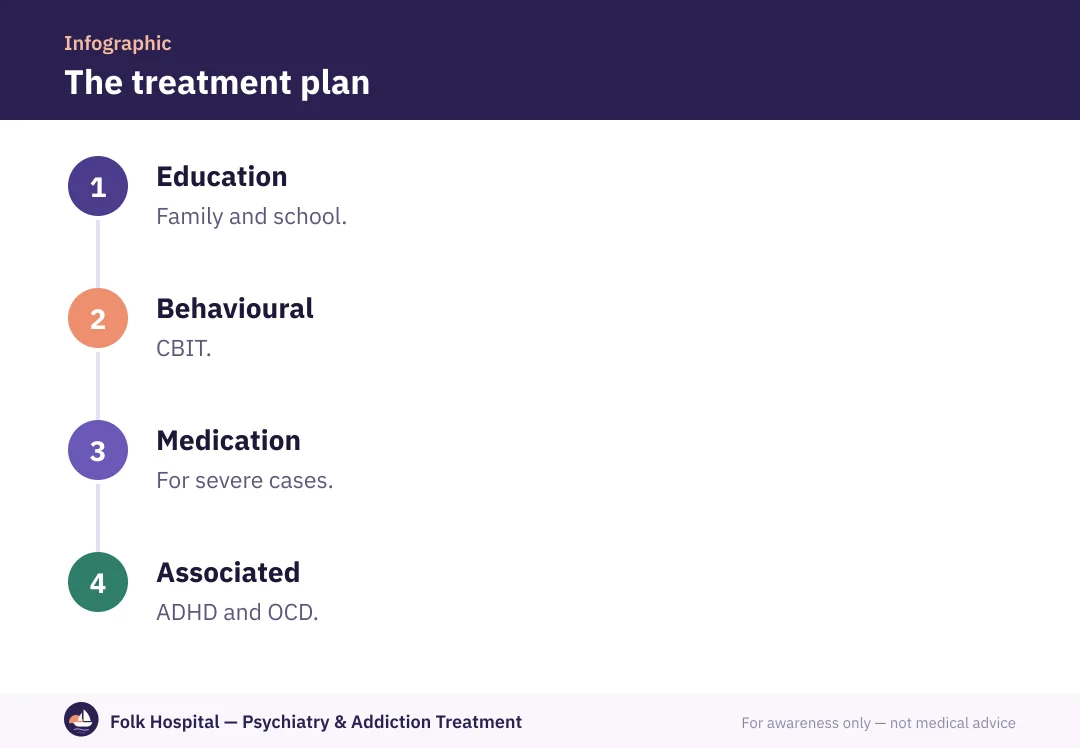
02Steps of treatment
- Educationthe child and family understanding the condition reduces anxiety and embarrassment.
- School supportinforming teachers and classmates, and allowing breaks.
- Comprehensive behavioural intervention for ticslearning to notice the feeling that comes before a tic.
- Habit reversal trainingdoing a competing movement incompatible with the tic when the urge comes.
- Medicines when neededfor severe, painful or disruptive tics.
03When are medicines used?
| Situation | Step |
|---|---|
| Mild tics that don't disrupt life | Education and follow-up without medicine |
| Moderate, bothersome tics | Behavioural therapy first |
| Severe, painful or very embarrassing tics | Prescribed medicines with behavioural therapy |
| Accompanying ADHD or OCD | Treating the co-existing disorder |
04Co-existing conditions
Many children with Tourette's have ADHD, OCD or anxiety. Sometimes these problems affect life more than the tics themselves, so they're treated as part of the plan.
05Tips for the family
- Don't comment on the tics or ask the child to stop them.
- Reduce stress and organise sleep.
- Focus on their strengths and favourite activities.
- Work with the school to support them and prevent bullying.
Read about cognitive behavioural therapy.
؟Frequently asked questions
Does Tourette's syndrome go away?
Tics ease in many people in late adolescence, and almost disappear in some.
Can the child stop the tics?
They may hold them back briefly, with a feeling of building pressure, before they appear. So they shouldn't be blamed or told to stop.
Do vocal tics always mean swearing?
No. Involuntary swearing occurs in only a small proportion; most vocal tics are simple, such as throat-clearing or sniffing.
What makes tics worse?
Stress, tiredness, great excitement, lack of sleep, and focusing on or commenting on them.
Does the child need a special school?
Usually not. Educating teachers, allowing breaks and simple exam adjustments when needed are enough.
Sources and references
- Tourette's syndrome — NHS (UK)
- Attention-Deficit/Hyperactivity Disorder — National Institute of Mental Health (NIMH)
- Obsessive-Compulsive Disorder — National Institute of Mental Health (NIMH)
- Psychotherapies — National Institute of Mental Health (NIMH)

A psychiatrist specialising in addiction and mental illness in adults and adolescents, with a focus on dual diagnosis.
For awareness only — not a substitute for medical advice. Editorial policy · View profile