01Motor and vocal tics
Common examples
- Eye blinking or eyebrow raising.
- Head or shoulder jerks.
- Facial grimacing.
- Throat clearing, sniffing or slight coughing.
- Short sounds.
- Repeating one's own or others' words.
- Complex movements such as jumping or touching.
02Diagnostic criteria
| Requirement | Meaning |
|---|---|
| Tics | Multiple motor and at least one vocal |
| Duration | More than a year |
| Onset | Before age 18 |
| Exclusion | Not due to a medicine, substance or other illness |
03How tics change over time
- Onsetsimple facial tics at school age.
- Developmentother tics and vocal tics appear.
- Peakusually before or in early adolescence.
- Improvementthey ease for many in adulthood.
Read Tourette syndrome, its treatment and children's mental health.
؟Frequently asked questions
What are the first symptoms of Tourette?
Usually simple facial motor tics such as blinking, with other and vocal tics appearing later.
What's the difference between temporary tics and Tourette?
Temporary tics are common in children and resolve within a year; Tourette requires motor and vocal tics for over a year.
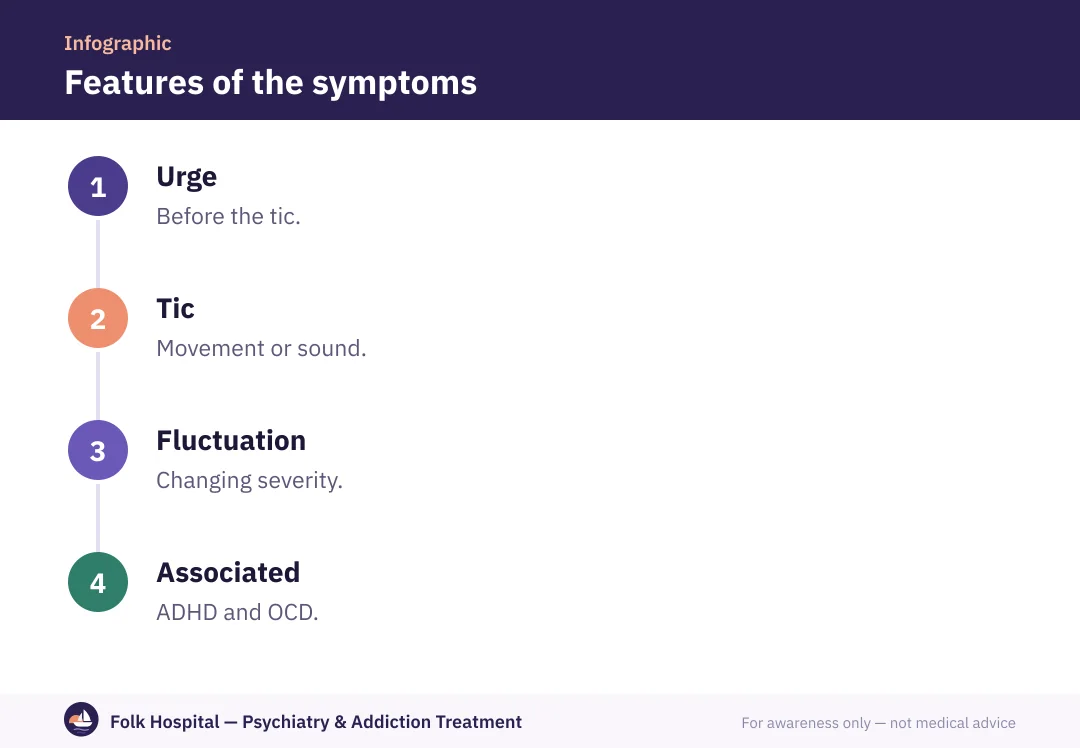
What is a premonitory urge?
An uncomfortable inner feeling, like an itch or pressure, before a tic that eases afterwards.
Do tics change?
Yes. One tic may disappear and another appear, and severity rises and falls with time and stress.
Do tics happen during sleep?
They're much reduced in sleep, though they can occur.
Does Tourette cause pain?
Some strong, repeated tics can cause neck or muscle pain.
Sources and references
- Tourette's syndrome — NHS (UK)
- Obsessive-Compulsive Disorder — National Institute of Mental Health (NIMH)

A psychiatrist specialising in addiction and mental illness in adults and adolescents, with a focus on dual diagnosis.
For awareness only — not a substitute for medical advice. Editorial policy · View profile