01External and internal sources
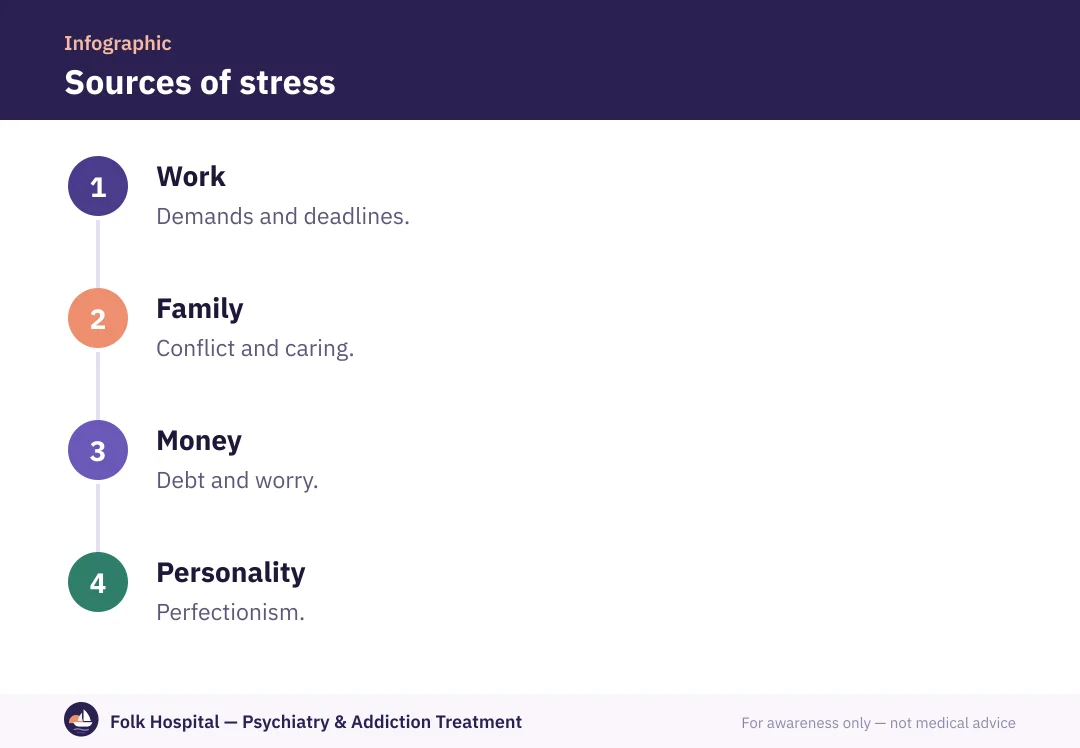
| Type | Examples |
|---|---|
| Work and study | Deadlines, conflict, job insecurity, exams |
| Money | Debt, unemployment, rising costs |
| Relationships | Marital conflict, problems with children, a family member's addiction |
| Health | Chronic illness, caring for someone ill |
| Events | Loss, moving, marriage, childbirth |
| Internal | Perfectionism, negative thinking, difficulty saying no |
02Small stresses add up
Stress doesn't always come from a big event. Daily traffic, endless work messages, little sleep and repeated small problems can accumulate until they weigh more than one major event.
03What softens the impact
Increases impact
- Isolation.
- Little sleep.
- Perfectionism.
- Alcohol or sedatives to cope.
Reduces impact
- Social support.
- Regular sleep and activity.
- Flexible expectations.
- Problem-solving skills.
04What can and can't be changed
- List your stressors.
- Sort themchangeable and unchangeable.
- For what can changea practical plan in small steps.
- For what can'tacceptance, managing your response and support.
Read stress, overthinking and burnout.
؟Frequently asked questions
What are the commonest causes of stress?
Work and study, money, family and marital relationships, illness, loss and major changes.
Can a happy event cause stress?
Yes, such as marriage, childbirth or a new job, because they require adjustment.
What are internal stressors?
Perfectionism, negative thinking, difficulty saying no and unrealistic expectations of oneself.
Why are some people affected more than others?
Because of differences in temperament, past experiences, coping skills, social support and physical health.
Does having an addict in the family cause stress?
Yes, it's among the heaviest sources of chronic family stress and deserves specific support.
Can sources of stress be controlled?
Some can be changed and some can't; solve problems where possible, and accept and manage your response where not.
Sources and references
- Stress — questions and answers — World Health Organization
- Mental disorders — fact sheet — World Health Organization
- Anxiety Disorders — National Institute of Mental Health (NIMH)

A psychiatrist specialising in addiction and mental illness in adults and adolescents, with a focus on dual diagnosis.
For awareness only — not a substitute for medical advice. Editorial policy · View profile