01Where the harm shows
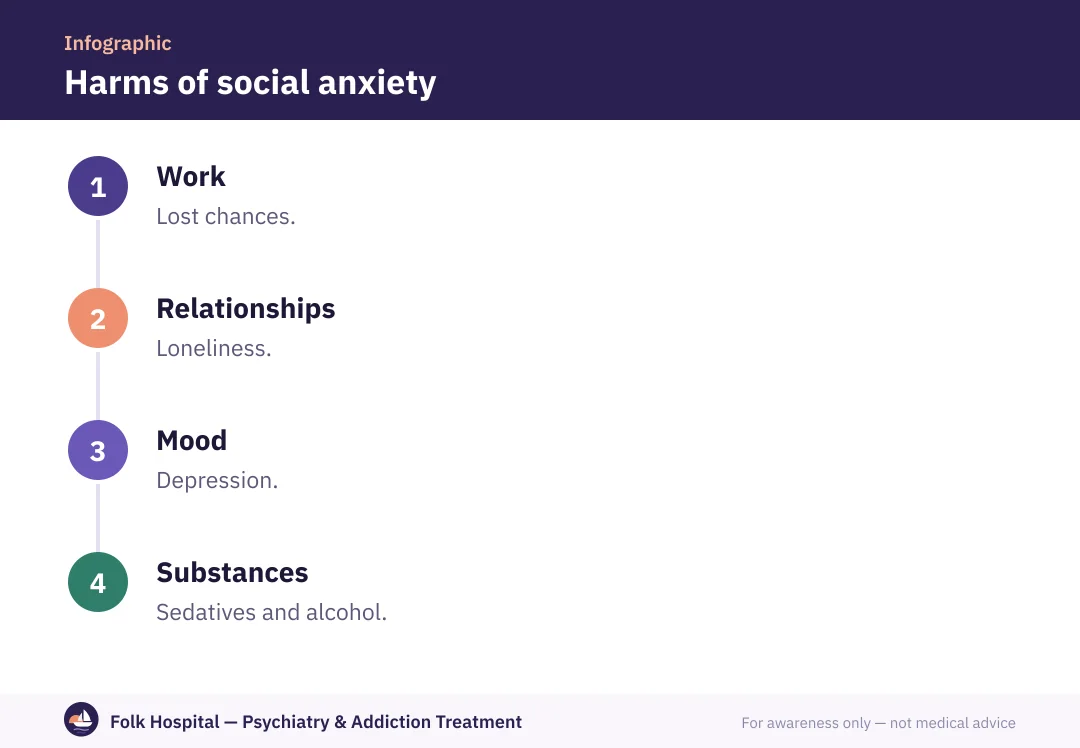
| Area | Harm |
|---|---|
| Study | Avoiding participation and presentations, falling grades |
| Work | Avoiding interviews, promotions and meetings |
| Relationships | Isolation; difficulty with friendships and marriage |
| Mental health | Depression and general anxiety |
| Substances | Addiction to alcohol or sedatives |
02A life on hold
What people may miss out on
- A suitable job because they avoided the interview.
- Friendships because they declined invitations.
- A subject they love because it needs presentations.
- Relationships because they didn't take the first step.
- Anxiety comes with severe depression or suicidal thoughts.
- Alcohol or sedative use has clearly increased.
Hotline 08008880700.
Ambulance: 12303Treatment regains opportunities
- Understanding the cyclethoughts, avoidance and anxiety.
- Gradual exposurefrom easy to hard situations.
- Dropping safety behavioursgradually.
- Treating depression or addictionif present.
Read social anxiety, its treatment and loneliness.
؟Frequently asked questions
What are the harms of social anxiety?
Setbacks at school and work, isolation, relationship difficulties, depression and a risk of addiction to alcohol or sedatives.
Does social anxiety cause depression?
It can, through isolation, missed opportunities and a sense of failure.
Does it affect marriage?
It may delay meeting people and marrying, or cause difficulties in shared social life.
Why do people delay seeking treatment?
Because visiting a doctor is itself a frightening social situation, and some believe shyness is an unchangeable trait.
Is it linked to addiction?
Yes, especially alcohol and sedatives used before social situations.
Do the harms go away with treatment?
Yes. Many patients regain academic, career and social opportunities with treatment.
Sources and references
- Social anxiety (social phobia) — NHS (UK)
- Anxiety Disorders — National Institute of Mental Health (NIMH)
- Anxiety disorders — fact sheet — World Health Organization

A psychiatrist specialising in addiction and mental illness in adults and adolescents, with a focus on dual diagnosis.
For awareness only — not a substitute for medical advice. Editorial policy · View profile