01Not just «passing sadness»
After birth many mothers go through days of crying and mood swings that quickly pass. Postpartum depression lasts more than two weeks, with sadness or emptiness, loss of pleasure, severe exhaustion, guilt or feeling inadequate as a mother, and sometimes difficulty bonding with the baby. Read about the symptoms of postpartum depression and its causes.
02Treatment options
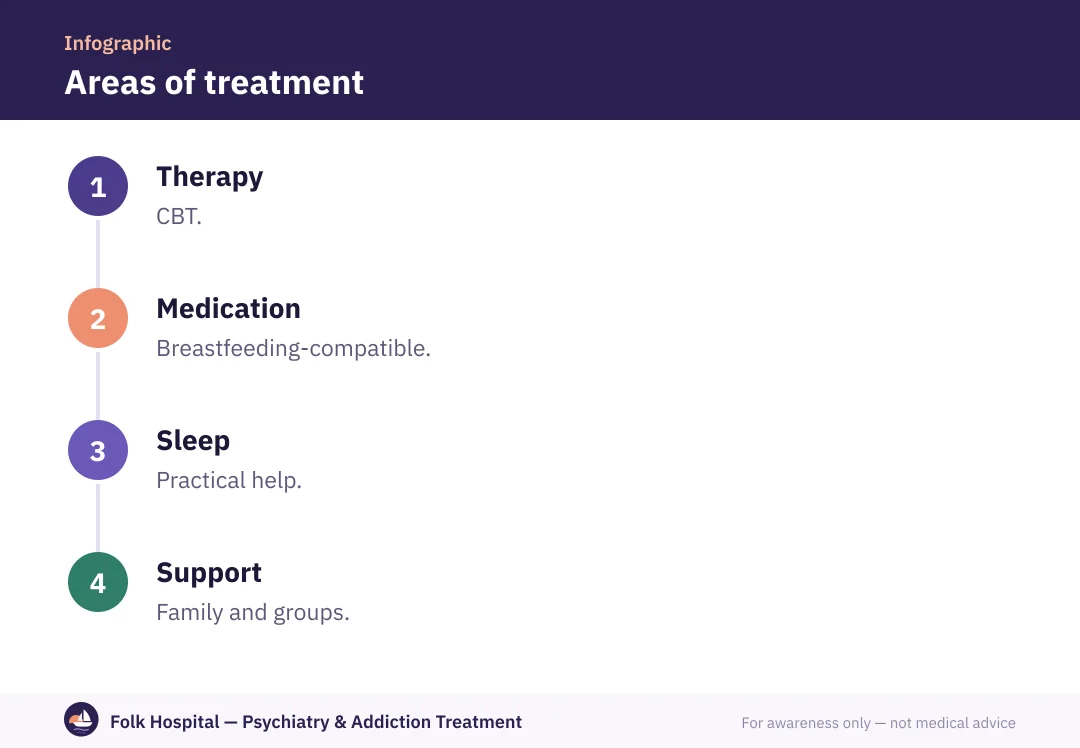
| Option | When it's used |
|---|---|
| Psychological therapy (cognitive or interpersonal) | The first step in mild and moderate cases |
| Breastfeeding-compatible antidepressants | Moderate and severe cases, or when therapy isn't enough |
| Practical support | In every case: sleep, baby care and help at home |
| Mothers' support groups | To reduce isolation and the feeling of being alone |
| Admission | When there's danger or psychotic symptoms |
Read about depression treatment and cognitive behavioural therapy.
03Sleep and support are part of treatment
- Splitting the nightthe husband or a relative takes one or more feeds so the mother gets unbroken sleep.
- Lightening the loadaccepting help with the house and cooking without guilt.
- Food and light movementregular meals and short walks when the doctor allows.
- Connectiontalking to someone you trust or to mothers who've been through it.
04Signs that need urgent help
- Thoughts of harming yourself or the baby.
- Hearing or seeing things that aren't there, or strange ideas and severe confusion.
- Being unable to care for yourself or the baby.
Ambulance 123, or the mental health hotline 08008880700.
Ambulance: 123Postpartum psychosis is rare but an emergency that needs hospital care. Read about psychosis and our psychiatric hospital.
؟Frequently asked questions
How long does recovery take?
Many mothers improve within weeks to months of starting treatment.
What's the difference between the baby blues and depression?
The baby blues are common, appear in the first days and pass within about two weeks. Depression is more severe, lasts more than two weeks and affects caring for oneself and the baby.
Can I breastfeed during treatment?
Usually yes. Some medicines are known to be compatible with breastfeeding, and the doctor chooses what suits you and monitors the baby. Don't stop breastfeeding or start a medicine without advice.
Does depression affect the baby?
Untreated, it can affect bonding and care, which is why early treatment benefits mother and baby together.
How can the husband and family help?
By taking over part of the baby's night care so the mother can sleep, helping at home, listening without blame and encouraging her to see a doctor.
Sources and references
- Depression — National Institute of Mental Health (NIMH)
- Depressive disorder (depression) — fact sheet — World Health Organization
- Psychotherapies — National Institute of Mental Health (NIMH)
- Mental Health Medications — National Institute of Mental Health (NIMH)
- Suicide Prevention — National Institute of Mental Health (NIMH)

A psychiatrist specialising in addiction and mental illness in adults and adolescents, with a focus on dual diagnosis.
For awareness only — not a substitute for medical advice. Editorial policy · View profile