01Risk factors
| Type | Examples |
|---|---|
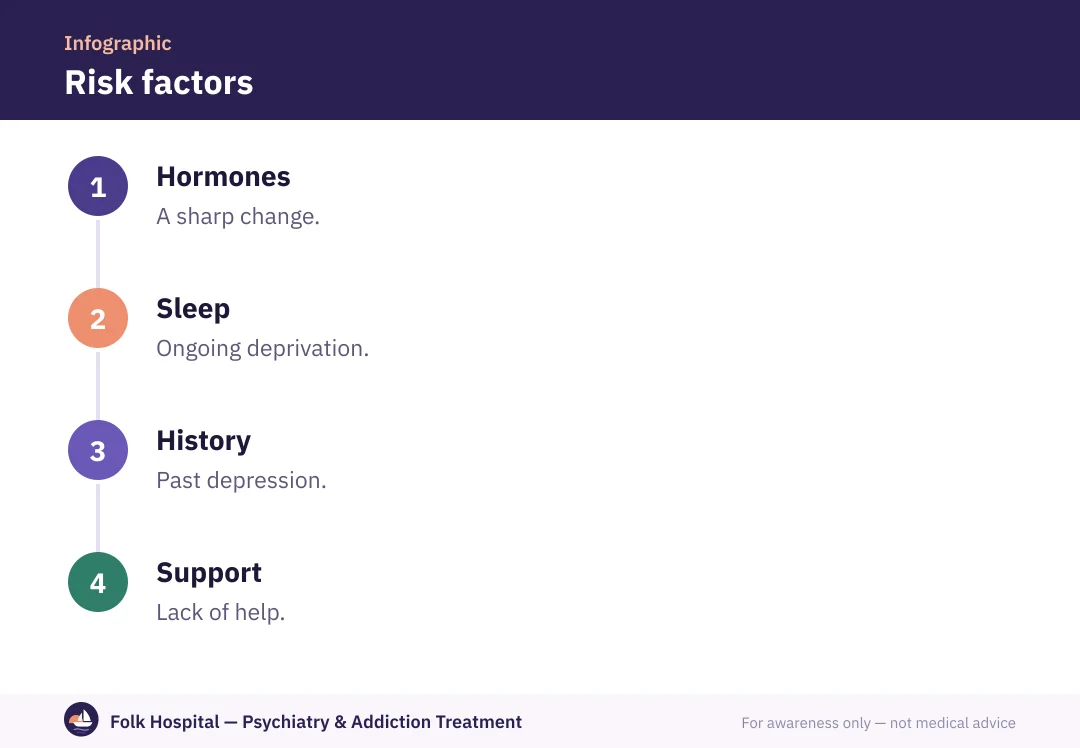
| Biological | Hormone changes, exhaustion, lack of sleep |
| Psychological | Past depression or anxiety, depression in pregnancy |
| Social | Poor support, relationship or money problems |
| Birth circumstances | Difficult birth, unwell or premature baby |
| Behavioural | Alcohol or substance use |
02Prevention
- Before birthdiscuss any mental-health history with the doctor.
- A support planwho helps with care and sleep.
- Follow-upmood checks after birth.
- Asking for help earlyat the first signs.
Raises risk
- Isolation.
- Sleep deprivation.
- Blame and comparison.
Protects
- Family support.
- Sharing care.
- Psychological follow-up.
Read postpartum depression, its symptoms and addiction in pregnancy.
؟Frequently asked questions
What causes postpartum depression?
An interaction of hormonal changes, lack of sleep and exhaustion with psychological and social factors.
Who is most at risk?
Those with a history of depression or anxiety, poor support, major stress or a difficult birth.
Is it only hormones?
No. Hormones are one factor, but psychological and social factors matter greatly.
Can it be prevented?
Risk can be reduced by planning support and sleep, and psychological follow-up for those with a history.
Does breastfeeding cause it?
Breastfeeding isn't a cause, but its difficulties and exhaustion can add pressure.
Does it recur in the next pregnancy?
Risk may be higher, so planning ahead with the doctor helps.
Sources and references
- Postnatal depression — NHS (UK)
- Postpartum Depression — U.S. National Library of Medicine — MedlinePlus
- Depression — National Institute of Mental Health (NIMH)

A psychiatrist specialising in addiction and mental illness in adults and adolescents, with a focus on dual diagnosis.
For awareness only — not a substitute for medical advice. Editorial policy · View profile