01The aim of treatment
Autism is a difference in brain development that affects communication, social interaction and behaviour. Treatment doesn't aim to «change the child's personality» but to develop communication and independence skills, reduce difficulties that hold their life back, and support the family. Read about the symptoms of autism and its diagnosis.
02Core interventions
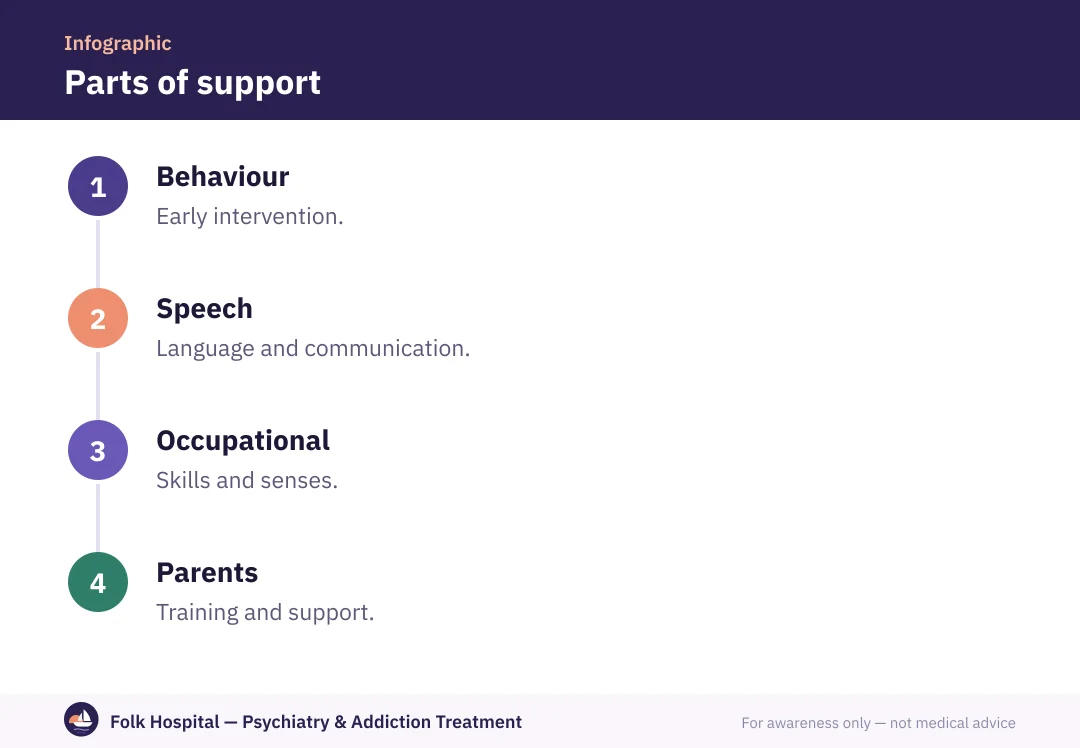
| Intervention | What it improves |
|---|---|
| Speech therapy | Speech, understanding and alternative means of communication |
| Behavioural intervention | Daily skills and reducing difficult behaviours |
| Occupational and sensory therapy | Fine motor skills and coping with sensitivity to sound and touch |
| Parent training | Applying skills at home throughout the day |
| Educational support | A school plan that fits the child's abilities |
03The role of medicines
No medicine treats autism itself, but the doctor may prescribe medicines for hyperactivity and inattention, anxiety, insomnia or severe aggression that disrupts learning. Read about ADHD.
04Beware of unproven treatments
Promises of a cure
Treatments promising a «full cure» are widespread, such as strict diets without a diagnosed sensitivity, or some unapproved supplements and injections. These can be expensive, without evidence and sometimes harmful. Ask the doctor before any new treatment.
05Supporting your child at home
- A fixed routineclear times for sleep, meals and play.
- Simple communicationshort sentences, with pictures and symbols when needed.
- Preparing for changetell them in advance about any change in the day.
- Rewarding good behaviourimmediate praise or an activity they love.
- Parents caring for themselvessupport and rest help you keep going.
Read how to deal with a child with autism and the types of autism.
؟Frequently asked questions
Does a gluten-free diet treat autism?
There isn't enough evidence for that, unless the child has a diagnosed sensitivity.
When should I start intervention?
As soon as you notice signs such as delayed speech, poor eye contact or not responding to their name; don't wait for the final diagnosis to start speech therapy and training.
Will my child improve with treatment?
Many children gain clear communication and independence skills; how much varies with the child, the severity of symptoms and when intervention starts.
Does the child need medicines?
Not always. Medicines are used for specific symptoms such as hyperactivity, anxiety, insomnia or severe aggression, under a doctor's supervision.
How can I support my child at home?
With a fixed daily routine, short clear instructions with pictures, preparing them for changes, rewarding good behaviour and applying what they learn in sessions.
Sources and references
- Autism Spectrum Disorder — National Institute of Mental Health (NIMH)
- Mental disorders — fact sheet — World Health Organization
- Attention-Deficit/Hyperactivity Disorder — National Institute of Mental Health (NIMH)
- Mental Health Medications — National Institute of Mental Health (NIMH)

A psychiatrist specialising in addiction and mental illness in adults and adolescents, with a focus on dual diagnosis.
For awareness only — not a substitute for medical advice. Editorial policy · View profile