01Support levels
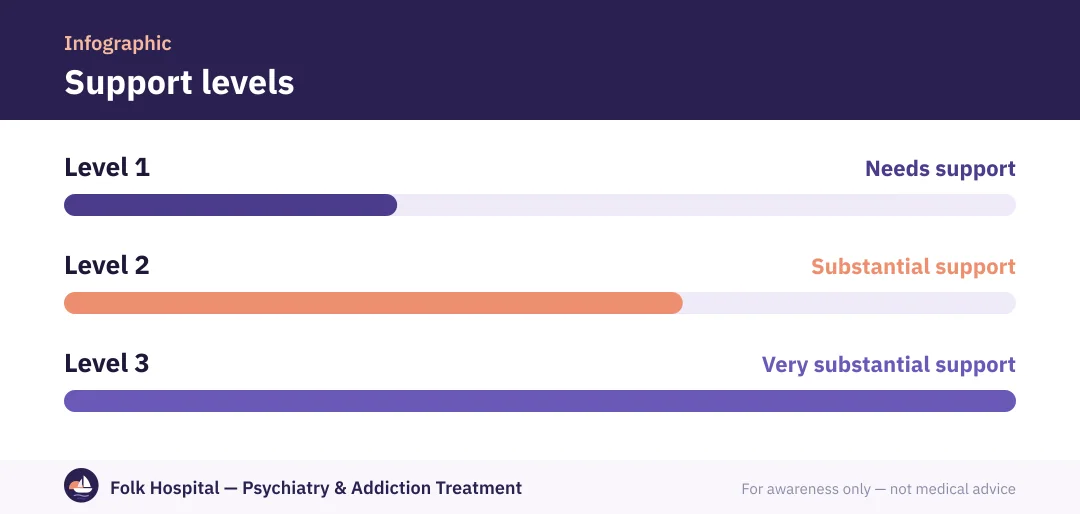
| Level | Social communication | Repetitive behaviours |
|---|---|---|
| 1: requires support | Difficulty initiating interaction and conversation | Difficulty switching activities and organising |
| 2: substantial support | Clear difficulties even with support | Noticeable repetitive behaviours and distress at change |
| 3: very substantial support | Very limited communication | Behaviours that severely disrupt daily life |
02The old names
Old classification
- Classic autism.
- Asperger's syndrome.
- Pervasive developmental disorder not otherwise specified.
Modern classification
- Autism spectrum disorder.
- With the support level specified.
- And language and intellectual abilities described.
03What the doctor adds to the diagnosis
Additional description
- With or without intellectual disability.
- With or without language impairment.
- Co-occurring conditions such as ADHD, anxiety or epilepsy.
- Sleep or eating problems.
Read autism, its diagnosis and supporting an autistic child.
؟Frequently asked questions
What are the types of autism?
There are no longer separate types but one spectrum described at three levels according to support needed.
What is Asperger's syndrome?
An old name for autism with typical language and intelligence, now within the autism spectrum, usually at level 1.
What's the difference between the three levels?
Level 1 needs support and is relatively independent; level 2 needs substantial support; level 3 needs very substantial support in most areas of life.
Does the level change?
It may improve with early intervention and education, and can vary across life stages.
What is high-functioning autism?
An informal description of people with good language and intelligence who still have real social and sensory difficulties.
Is autism linked to intellectual disability?
It can accompany it in some people, while others have average or high intelligence.
Sources and references
- Autism Spectrum Disorder — National Institute of Mental Health (NIMH)
- Mental disorders — fact sheet — World Health Organization

A psychiatrist specialising in addiction and mental illness in adults and adolescents, with a focus on dual diagnosis.
For awareness only — not a substitute for medical advice. Editorial policy · View profile