01Communication and social interaction
Common signs
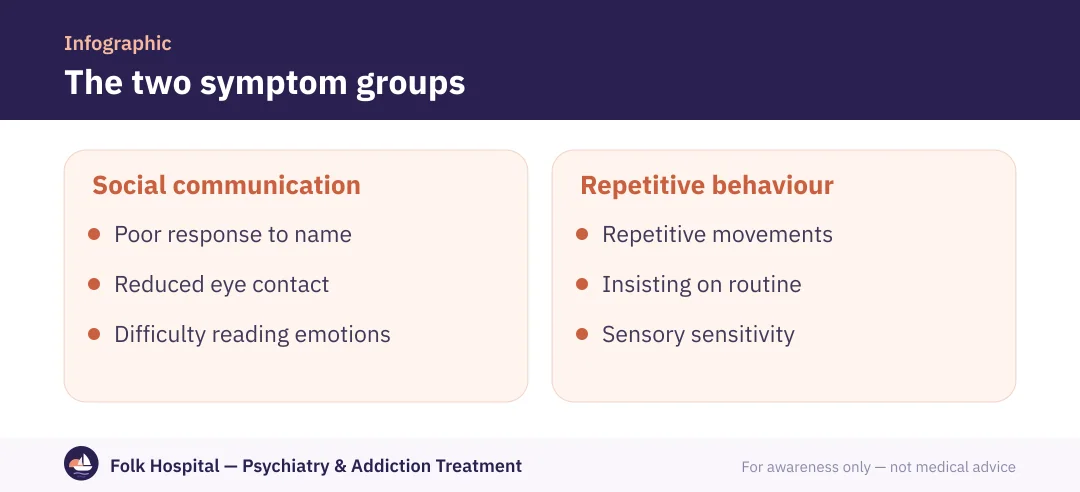
- Limited eye contact.
- Not responding to their name.
- Difficulty reading facial expressions and feelings.
- Delayed speech or echoing words.
- Difficulty with back-and-forth conversation.
- Difficulty making friends or understanding the rules of play.
02Behaviours and interests
| Type | Examples |
|---|---|
| Repetitive movements | Hand-flapping, rocking, spinning |
| Rigid routine | Strong distress at a changed route or arrangement |
| Narrow interests | Deep preoccupation with one subject such as numbers or trains |
| Sensory sensitivity | Distress at sounds or clothing, or seeking particular sensations |
| Unusual play | Lining up toys instead of pretend play |
03By age
Early childhood
- Little eye contact and pointing.
- Delayed speech.
- Little interest in playing with others.
Adolescence and adulthood
- Difficulty with friendships and understanding jokes.
- Social anxiety.
- Exhaustion from trying to fit in.
Loss of skills
If a child loses words or social skills they had gained, this calls for urgent assessment.
Read autism, diagnosing autism and levels of autism.
؟Frequently asked questions
What are the first signs of autism in infants?
Limited eye contact, not responding to their name, little shared smiling and not pointing at things.
Does delayed speech mean autism?
Not always; it can have other causes, but it calls for assessment, especially with weak social communication.
What are repetitive movements?
Such as hand-flapping, rocking, spinning, or arranging objects in a particular way.
What is sensory sensitivity?
Strong distress at certain sounds, lights or textures, or the opposite: seeking strong sensations or not feeling pain.
Do autism symptoms differ in girls?
They may be less obvious because some girls imitate social behaviour, delaying diagnosis.
Can adults be diagnosed with autism?
Yes. Many adults are diagnosed late, especially those with a milder presentation.
Sources and references
- Autism Spectrum Disorder — National Institute of Mental Health (NIMH)
- Mental disorders — fact sheet — World Health Organization

A psychiatrist specialising in addiction and mental illness in adults and adolescents, with a focus on dual diagnosis.
For awareness only — not a substitute for medical advice. Editorial policy · View profile