01Why are sex and drugs linked?
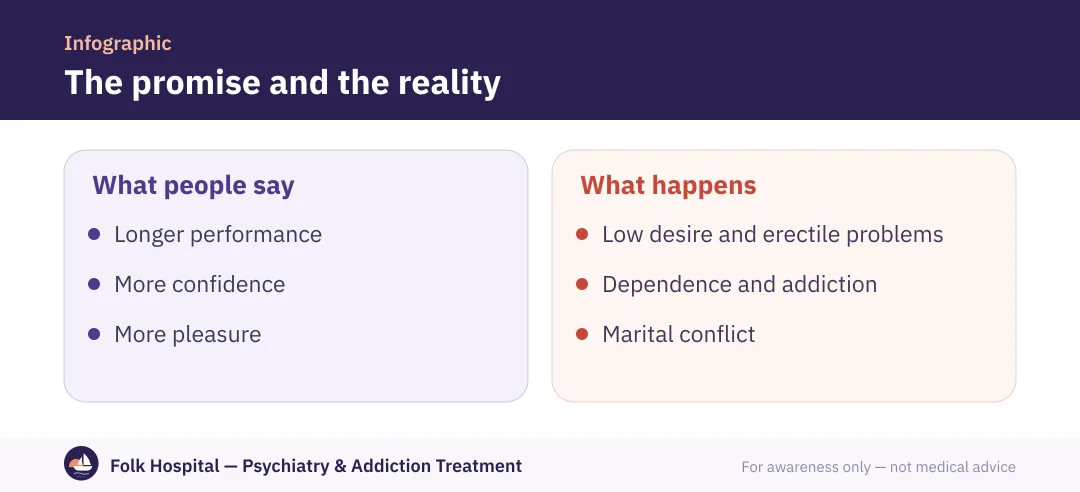
Many men start tramadol, hashish or stimulants looking for better performance or to escape anxiety in their relationship, and at first the effect seems encouraging. But sex depends on a delicate balance of nerves, hormones, blood vessels and mental state, and continued drug use disrupts all of it.
02How each substance affects sexual health
| Substance | What the person feels at first | What happens with continued use |
|---|---|---|
| Tramadol and opioids | Delayed ejaculation and relaxation | Low testosterone, weak desire and erections, difficulty ejaculating |
| Alcohol | Boldness and less tension | Weaker erections, lower hormones, risky decisions |
| Hashish | Relaxation and altered sensation | Erectile problems in some users; fertility affected |
| Shabu and stimulants | Heightened desire and energy | Erectile problems, risky sex, infection |
| Pregabalin | Calm | Weaker desire and difficulty reaching orgasm in some |
| Anabolic steroids | Body confidence | Testicular shrinkage and low sperm count |
03Opioids and testosterone
Long-term opioid use, including tramadol, suppresses the hormonal axis between the brain and testicles, lowering testosterone. The result: weak desire, erectile problems, fatigue, low mood and sometimes reduced fertility. Women can also have menstrual disturbances with opioids.
04Hidden risks
- Unsafe sex under stimulants or alcohol, with a risk of sexually transmitted infections.
- Hepatitis and HIV from injecting and sharing equipment. Read injection harms.
- Unplanned pregnancy and the effects of substances on the baby. Read drugs and pregnancy.
- Exploitation while unconscious or unable to remember, with sedatives such as Rohypnol.
- Marital problems and loss of trust. Read addiction and marriage.
Mixing sexual enhancers with drugs
Combining erectile medicines with certain substances, or taking them with undiagnosed heart disease, can cause a sharp drop in blood pressure or heart problems. Don't combine them without medical advice.
05Does performance improve after recovery?
- The first weeks after stoppingthere may be a temporary dip or rapid ejaculation after quitting tramadol; this is expected and doesn't mean permanent damage.
- The first monthshormones and desire start to rebalance, and sleep and mood improve.
- Specialist assessmentif problems persist, hormones are checked and the patient is referred to an andrologist for safe treatment.
Many relapses are driven by fear about performance after stopping, so we address this openly and confidentially within the treatment plan.
؟Frequently asked questions
Does tramadol treat premature ejaculation?
It may delay ejaculation temporarily, but it isn't a safe treatment for this without supervision: repeated use causes dependence and weaker desire and erections. Safer treatments exist, chosen by an andrologist.
Do drugs cause infertility?
Some can reduce sperm quality and count and disrupt hormones, such as opioids, hashish, alcohol and steroids. Many of these effects improve after stopping.
Does sexual performance return after quitting?
It usually improves gradually over weeks to months. There may be a temporary dip right after stopping, then hormones and desire rebalance, and remaining problems can be treated.
Why does alcohol raise desire but weaken ability?
It lowers inhibition so the person feels bolder, but it depresses the nervous system and circulation, weakening erections, and chronic heavy drinking lowers testosterone.
Does hashish increase sexual pleasure?
It may change sensation temporarily for some, but regular use has been linked to erectile and fertility problems in some men and to disturbed desire.
Should I talk to the doctor about sexual problems during treatment?
Yes. They're part of assessment and treatment, and if ignored they're often a reason for relapse. The conversation is confidential and professional.
Sources and references
- Opioids — research topic — National Institute on Drug Abuse (NIDA)
- Alcohol — research topic — National Institute on Drug Abuse (NIDA)
- Methamphetamine — research topic — National Institute on Drug Abuse (NIDA)
- Cannabis (Marijuana) — research topic — National Institute on Drug Abuse (NIDA)
- Drugs, Brains, and Behavior: The Science of Addiction — National Institute on Drug Abuse (NIDA)

A psychiatrist specialising in addiction and mental illness in adults and adolescents, with a focus on dual diagnosis.
For awareness only — not a substitute for medical advice. Editorial policy · View profile