01Ritalin: a useful medicine that's misused
Ritalin (methylphenidate) is a stimulant prescribed for ADHD, and it clearly helps people with the condition focus and organise themselves. But it's misused by students around exams to stay up and concentrate, and sometimes snorted or injected for a high, which is where it becomes dangerous.
Read about signs of Ritalin misuse.
02The first step: is there ADHD?
If ADHD is present
- Proper treatment at a suitable dose with follow-up.
- Formulations less open to misuse when needed.
- Behavioural treatment and organisation skills.
- Keeping the medicine safe and monitoring adherence.
If it isn't
- Stopping the medicine with a plan.
- Finding the real cause of poor concentration.
- Treating anxiety, depression or lack of sleep.
- Realistic study skills.
Read about ADHD and its treatment.
03How is it treated?
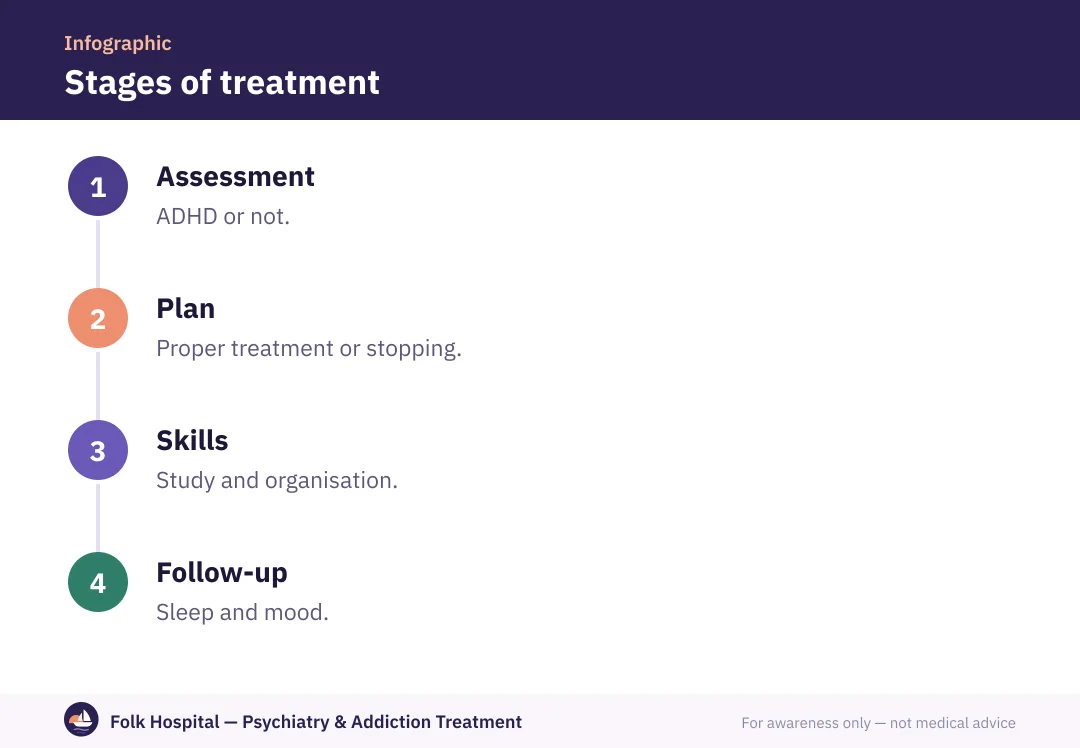
- AssessmentADHD diagnosis, dose and route, other drugs, heart and blood pressure, sleep and mood.
- A medication planproper treatment for those who need it, or a gradual stop for those who don't.
- Treating insomnia and anxietyregular sleep and treatment of accompanying anxiety.
- Study skillsdividing time, breaks and realistic expectations.
- Follow-upsessions, and family oversight of the medicine.
04The risks of misuse
- Chest pain, strong palpitations or fainting.
- Agitation, hallucinations or paranoia.
- High temperature or seizures.
Call an ambulance on 123 immediately. Snorting or injecting greatly increases these risks.
Ambulance: 123Read about the harms of Ritalin.
05Academic pressure: the real root
Many students turn to Ritalin under exam pressure or family expectations. Here treatment works on:
- Managing stress and anxiety in healthy ways.
- Enough sleep, because lack of sleep alone badly weakens concentration.
- A realistic study plan instead of all-nighters.
- Talking with the family about expectations and pressure.
06For families
- Keep prescribed medicine somewhere safe and keep count of the tablets.
- Watch for long nights awake, loss of appetite and irritability.
- Talk about academic pressure without accusations.
؟Frequently asked questions
I use Ritalin to study without a prescription. Is that dangerous?
Yes. It can cause insomnia, anxiety, racing heart and loss of appetite, and high doses can cause dependence or psychotic symptoms. Research doesn't confirm it improves academic performance in people without ADHD.
Do I need an ADHD diagnosis?
Yes, a specialist assessment determines whether poor concentration is due to ADHD or to anxiety, lack of sleep or depression, each of which has different treatment.
My son takes Ritalin on prescription. Will he become addicted?
At the prescribed dose with medical follow-up, the risk of addiction is low. What matters is sticking to the dose, keeping the medicine safe and seeing the doctor regularly.
Is stopping Ritalin dangerous?
It doesn't usually cause dangerous withdrawal, but tiredness, sleeping a lot and low mood can appear for days, especially after high doses.
Sources and references
- Attention-Deficit/Hyperactivity Disorder — National Institute of Mental Health (NIMH)
- Prescription Medicines — research topic — National Institute on Drug Abuse (NIDA)
- Treatment Approaches for Drug Addiction — DrugFacts — National Institute on Drug Abuse (NIDA)
- Mental Health Medications — National Institute of Mental Health (NIMH)

A psychiatrist specialising in addiction and mental illness in adults and adolescents, with a focus on dual diagnosis.
For awareness only — not a substitute for medical advice. Editorial policy · View profile