01What's the aim of treatment?
ADHD is a brain development condition affecting attention, impulse control and activity regulation. Treatment doesn't change a child's or adult's personality; it helps them function at their real ability in study, work and relationships. Read about the symptoms of ADHD and how it's diagnosed.
02Treatment by age
| Group | Usually first-line |
|---|---|
| Young children | Parent training in behaviour management, and organising environment and routine |
| School-age children and teens | Medication with behavioural therapy and school support |
| Adults | Medication with CBT and organisation skills |
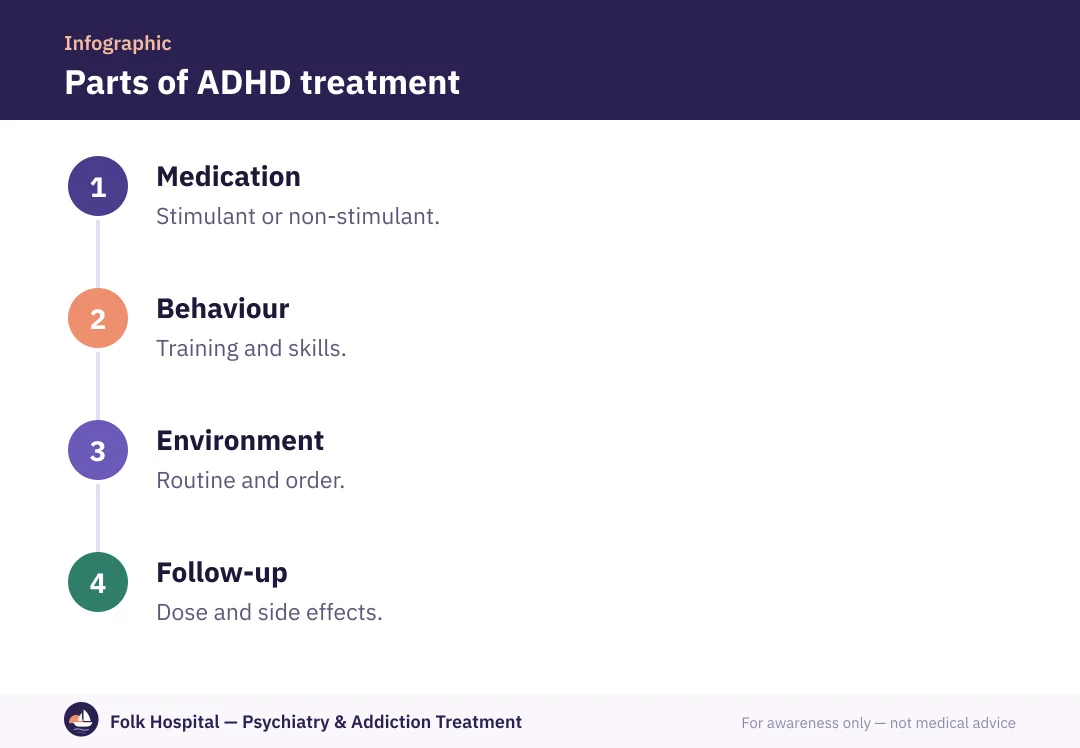
03Medication
Stimulants
- Such as methylphenidate.
- Work quickly and are effective for most patients.
- Need monitoring of sleep, appetite and blood pressure.
- Safe at prescribed doses, with misuse watched for.
Non-stimulants
- Such as atomoxetine.
- Take weeks to work.
- An option with a history of addiction or stimulant side effects.
- Carry no risk of misuse.
04Skills and behavioural therapy
- Parent training: clear rules, immediate rewards, short instructions and a steady routine.
- Behavioural therapy for children: building desired behaviours and reducing problems.
- CBT for adults: managing time, breaking tasks down, and handling procrastination and frustration.
- School support: arrangements such as sitting at the front, extra time and splitting assignments.
05Lifestyle
- Regular, sufficient sleep, because lack of sleep mimics and worsens ADHD symptoms.
- Daily physical activity.
- Less screen time before bed.
- Lists, reminders and simple organisation tools.
06ADHD and addiction
Treatment protects
Untreated ADHD raises the risk of substance use, especially stimulants as self-medication. Proper treatment with follow-up is linked to a lower risk. Misuse of stimulant medicine is watched for, especially among students. Read about ADHD and addiction and treating Ritalin misuse.
؟Frequently asked questions
Is medication for life?
Not necessarily. It's reviewed regularly; some people need it long-term and others for set periods.
Will ADHD medicine make my child addicted?
At prescribed doses with follow-up the risk is low, and proper treatment is linked to a lower risk of later substance use compared with leaving the condition untreated.
Can ADHD be treated without medication?
In mild cases and in young children, treatment usually starts with parent training and behavioural therapy. In moderate and severe cases it usually combines both.
Do adults have ADHD?
Yes. Many adults have ADHD that wasn't diagnosed in childhood, showing as distraction, disorganisation and impulsivity, and it has effective treatment.
Sources and references
- Attention-Deficit/Hyperactivity Disorder — National Institute of Mental Health (NIMH)
- Mental Health Medications — National Institute of Mental Health (NIMH)
- Psychotherapies — National Institute of Mental Health (NIMH)
- Prescription Medicines — research topic — National Institute on Drug Abuse (NIDA)

A psychiatrist specialising in addiction and mental illness in adults and adolescents, with a focus on dual diagnosis.
For awareness only — not a substitute for medical advice. Editorial policy · View profile