01Signs
| Type | Signs |
|---|---|
| Under the effect | Excess alertness, lots of talk, fast heartbeat, sweating and wide pupils |
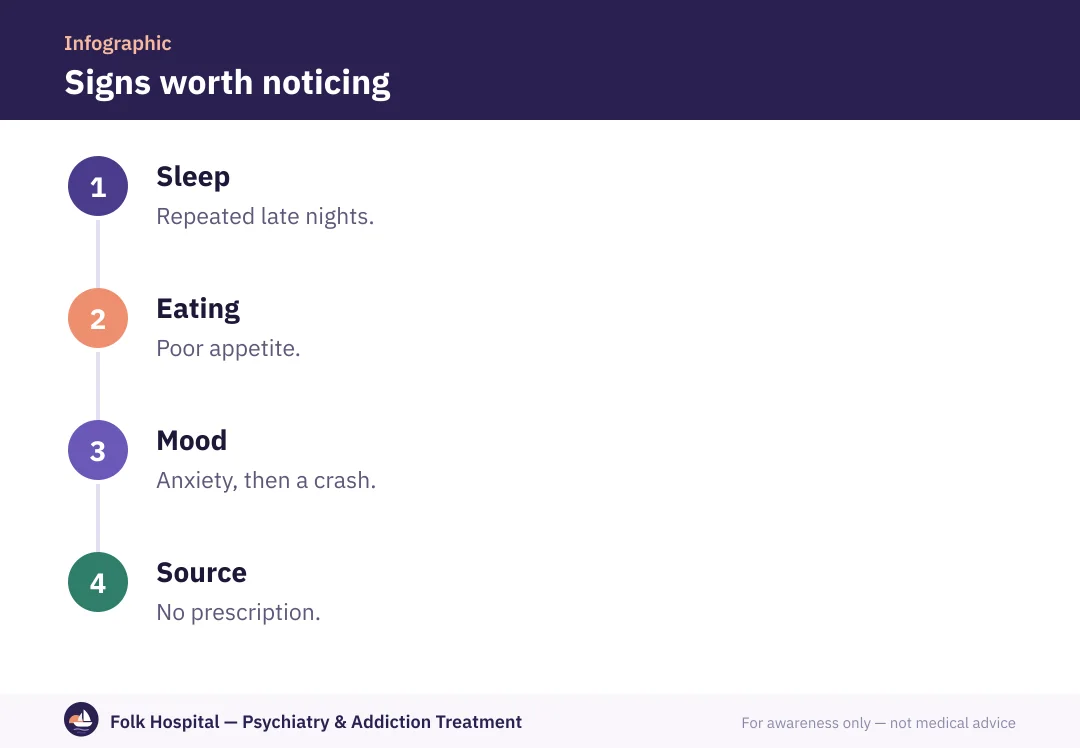
| With repeated use | Insomnia, loss of appetite, weight loss, anxiety and irritability |
| Signs of misuse | Getting it without a diagnosis or from classmates, crushing and snorting tablets |
| After stopping | Tiredness, long sleep, sadness and poor concentration |
02Danger signs
- Chest pain or a very fast heartbeat.
- Agitation, suspicion or hallucinations.
- Seizures.
03What should you do?
If there are real concentration difficulties, an ADHD assessment and supervised treatment are better. Read about Ritalin addiction treatment, its harms and ADHD.
؟Frequently asked questions
My son takes his friend's Ritalin to study. Is that dangerous?
Yes; without a diagnosis and medical dose it can cause harm and dependence. If he has a real concentration problem, he should be assessed for ADHD.
Does Ritalin improve grades in people without ADHD?
The evidence doesn't confirm that, and it can harm sleep and concentration and cause anxiety and dependence.
Does Ritalin cause addiction in people with ADHD?
When used at the prescribed dose with follow-up, the risk of addiction is low, and treating ADHD may even reduce the risk of substance use.
What's the danger of crushing tablets?
It raises blood levels quickly, increasing the risk of heart rhythm problems, anxiety and dependence.
Sources and references
- Prescription Medicines — research topic — National Institute on Drug Abuse (NIDA)
- Attention-Deficit/Hyperactivity Disorder — National Institute of Mental Health (NIMH)

A psychiatrist specialising in addiction and mental illness in adults and adolescents, with a focus on dual diagnosis.
For awareness only — not a substitute for medical advice. Editorial policy · View profile