01What does «powder» mean on the street?
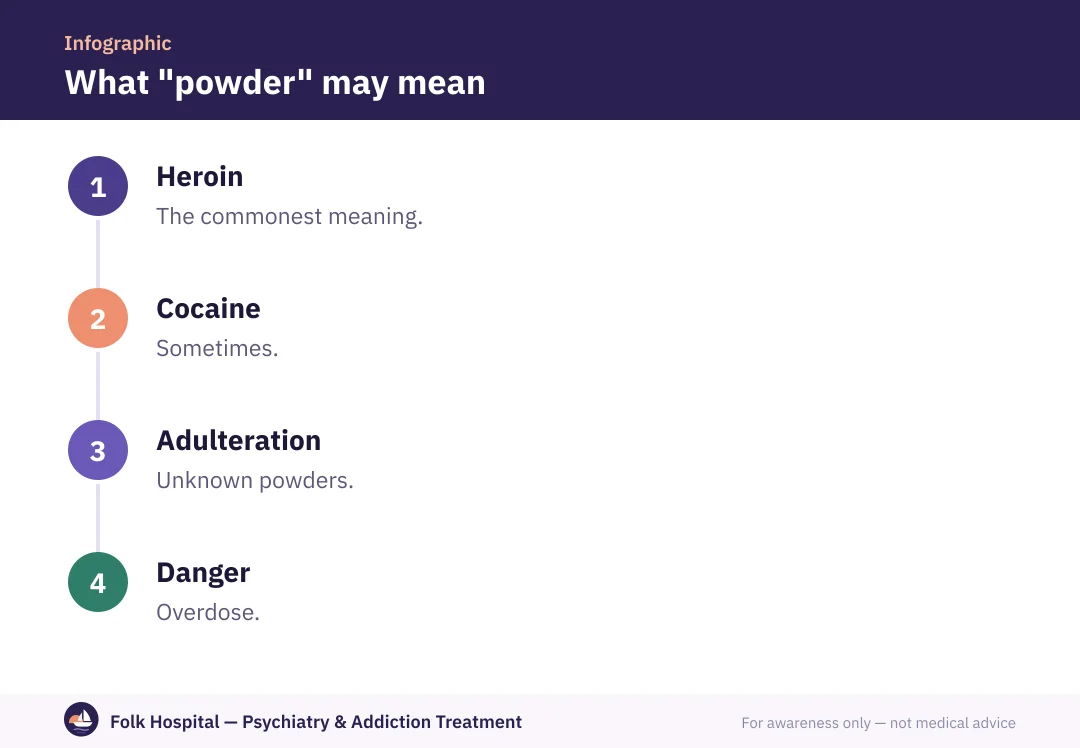
When someone in Egypt says a person «uses powder», they usually mean heroin. But the word is sometimes used for cocaine, and sometimes for unknown powders. Even heroin itself is often cut with fillers or stronger substances to increase profit, so the user doesn't know what enters their body.
02«Powder»: heroin or cocaine?
If it's heroin
- Drowsiness, nodding off, warmth and relaxation.
- Pinpoint pupils.
- Slow breathing; the danger is overdose.
- Withdrawal: yawning, runny nose, pain and diarrhoea.
If it's cocaine
- Energy, confidence and fast speech.
- Dilated pupils and palpitations.
- The danger is to the heart, plus psychosis.
- Crash: exhaustion, low mood and cravings.
03Signs of «powder» use
Common signs
- Drowsiness and nodding off while sitting or talking.
- Pinpoint pupils.
- Burnt foil, small tubes or burnt spoons.
- Injection marks or constant long sleeves.
- Weight loss, constipation and neglected appearance.
- Money or belongings going missing at home.
04The gravest dangers
- Overdose: purity varies, so today's dose may be stronger than yesterday's.
- Fentanyl mixed in: can stop breathing in a tiny amount. Read fentanyl.
- Mixing with tramadol, sedatives or alcohol multiplies the suppression of breathing.
- Infection: hepatitis and HIV from shared needles and equipment. Read injection harms.
- Rapid addiction and painful withdrawal.
- No response to calling or shaking.
- Very slow breathing or strange snoring.
- Blue lips and nails.
- Pinpoint pupils.
Put the person on their side, don't leave them alone, and don't try to wake them with cold water or slapping.
Ambulance: 12305How does treatment start?
- Assessmentidentifying the substance, amount and route, and testing for blood-borne viruses.
- Detoxwith medicines that ease withdrawal. Read opioid withdrawal.
- Medicationthe doctor may choose substitution or blocking treatment that reduces relapse and death.
- Rehabilitation and follow-uppsychological and family therapy for at least a year.
Details in heroin addiction treatment.
؟Frequently asked questions
What is «powder»?
A street name for a powder that is snorted, smoked or injected; in Egypt it's most often heroin, sometimes cocaine or an adulterated mix.
Is «powder» heroin?
Usually, but the name doesn't guarantee the contents; it may be mixed with other substances or be something else entirely.
How can I tell if a relative is using «powder»?
Drowsiness and nodding off, pinpoint pupils, constipation, weight loss, burnt foil or injecting equipment, and withdrawal signs such as yawning and a runny nose when a dose is late.
What's the danger of fentanyl in «powder»?
Fentanyl is far stronger than heroin; a tiny amount can stop breathing, and the user doesn't know it's there.
Is snorting less dangerous than injecting?
Injecting adds infection, abscess and clot risks, but addiction and overdose are possible by every route.
How does treatment start?
With a medical assessment of the substance and dose, then safe detox, then rehabilitation and, if the doctor decides, medicine that reduces relapse.
Sources and references
- Heroin — research topic — National Institute on Drug Abuse (NIDA)
- Fentanyl — research topic — National Institute on Drug Abuse (NIDA)
- Cocaine — research topic — National Institute on Drug Abuse (NIDA)
- Opioid overdose — fact sheet — World Health Organization
- Hepatitis C — fact sheet — World Health Organization

A psychiatrist specialising in addiction and mental illness in adults and adolescents, with a focus on dual diagnosis.
For awareness only — not a substitute for medical advice. Editorial policy · View profile