01What sets nalbuphine addiction apart?
Nalbuphine is an opioid painkiller usually given by injection in hospitals for moderate to severe pain. It works a little differently from morphine but causes dependence and withdrawal with repeated use. Two things make addiction to it distinctive:
- The injecting itself, with its risks of infection and inflammation, and the psychological attachment to the ritual of preparing and injecting.
- Interaction with other opioids, because the way it works can cause sudden withdrawal if taken by someone dependent on another opioid.
Read about signs of nalbuphine addiction.
02How is it treated?
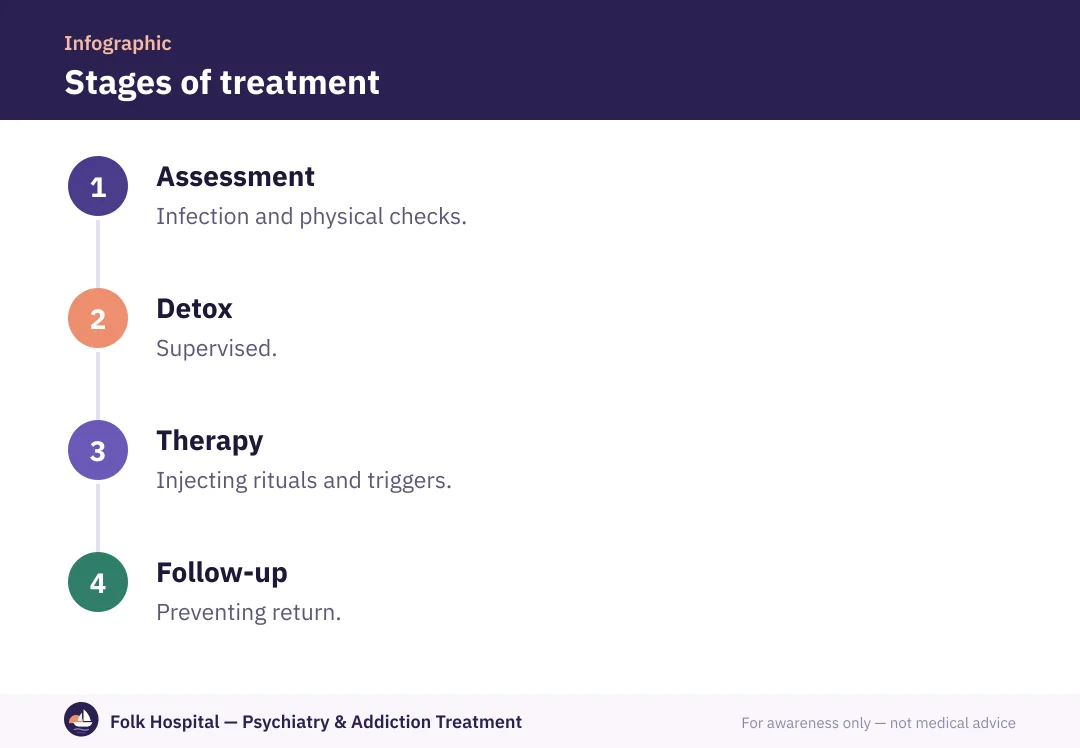
- Medical assessmentchecking skin and veins, testing for hepatitis and HIV, liver and kidney function, and other drugs.
- Treating injection complicationsabscesses and infections of skin and veins.
- Supervised detoxsymptom medicines, with a plan covering any other opioids.
- Psychological rehabilitationtackling injection rituals and triggers, and relapse prevention.
- Follow-upfor months, including follow-up of treatment for any infection.
Read about nalbuphine withdrawal.
03Injection risks: what we check and treat
| Problem | Signs | What we do |
|---|---|---|
| Skin infection and abscess | Redness, swelling, pain, pus | Cleaning, antibiotics and sometimes surgical drainage |
| Inflamed veins and clots | Pain and swelling in an arm or leg | Assessment and specialist treatment |
| Hepatitis viruses | Often no symptoms at first | Testing and referral for treatment; many are treatable today |
| HIV | May cause no symptoms for years | Testing and referral for treatment when needed |
Read about the harms of nalbuphine.
04The injection ritual: why does it need specific treatment?
Many patients describe craving "the injection itself": preparing the equipment, the feel of the needle and the first minutes after. This is a link the brain has learned over time, and it can trigger cravings even after physical withdrawal has gone. Cognitive behavioural therapy tackles it by:
- Identifying cues linked to injecting: places, equipment, times and people.
- Getting rid of equipment and removing cues.
- Structured, gradual exposure to some cues within sessions to weaken the link.
- Practical alternatives for the moment of craving.
05Residential or outpatient?
Outpatient care may suit
- Light, recent use.
- No infections and no other drugs.
- A supportive family.
Residential care is better with
- Daily repeated injecting.
- Infections or abscesses.
- Mixing with other opioids or sedatives.
- Failed previous attempts.
Read opioid addiction treatment and the harms of injecting drugs.
؟Frequently asked questions
Is nalbuphine less dangerous than heroin?
It works differently, but it causes dependence and withdrawal, and repeated injecting carries risks of infection, inflamed veins and abscesses, so it isn't safe.
How long does nalbuphine treatment take?
Detox usually takes days to two weeks, rehabilitation one to two months, and follow-up several months.
Why do I crave the injection itself?
Over time, preparing and injecting become linked with relief in the brain, so they become part of the craving. Behavioural treatment tackles this link directly.
Do I need virus tests?
Yes, if there's been injecting, especially with shared equipment. Early detection allows effective treatment of many of these infections.
Can treatment be done as an outpatient?
In a few cases. Repeated injecting, infections or other drugs make a residential stay safer.
Sources and references
- Prescription Medicines — research topic — National Institute on Drug Abuse (NIDA)
- Opioids — research topic — National Institute on Drug Abuse (NIDA)
- Guidelines for the psychosocially assisted pharmacological treatment of opioid dependence — World Health Organization
- Drug misuse in over 16s: opioid detoxification (CG52) — National Institute for Health and Care Excellence (NICE)

A psychiatrist specialising in addiction and mental illness in adults and adolescents, with a focus on dual diagnosis.
For awareness only — not a substitute for medical advice. Editorial policy · View profile