- Household and industrial products sniffed for quick dizziness and a high.
- They're common among children and teenagers because they're cheap and easy to get.
- They can cause sudden death the first time.
Inhalants aren't «drugs» in the traditional sense, but they're among the most dangerous misused substances because they're available in every home and shop.
01Key facts
| Item | Details |
|---|---|
| Class | Solvents, gases and aerosols |
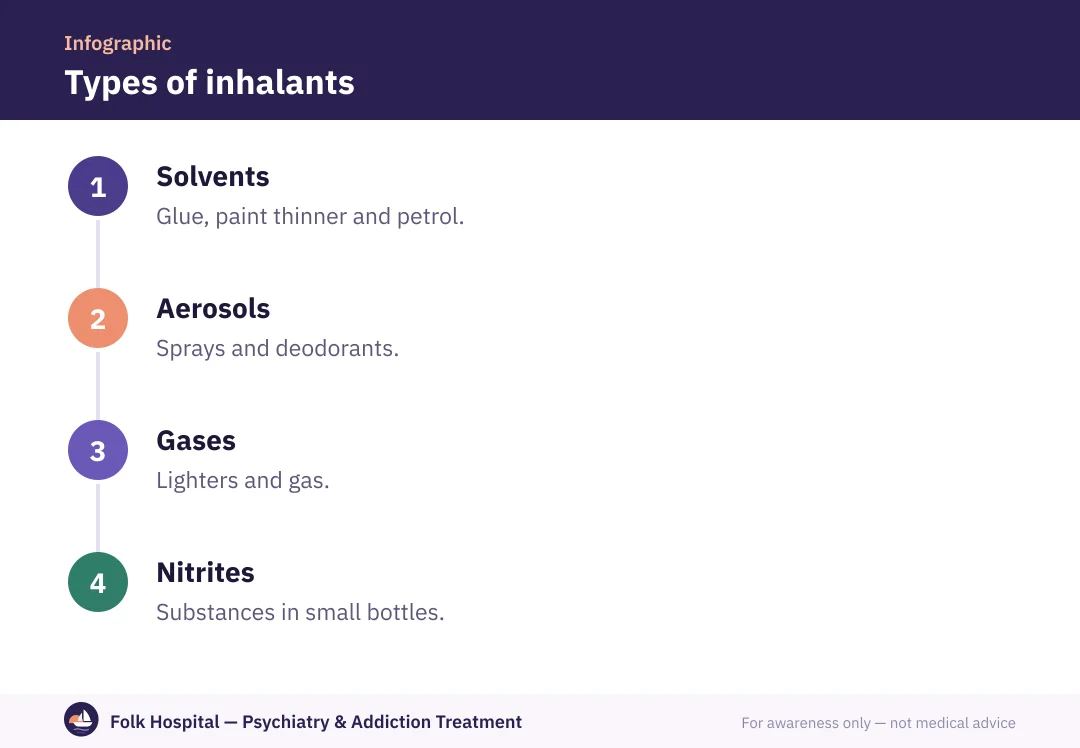
| Common forms and names | Glue, petrol, paint thinners, sprays and lighter gas |
| How it's used | Sniffed from a bag, a cloth or directly |
| Does it show on a standard test? | No, it needs a specific test |
| Risk of dependence | Moderate, with nerve damage over time |
02How does it affect the brain and body?
The vapours are absorbed quickly through the lungs and depress the brain, causing minutes of dizziness and a drunk-like high, but they can trigger a sudden heart rhythm disturbance.
03The main risks
- Sudden death from heart rhythm disturbance.
- Brain and nerve damage with repetition.
- Liver and kidney damage.
- Suffocation and accidents.
- Unconsciousness or difficulty breathing.
- Palpitations or seizures.
04What to read next
؟Frequently asked questions
Is glue sniffing addictive?
Yes, it can cause psychological dependence, and worse, it can kill suddenly or damage the brain.
What is "sudden sniffing death"?
A sudden heart stoppage or rhythm disturbance during or right after sniffing, especially with exertion or fright, even the first time.
What is glue sniffing?
Sniffing industrial glue for its intoxicating effect, among the most common substances used by street children and teenagers.
How can I protect my children?
By storing chemicals away, talking early about their danger, and keeping track of friends and behaviour.
Sources and references
- Inhalants — research topic — National Institute on Drug Abuse (NIDA)
- Parents & Educators — National Institute on Drug Abuse (NIDA)

A psychiatrist specialising in addiction and mental illness in adults and adolescents, with a focus on dual diagnosis.
For awareness only — not a substitute for medical advice. Editorial policy · View profile