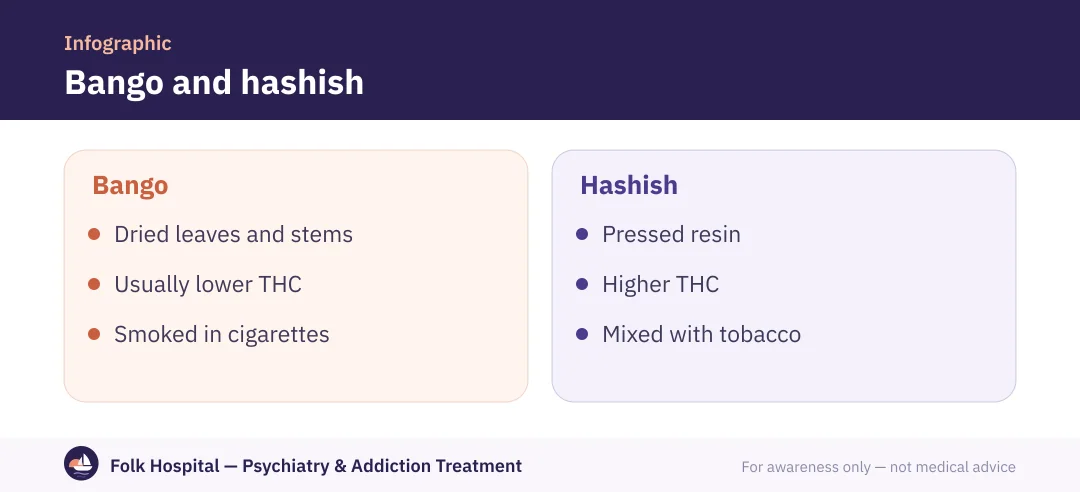
Bango is the dried plant form of cannabis, usually smoked in cigarettes. Although seen as «milder» than hashish, its harms to memory, mood and study are real.
01Key facts
| Item | Details |
|---|---|
| Class | Plant cannabis (THC) |
| Common forms and names | Dried leaves and flowers, sometimes called «bango» or «hashisha» |
| How it's used | Usually smoked |
| Does it show on a standard test? | Yes, on a cannabis test |
| Risk of dependence | Moderate, rising with early starting and daily use |
02How does it affect the brain and body?
THC binds to brain receptors responsible for memory, mood and sense of time, causing relaxation, laughter, red eyes and hunger, and with repetition it weakens memory and motivation.
03The main risks
- Weak memory and concentration and slipping at school.
- Anxiety, panic and suspicion, and psychosis risk in predisposed people.
- Dependence with daily use.
- Mixing with dangerous synthetic substances.
- Seizures, freezing or unconsciousness.
- Severe hallucinations or dangerous behaviour.
04What to read next
؟Frequently asked questions
Is bango addictive?
Yes, it can cause dependence with repeated use, especially in teenagers, with withdrawal such as insomnia and irritability.
Is bango a drug?
Yes. It contains THC, the active intoxicating substance in cannabis.
Is bango less harmful than hashish?
It's usually weaker, but the harms are real, and adulterated bango may be more dangerous.
Sources and references
- Cannabis (Marijuana) — research topic — National Institute on Drug Abuse (NIDA)
- Synthetic Cannabinoids (K2/Spice) DrugFacts — National Institute on Drug Abuse (NIDA)

A psychiatrist specialising in addiction and mental illness in adults and adolescents, with a focus on dual diagnosis.
For awareness only — not a substitute for medical advice. Editorial policy · View profile