01What is trichotillomania?
A disorder in which hair is repeatedly pulled from the scalp, eyebrows or eyelashes despite attempts to stop, causing noticeable gaps and distress. It may happen automatically, without awareness, while reading or on screens, or in a focused way to relieve tension or an unpleasant feeling. Read about the causes of hair pulling.
02Habit reversal training
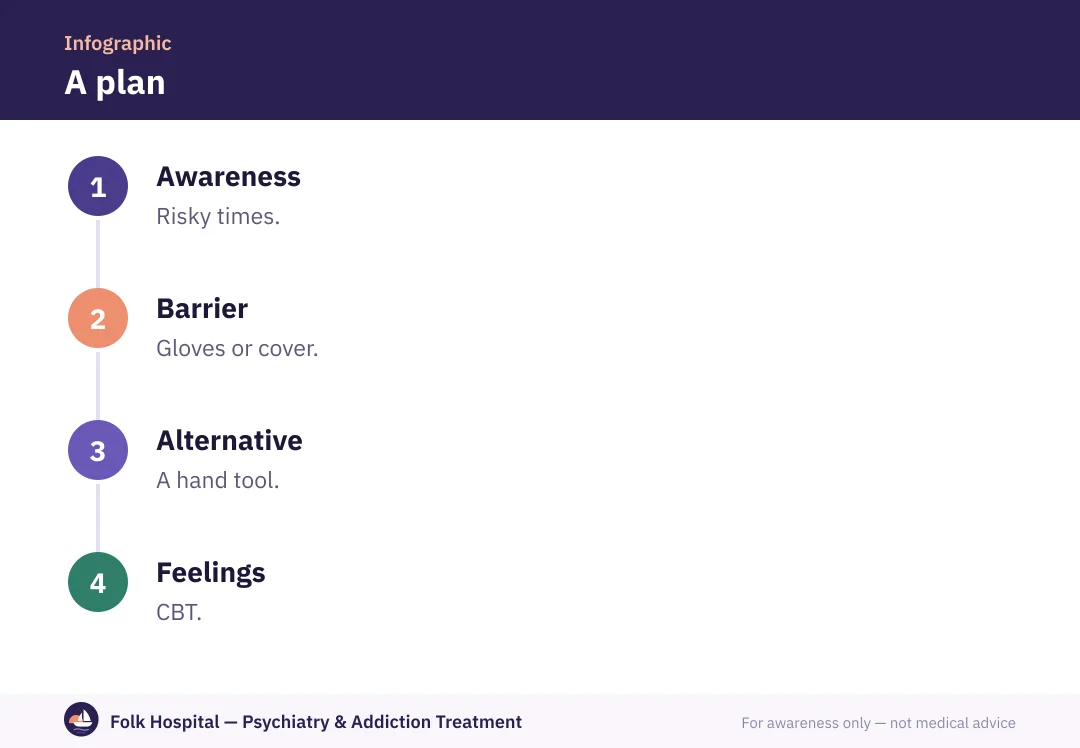
- Awarenessrecording when and where pulling happens, and the feeling before it.
- Early signalsnoticing the hand moving towards the hair before pulling.
- A competing responseclenching the fist or holding something for a minute until the urge passes.
- Supportsomeone close who encourages and gently reminds, without blame.
03Controlling triggers
| Situation | What helps |
|---|---|
| Reading or screens | A stress ball or hand toy within reach |
| In front of the mirror | Less time and softer lighting |
| Before sleep | Light gloves or a head covering |
| Stress | Slow breathing or a short walk |
04Cognitive behavioural therapy
It helps with the feelings that drive pulling, such as tension, boredom and distress, and reduces self-criticism after episodes. When OCD, anxiety or depression is present, it's treated as part of the plan.
For parents
With children, avoid punishment or commenting in front of others. Gentle reminders and encouraging alternatives work much better.
Read also about nail biting, a behaviour from the same family.
؟Frequently asked questions
Is there a medicine for hair pulling?
There's no specifically approved medicine, but some medicines may help in selected cases under a doctor's supervision; behavioural therapy is essential.
Does the hair grow back?
Usually yes after stopping, but years of pulling can weaken follicles in some areas.
Is swallowing hair dangerous?
Yes. It can collect in the stomach and cause a blockage. Tell the doctor if it happens.
Is it linked to OCD?
It's classed among the OCD-related disorders, and may come with anxiety or depression.
Sources and references
- Trichotillomania (hair pulling disorder) — NHS (UK)
- Obsessive-Compulsive Disorder — National Institute of Mental Health (NIMH)
- Psychotherapies — National Institute of Mental Health (NIMH)
- Anxiety Disorders — National Institute of Mental Health (NIMH)
A specialist in psychological rehabilitation, behaviour modification and relapse prevention, with over 15 years in addiction programmes.
For awareness only — not a substitute for medical advice. Editorial policy · View profile