01Why does a narcissist come for treatment?
Narcissistic personality disorder involves an exaggerated sense of importance, a strong need for admiration, little empathy, and great sensitivity to criticism that hides inner fragility. The person rarely seeks treatment for narcissism itself, but because of depression, a marriage or work crisis or addiction. Read about the symptoms of narcissistic personality disorder and its causes.
02Psychological therapies
| Therapy | What it works on |
|---|---|
| Schema therapy | Deep patterns formed in childhood, such as the need for perfection and admiration |
| Cognitive behavioural therapy | Thoughts about superiority and criticism, and angry reactions |
| Psychodynamic therapy | Understanding the inner fragility behind the image of grandeur |
| Couples and family therapy | Improving communication and setting healthy boundaries |
03Realistic goals
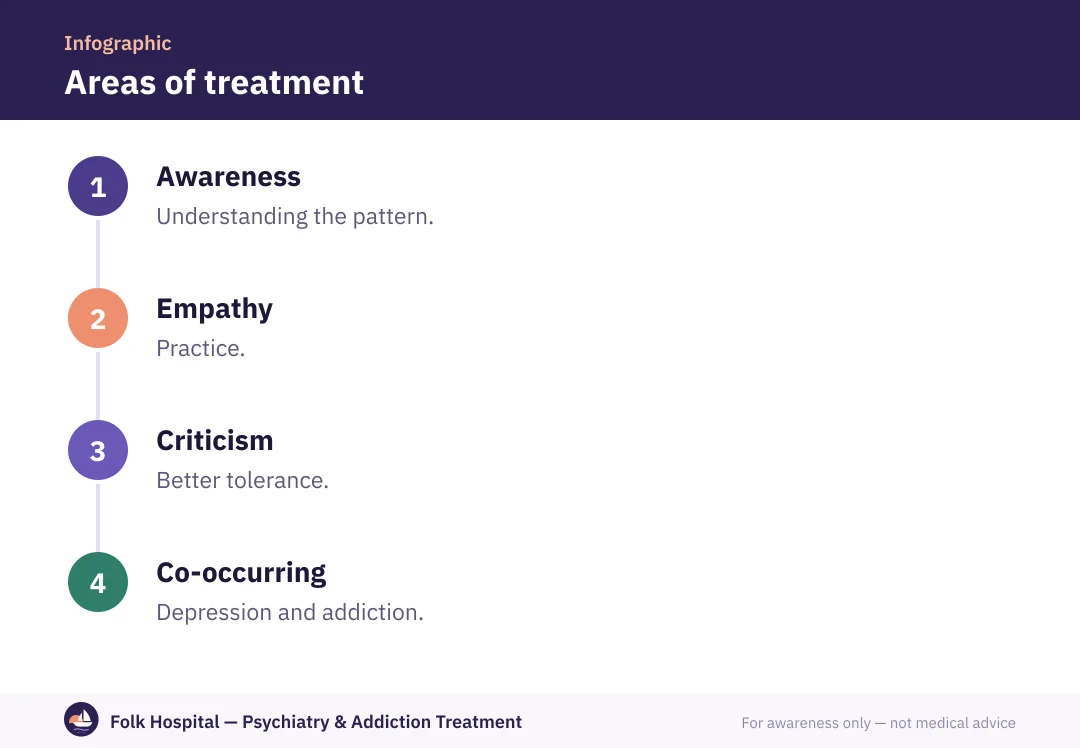
- Noticing the impactrealising how behaviour affects others and their own life.
- Tolerating criticismlistening to feedback without attacking or withdrawing.
- Building empathypractising seeing a situation from the other person's view.
- Managing angerinstead of violent reactions when feeling insulted.
- More stable relationshipsat home and at work.
04Co-existing disorders
The disorder is sometimes linked to depression, especially after failure or loss, or to addiction. Treating these problems is a core part of the plan.
05For the partner and family
- Set clear boundaries and don't excuse insults.
- Don't get into arguments to prove who's right.
- Seek support for yourself.
- Leave when there's violence or ongoing abuse.
Read how to deal with a narcissist, marriage to a narcissist and the harms of narcissism.
؟Frequently asked questions
Is there a medicine for narcissism?
No, but medicines treat accompanying depression or anxiety.
Can a narcissist change?
Change is possible but slow, and usually happens when the person realises their behaviour is costing them real losses and commits to long-term therapy.
How long does treatment for narcissism take?
Usually a year or more of regular therapy, because the aim is to change entrenched personality patterns.
Should I stay in a relationship with a narcissist?
It's a personal decision that depends on the harm and their willingness to be treated. Either way, set clear boundaries, seek support, and leave if there's violence or abuse.
Sources and references
- Personality disorder — NHS (UK)
- Psychotherapies — National Institute of Mental Health (NIMH)
- Depression — National Institute of Mental Health (NIMH)
- Co-Occurring Disorders and Health Conditions — National Institute on Drug Abuse (NIDA)

A psychiatrist specialising in addiction and mental illness in adults and adolescents, with a focus on dual diagnosis.
For awareness only — not a substitute for medical advice. Editorial policy · View profile