01The common relationship cycle
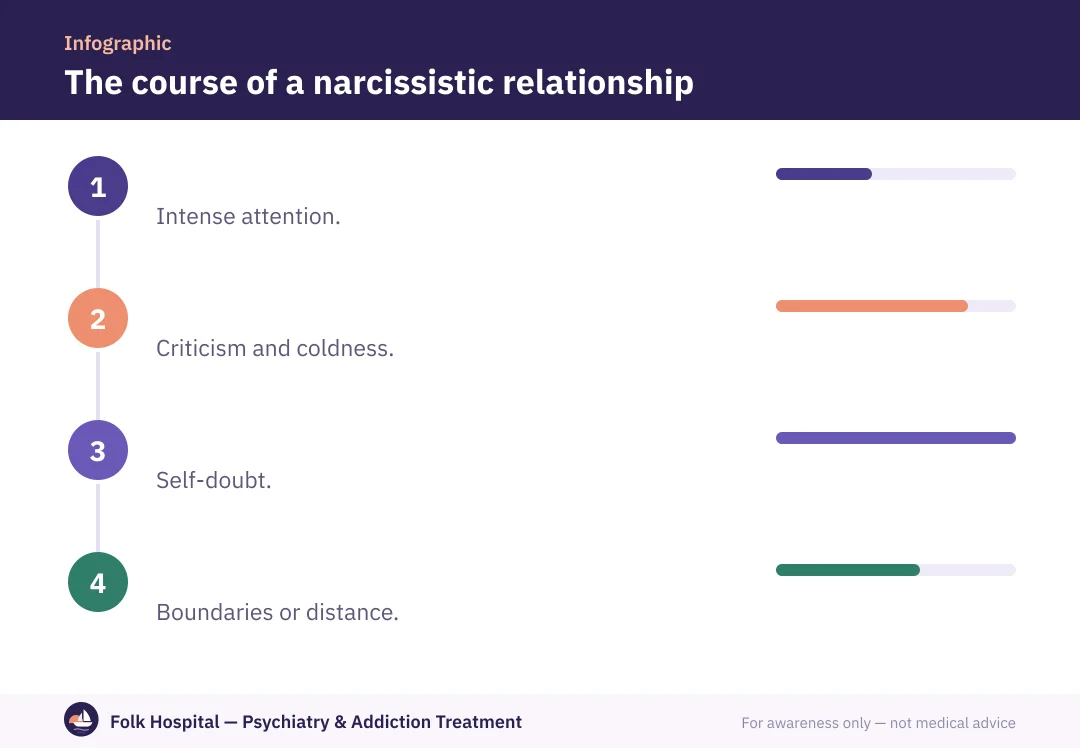
- Idealisationpraise, attention and feeling special.
- Devaluationcriticism, mockery and comparison.
- Controlover money, relationships or decisions.
- Ignoring or silent punishmentwhen admiration isn't given.
- Back to idealisationand the cycle restarts.
02The effect on the partner
What you may feel
- Doubting your memory and judgement.
- A constant sense that you're the one at fault.
- Anxiety before every conversation.
- Isolation from family and friends.
- Emotional exhaustion.
03Your options
| Option | When it fits |
|---|---|
| Clear boundaries | Always, as a first step |
| Couples counselling | If both commit to the work |
| Individual support | In every case |
| Separation | With ongoing abuse or violence |
- Keep important documents and emergency numbers.
- Tell someone you trust what's happening.
- Seek police protection on 122 if in danger.
Read dealing with a narcissist, harms of narcissism and mental illness and marriage.
؟Frequently asked questions
How do I know if my spouse is a narcissist?
A lasting pattern of needing admiration, belittling you, limited empathy, anger at criticism and manipulation; diagnosis needs a specialist.
Can a marriage to a narcissist work?
It may continue with clear boundaries, if the other accepts treatment and counselling, but it takes great effort.
Is couples counselling useful?
It helps if both are willing to work; individual therapy for the affected partner may matter more at first.
How do I protect my children?
By providing a supportive environment, talking with them about their feelings, and seeking psychological support for them when needed.
When should I consider separation?
With ongoing abuse, violence or major harm to your mental health or the children, with specialist help.
How do I rebuild my self-confidence?
With psychological support, reconnecting with friends and family, reminding yourself of the facts, and activities that strengthen you.
Sources and references
- Personality disorder — NHS (UK)
- Psychotherapies — National Institute of Mental Health (NIMH)

A psychiatrist specialising in addiction and mental illness in adults and adolescents, with a focus on dual diagnosis.
For awareness only — not a substitute for medical advice. Editorial policy · View profile